Connect with us

Education

Cyberbullying in Middle School: Recognizing the Hidden Signs

Published

on

Cyberbullying in middle school hidden signs and online student safety

Cyberbullying in middle school can be difficult to recognize because it does not always involve obvious threats or public insults. A student may simply stop participating in group chats, become anxious after checking a phone, avoid school, or suddenly lose interest in activities they once enjoyed. These changes can look like ordinary teenage behavior, yet they may signal a deeper problem.

Middle school students face a particularly complicated social environment. Friend groups change quickly, online conversations continue after school, and a single post or screenshot can reach a large audience within minutes. As a result, cyberbullying can follow a student from the classroom to the home and leave little opportunity to escape it.

Recognizing the hidden signs early can make a significant difference. This guide explains what cyberbullying in middle school looks like, why some students hide it, which behavioral and digital warning signs deserve attention, and how families and schools can respond without making the situation worse.

What Is Cyberbullying in Middle School?

Cyberbullying refers to repeated or harmful behavior carried out through digital technology with the intention or effect of intimidating, humiliating, excluding, threatening, or harming another person.

For middle school students, it can occur through:

  • Group chats and direct messages
  • Social media platforms
  • Online gaming communities
  • School-related messaging groups
  • Video-sharing platforms
  • Comments and public posts
  • Fake or impersonation accounts
  • Shared photos, videos, or screenshots

Not every online disagreement qualifies as cyberbullying. Students sometimes argue, misunderstand one another, or make insensitive comments without an ongoing pattern of harassment.

However, repeated targeting, deliberate humiliation, social exclusion, threats, impersonation, or the distribution of private material can indicate a much more serious problem.

Why Cyberbullying Can Be Difficult to See

Traditional bullying may leave visible clues, such as damaged belongings or physical injuries. Digital harassment often leaves different evidence.

A student may be sitting quietly at the dinner table while receiving dozens of hostile messages. Adults may never see the original posts because the student deletes them or the platform removes them.

Therefore, behavioral changes often become the first visible warning signs.

Hidden Signs of Cyberbullying Parents Should Watch For

One unusual behavior does not automatically prove that a child is being bullied. Instead, look for patterns, sudden changes, and combinations of warning signs.

1. Sudden Changes in Phone or Internet Habits

A student who previously enjoyed social media may suddenly stop using it. Another child might constantly check notifications but become visibly upset afterward.

Both reactions can be meaningful.

Watch for:

  • Suddenly avoiding a phone or computer
  • Checking notifications repeatedly
  • Hiding the screen whenever someone approaches
  • Deleting messages or accounts unexpectedly
  • Creating new accounts without explanation
  • Becoming nervous when receiving notifications
  • Refusing to participate in online activities

Some students may also ask parents to take away their phone. If this behavior appears alongside anxiety or social withdrawal, a calm conversation may be appropriate.

2. Avoiding School or Certain Classes

Cyberbullying can affect school attendance even when the harassment happens outside school hours.

A student may begin reporting vague physical complaints before school. They might also ask to stay home, arrive late, or suddenly dislike a particular class or activity.

Look for changes such as:

  • Frequent requests to stay home
  • Anxiety before school
  • Avoiding specific classmates
  • Sudden reluctance to attend extracurricular activities
  • Declining participation in school events

The connection may not be obvious at first. However, online harassment often involves the same peer group the student encounters at school.

3. Losing Interest in Friends and Activities

Middle school friendships naturally change. Nevertheless, a sudden withdrawal from nearly everyone can deserve attention.

A student who once enjoyed sports, gaming, clubs, or spending time with friends may suddenly isolate themselves.

The key question is not simply, “Is my child spending more time alone?”

Instead, ask:

“Has their normal pattern of social interaction changed significantly?”

A noticeable shift can provide an important reason to check in.

4. Mood Changes After Using Digital Devices

Pay attention to what happens immediately after the student uses a phone, tablet, computer, or gaming system.

For example, a child may appear relaxed before checking a group chat and become angry, embarrassed, frightened, or tearful afterward.

Repeated emotional changes connected to digital activity can be more informative than general moodiness.

5. Sleep Problems

Digital harassment can interfere with sleep because students may worry about what others are posting while they are offline.

Some students stay awake checking messages. Others may struggle to sleep because they anticipate another humiliating post the next morning.

Possible signs include:

  • Difficulty falling asleep
  • Waking during the night to check notifications
  • Fatigue during school
  • Asking to sleep near a parent
  • Increased nighttime anxiety

Sleep changes have many possible causes, so they should be considered alongside other warning signs rather than treated as proof of cyberbullying.

Digital Warning Signs That Are Easy to Miss

Behavioral changes matter, but digital clues can also provide useful context.

Repeated Account Changes

Frequent username changes, deleted profiles, or newly created accounts may indicate that a student is trying to escape unwanted attention.

Likewise, a child who suddenly blocks numerous classmates may be dealing with persistent online conflict.

Unexplained Screenshots

A student may save screenshots without discussing why.

Screenshots can sometimes document harassment, impersonation, threats, or unwanted sharing. Therefore, parents should avoid immediately deleting suspicious messages or demanding that the child erase an account.

Preserving relevant evidence can become useful when reporting serious incidents.

Changes in Group Participation

A student may remain active online but stop communicating with a particular group.

For instance, they might continue playing an online game while avoiding a specific server or group chat. They may also stop appearing in photos with friends.

This can indicate social exclusion rather than general disinterest in technology.

Why Middle School Students Often Hide Cyberbullying

Many students do not immediately tell an adult when something goes wrong online.

There are several reasons.

Fear of Losing Internet Access

A student may believe that reporting the problem will result in parents confiscating their phone or restricting social media.

Consequently, they may decide that staying silent feels safer.

Embarrassment

Cyberbullying can involve personal conversations, embarrassing photographs, rumors, or private information. A student may fear being judged for something they said or shared.

Fear of Making Things Worse

Students may worry that involving an adult will cause the bully to retaliate.

This concern can become stronger when the person responsible belongs to the same school or friend group.

Believing Adults Will Not Understand

Parents may know how to use technology but still be unfamiliar with the social dynamics of a particular platform or online community.

Therefore, the best first response is usually curiosity rather than interrogation.

How Parents Can Talk to a Child About Cyberbullying

The opening conversation can influence whether a student feels comfortable sharing more.

Instead of immediately asking, “Who is bullying you?” try broader questions:

  • “How are things going with your classmates online?”
  • “Have you noticed anything strange in your group chats lately?”
  • “Is anyone making people uncomfortable online?”
  • “What happens when someone has a problem in your friend group?”
  • “Is there anything online that you wish adults understood better?”

If the student starts talking, listen before trying to solve the problem.

Avoid blaming questions such as:

  • “Why did you respond?”
  • “Why did you send that picture?”
  • “Why didn’t you block them?”

A better approach is to say that they can talk about what happened without being immediately punished.

What to Do When Cyberbullying Is Confirmed

Once there is credible evidence of harassment, take practical steps.

Step 1: Stay Calm

The student’s immediate need is usually safety and support.

Reacting with anger can make them less willing to share additional information.

Step 2: Preserve Evidence

Save relevant:

  • Screenshots
  • Messages
  • Usernames
  • Dates and times
  • Profile links
  • Emails
  • Images or videos

Do not encourage the student to continue engaging with the person responsible simply to collect more evidence.

Step 3: Use Platform Reporting Tools

Most major platforms provide tools for reporting harassment, threats, impersonation, or abusive content.

The appropriate reporting category depends on what happened. If the content involves threats or potentially criminal conduct, platform reporting may not be sufficient on its own.

Step 4: Block or Restrict the Account When Appropriate

Blocking can reduce direct contact, although it may not stop content that others continue to share.

Therefore, blocking works best as one part of a broader response.

Step 5: Involve the School When School Relationships Are Involved

If the students attend the same school, parents should consider contacting an appropriate school administrator, counselor, teacher, or safeguarding professional.

Provide factual documentation rather than relying only on assumptions about who is responsible.

Step 6: Escalate Serious Safety Concerns

Threats of violence, stalking, sexual exploitation, blackmail, or credible threats of self-harm require immediate adult intervention and may require emergency or law-enforcement assistance depending on the circumstances.

When immediate danger exists, prioritize physical safety over online evidence collection.

Cyberbullying Response: What Helps and What Can Backfire?

Response Potential benefit Possible problem
Listening calmly Builds trust May feel slow when parents want immediate action
Saving evidence Creates documentation Evidence can disappear if not preserved quickly
Blocking the account Reduces direct contact Does not always stop third-party sharing
Reporting content Alerts the platform Removal decisions can vary
Contacting school staff Addresses school-related peer conflict Poorly handled intervention can increase tension
Removing all internet access Creates immediate distance Child may feel punished or become less willing to report problems
Publicly confronting the bully May feel decisive Can escalate conflict or create additional attention

The goal should not simply be to make the offending account disappear. Instead, the response should protect the student, reduce further harm, document serious conduct, and address the social environment that allows the behavior to continue.

The Difference Between Conflict, Drama, and Cyberbullying

This distinction matters because not every unpleasant online interaction requires the same response.

Situation Typical characteristic Appropriate response
One-time argument Both sides participate in a disagreement Encourage communication and boundaries
Friendship conflict Relationship problems between peers Support healthy conflict resolution
Mean comment Hurtful but isolated statement Address behavior and report if necessary
Repeated harassment Ongoing targeting Document, report, and involve responsible adults
Threat Statement suggesting potential harm Treat seriously and escalate appropriately
Impersonation Someone pretends to be another student Preserve evidence and report the account
Non-consensual sharing Private content distributed without permission Preserve evidence, report, and seek adult support

Context matters. A single message can still be extremely serious if it contains a credible threat or involves exploitation.

How Schools Can Reduce Cyberbullying in Middle School

Schools cannot control every online interaction, but they can create conditions that make reporting easier and reduce the impact of digital harassment.

Establish Clear Digital Conduct Rules

Students should understand what the school considers unacceptable behavior.

Policies should address more than physical bullying. They should also consider harassment through school-related communication channels, impersonation, threats, and harmful digital content when these issues fall within the school’s authority.

Create Confidential Reporting Routes

Students may not report problems if they believe everyone will find out.

Schools can provide multiple reporting options, including trusted adults and confidential or anonymous systems where appropriate.

Teach Digital Citizenship

Digital citizenship should cover practical skills such as:

  • Protecting personal information
  • Understanding screenshots and digital sharing
  • Recognizing manipulation
  • Reporting abusive content
  • Setting privacy controls
  • Respecting consent
  • Understanding the consequences of online behavior

These lessons work best when they use realistic situations rather than simple warnings to “be nice online.”

Technology Can Help, But It Is Not the Whole Solution

Parental controls, privacy settings, screen-time tools, and platform safety features can reduce certain risks.

However, technology cannot replace communication.

A student can bypass a restriction, create another account, use a friend’s device, or move a conversation to another platform. Consequently, technical controls work best when combined with trust, supervision appropriate to the child’s age, and clear expectations.

Parents should also periodically review privacy settings because platforms frequently change their menus and safety features.

A Frequently Overlooked Risk: Secondary Sharing

One of the most difficult aspects of cyberbullying is that the original offender may not be the only person causing harm.

A humiliating image can be reshared by several students. A rumor can move from one group chat to another. A screenshot can circulate long after the original message disappears.

That means focusing exclusively on the person who created the content may miss the wider network participating in its spread.

Students should understand that resharing harmful content can contribute to the damage even when the person sharing it did not create it.

Protecting Privacy During a Cyberbullying Investigation

Parents sometimes want to inspect every message immediately. However, an overly aggressive approach can cause a child to shut down.

A better strategy is to explain what information you need and why.

For example, if a serious incident occurred, you might preserve relevant evidence while avoiding unnecessary exposure of unrelated private conversations.

This balance matters because young people deserve reasonable privacy while adults still have a responsibility to protect them from serious harm.

When Professional Support May Be Appropriate

Cyberbullying can affect emotional well-being, school participation, relationships, and daily routines.

Consider seeking support from a school counselor, qualified mental-health professional, pediatric healthcare provider, or another appropriate adult when a student shows persistent distress.

Extra attention is especially important when there are significant changes in:

  • Sleep
  • Eating
  • School attendance
  • Social behavior
  • Academic performance
  • Emotional stability
  • Sense of safety

If a child talks about wanting to die, self-harm, or not wanting to live, treat the statement seriously and seek immediate professional or emergency support appropriate to your location.

Five Practical Questions Parents Should Ask

Rather than conducting a long interview, parents can use a few simple questions regularly:

  1. Who do you feel comfortable talking to at school?
  2. Is there any online group you no longer enjoy being part of?
  3. Has anyone shared something about you that you wanted to keep private?
  4. Do you ever feel nervous about checking your phone?
  5. If something went wrong online, would you feel safe telling me?

These questions can create opportunities for disclosure before a problem becomes severe.

Frequently Asked Questions

What are the hidden signs of cyberbullying in middle school?

Hidden signs can include sudden withdrawal, changes in phone use, school avoidance, sleep problems, mood changes after receiving notifications, loss of interest in activities, and unexplained account changes. One sign alone does not establish cyberbullying, so parents should look for persistent or unusual patterns and talk with the student calmly.

How can I tell if my child is being cyberbullied?

Look for changes that occur alongside digital activity. For example, your child may become distressed after checking messages, avoid certain classmates, stop using a favorite platform, or suddenly isolate themselves. Ask open-ended questions rather than assuming what happened. If the child shares evidence, preserve it and consider involving the school or platform.

Should parents take away a child’s phone after cyberbullying?

Taking away a phone may provide temporary relief, but it can also make a student feel punished for reporting the problem. Instead, consider adjusting privacy settings, blocking harmful accounts, and establishing safer technology boundaries. The appropriate response depends on the situation, the child’s age, and the severity of the harassment.

Should cyberbullying be reported to the school?

If the people involved attend the same school, reporting may be appropriate, particularly when online behavior affects the student’s safety, attendance, relationships, or learning. Provide specific evidence and describe the impact on the student. Schools have different policies and legal responsibilities, so the exact response can vary by location.

What should I do if cyberbullying includes threats?

Treat credible threats seriously. Preserve relevant evidence without encouraging further contact, report the content through the appropriate platform, and notify responsible adults or school officials when relevant. If there is an immediate risk of physical harm, contact local emergency services or law enforcement rather than relying solely on platform reporting.

Conclusion

Cyberbullying in middle school does not always look like obvious online abuse. Sometimes the clearest warning appears in a student’s behavior: avoiding school, withdrawing from friends, changing phone habits, losing sleep, or becoming distressed after checking notifications.

Parents and educators can respond more effectively by looking for patterns, listening without blame, preserving relevant evidence, using platform reporting tools, and involving appropriate school or professional support when necessary. At the same time, students need to know that asking for help will not automatically result in punishment or loss of every digital privilege.

The most useful goal is not simply to remove one offensive post. It is to restore the student’s sense of safety, reduce continued harm, and create an environment where speaking up feels possible.

Continue Reading
Click to comment

Leave a Reply

Your email address will not be published. Required fields are marked *

Education

Pedrovazpaulo Coaching: Benefits, Services & Approach

Published

on

Pedrovazpaulo Coaching key benefits and services

Pedrovazpaulo Coaching is presented online as a personalized coaching service focused on professional development, leadership, mindset, goal setting, and personal growth. Its published coaching materials describe support for entrepreneurs, professionals, managers, executives, and people looking for greater clarity in their careers or personal goals.

The service combines one-to-one coaching with structured goal setting, accountability, reflection, and practical action plans. However, people considering any coaching program should distinguish between the services a provider describes and independently verified outcomes. Coaching can provide structure and accountability, but results depend heavily on the client’s goals, participation, and the quality of the coaching relationship.

This article examines what Pedrovazpaulo Coaching offers, its main benefits, how its approach works, who may find it useful, and what prospective clients should consider before choosing a coaching service.

What Is Pedrovazpaulo Coaching?

Pedrovazpaulo Coaching is positioned as a personalized coaching approach for people seeking improvement in both professional and personal areas. The official coaching page describes its focus around clarity, mindset, goal execution, leadership, emotional resilience, communication, work-life alignment, and accountability.

Rather than presenting coaching as a single standardized course, the service describes a process built around the client’s current situation and objectives. The stated approach begins with understanding challenges and goals before developing a personalized plan.

This distinction matters because coaching differs from general motivational content. A coaching relationship typically involves discussion, questioning, goal setting, reflection, and follow-up. The coach does not simply provide information; instead, the process is designed to help the client identify priorities and turn them into practical actions.

The broader Pedrovazpaulo business website also describes services involving executive coaching and business consulting, suggesting that its coaching offering can overlap with professional and organizational development.

What Services Does Pedrovazpaulo Coaching Provide?

The published materials identify several areas of coaching. Although the exact structure can vary depending on the client’s needs, the main services can be grouped into several categories.

Clarity and Goal Coaching

One major focus is helping clients clarify what they want to achieve.

A person may know that something needs to change without knowing exactly what the next step should be. Coaching can provide a structured environment for examining priorities, identifying obstacles, and turning broad ambitions into specific objectives.

The service describes clarity coaching as a way to establish direction, purpose, and priorities while reducing distractions.

For example, someone considering a career change may need to separate several different questions:

  • What type of work do I actually want?
  • Which skills do I already have?
  • Which skills need development?
  • What financial or practical constraints exist?
  • What should I accomplish during the next three months?

Breaking a vague problem into smaller decisions can make a large goal easier to manage.

Leadership Coaching

Leadership development is another important part of Pedrovazpaulo Coaching.

The executive coaching material identifies areas such as decision-making, communication, delegation, team building, strategic thinking, and leadership effectiveness.

Leadership coaching can be relevant when a technically strong professional moves into management and discovers that managing people requires a different skill set.

For instance, a new manager may understand their department’s technical work but struggle with delegation. Coaching can help them examine why they hold onto tasks, how they communicate expectations, and how they can create clearer accountability within the team.

Mindset and Personal Development

The service also emphasizes mindset work and personal development.

According to its published description, this includes identifying mental barriers, reframing challenges, developing self-awareness, and strengthening resilience.

These areas should not be confused with clinical mental-health treatment. Coaching is generally focused on personal or professional development rather than diagnosing or treating mental-health conditions.

That distinction is particularly important for people dealing with serious psychological symptoms. In such situations, a qualified healthcare professional may be more appropriate than a business or life coach.

Career Coaching

Career development is another area associated with the Pedrovazpaulo brand. Published materials describe career coaching around clarity, professional direction, skills development, confidence, networking, and career planning.

Career coaching may be useful for someone who is:

  • Considering a career change
  • Preparing for a leadership position
  • Trying to improve professional confidence
  • Planning a long-term career path
  • Preparing for interviews
  • Evaluating professional strengths
  • Building a stronger personal brand

The key advantage is the structured conversation around the individual’s particular circumstances rather than generic career advice.

Executive Coaching

Pedrovazpaulo also presents executive coaching for CEOs, founders, senior leaders, and other professionals managing complex responsibilities. Its published executive coaching page highlights strategic decision-making, communication, team dynamics, resilience, delegation, and alignment between business objectives and leadership behavior.

Executive coaching can therefore operate at a different level from general personal-development coaching. The issues may involve organizational decisions, leadership relationships, team performance, and the pressure associated with senior responsibilities.

Key Benefits of Pedrovazpaulo Coaching

The potential value of coaching depends on the individual, but several benefits are consistently emphasized in the service’s published materials.

1. Greater Clarity

One of the most practical benefits is structured thinking.

When someone faces too many competing priorities, an outside perspective can help separate urgent problems from important long-term objectives. A coach can ask questions that encourage the client to examine assumptions and define what success actually means.

Clarity is especially useful when the problem is not a lack of information but difficulty deciding what to do next.

2. Better Accountability

Goals often fail because there is no follow-up.

Pedrovazpaulo describes regular coaching sessions and progress reviews as part of its process.

For example, instead of simply deciding to improve communication, a client might establish a specific action such as conducting one structured team feedback session each week.

The next coaching session then provides an opportunity to review what happened, identify difficulties, and adjust the plan.

3. Improved Leadership Awareness

Leadership development is not only about learning techniques. It also involves understanding how one’s behavior affects other people.

Coaching can encourage leaders to examine questions such as:

  • Do I communicate expectations clearly?
  • Do I listen before responding?
  • Do I delegate effectively?
  • How do I react under pressure?
  • How does my management style affect the team?

This kind of self-reflection can be particularly valuable when a professional receives limited honest feedback in their normal working environment.

4. More Structured Decision-Making

Senior professionals frequently have to make decisions with incomplete information.

Pedrovazpaulo’s executive coaching materials specifically mention strategic decision-making and support for complex professional challenges.

A coach does not necessarily have the correct answer to a particular business problem. Instead, the value may come from helping the client clarify assumptions, compare options, recognize risks, and decide what information is still missing.

5. Stronger Communication Skills

Communication appears across several areas of the service, particularly leadership and executive coaching.

Better communication can involve more than speaking confidently. It may include listening, giving feedback, handling disagreements, explaining decisions, and adapting communication to different audiences.

For managers, these skills can influence how clearly employees understand expectations and how comfortable they feel raising problems.

6. Focus and Productivity

The coaching service also describes support for building peak-performance habits, improving focus, and creating routines.

However, productivity coaching should not be reduced to simply working more hours.

A more useful approach is identifying which activities contribute to important goals and which create unnecessary workload. In practice, better productivity can mean clearer priorities, better delegation, fewer distractions, or improved planning.

7. Personal and Professional Alignment

Another stated area is life-work alignment.

This approach recognizes that professional goals do not exist separately from personal circumstances. A career decision may affect family responsibilities, time, energy, finances, and lifestyle.

Therefore, a realistic coaching plan should consider whether a goal is sustainable rather than simply whether it looks impressive on paper.

Pedrovazpaulo Coaching Process

The published coaching process is structured around four main stages.

Stage Main Purpose Typical Focus
Discovery and vision Understand the current situation Challenges, goals, aspirations
Personalized plan Create a roadmap Priorities, milestones, outcomes
Coaching sessions Work on active challenges Reflection, action, accountability
Growth tracking Review progress Results, adjustments, next steps

Step 1: Discovery and Vision

The process begins by examining the client’s current circumstances and desired direction.

This stage is important because a coaching plan cannot be genuinely personalized without understanding the problem first.

Step 2: Personalized Coaching Plan

The next stage involves developing a roadmap around the client’s objectives.

A useful plan should contain more than broad statements such as “become a better leader.” It should translate that goal into observable actions and milestones.

Step 3: Weekly or Bi-Weekly Sessions

The service describes recurring sessions, with frequency depending on the coaching arrangement.

Regular meetings create a rhythm for reviewing progress and dealing with new obstacles.

Step 4: Growth Tracking and Optimization

Finally, the process includes reviewing progress and adjusting the strategy.

This is an important feature because goals can change. A plan that made sense at the beginning of a coaching relationship may need modification after circumstances change.

Pedrovazpaulo Coaching vs. Traditional Consulting

Coaching and consulting can overlap, but they generally serve different purposes.

Coaching Consulting
Focuses heavily on the client or leader Often focuses on a business problem
Uses questions, reflection, and accountability Usually provides analysis and recommendations
Encourages client-led decisions Consultant may recommend specific solutions
Emphasizes development Emphasizes solving a defined problem
Can focus on behavior and leadership Can focus on strategy, operations, technology, or finance

Pedrovazpaulo’s broader business offering includes both coaching and consulting. Its business consulting materials describe areas such as operational efficiency, team performance, cash-flow management, and process improvement.

Consequently, someone with a clearly defined technical or operational problem may need consulting rather than coaching.

Who May Benefit Most From Pedrovazpaulo Coaching?

Pedrovazpaulo Coaching appears most relevant to people who are willing to actively participate in their development.

Potential users include:

Entrepreneurs

Business owners may use coaching to improve decision-making, leadership, priorities, and personal effectiveness.

Managers

Managers moving into larger roles may benefit from support with communication, delegation, conflict management, and team leadership.

Executives

Senior leaders may face complex decisions that benefit from structured reflection and confidential discussion.

Career Changers

People considering a new professional direction may use coaching to clarify goals, evaluate strengths, and build an action plan.

Professionals Seeking Greater Focus

Someone who understands their goals but struggles with consistency may benefit from accountability and structured follow-up.

The important point is that coaching works best when the client has a problem or objective that can be explored and acted upon.

What Pedrovazpaulo Coaching May Not Be Able to Do

Coaching should not be treated as a universal solution.

For example, coaching cannot guarantee:

  • A promotion
  • A specific salary increase
  • Business profitability
  • Immediate leadership success
  • A successful startup
  • Elimination of workplace stress
  • A particular career outcome

External factors can influence these results.

A strong coach can help someone prepare, plan, reflect, and act more effectively. However, the final outcome may also depend on market conditions, organizational decisions, competition, finances, other people, and circumstances outside the client’s control.

This distinction is essential when evaluating any coaching provider.

How to Evaluate a Pedrovazpaulo Coaching Program Before Joining

Before committing to a coaching program, prospective clients should look beyond marketing language.

Check the Coach’s Background

Look for clearly presented professional experience, relevant qualifications, and a consistent professional history.

If a service claims specific credentials, clients should verify them where possible rather than relying solely on promotional statements.

Understand What Is Included

Ask for clarity about:

  • Session frequency
  • Session duration
  • Program length
  • Communication between sessions
  • Assessment methods
  • Progress tracking
  • Cancellation terms
  • Total cost

A clear service structure makes comparison easier.

Look for Specific Outcomes

A coaching provider should be able to explain what the program is designed to help clients achieve.

“Personal transformation” is difficult to evaluate. A more useful objective might be improving delegation, developing a career plan, preparing for a leadership role, or establishing measurable professional goals.

Consider Privacy

Coaching discussions can involve sensitive career and business information. Before sharing confidential information, understand how the provider handles client data and communications.

What Makes Coaching More Effective?

The quality of the coaching relationship matters, but the client’s behavior matters too.

A client can improve the usefulness of sessions by arriving prepared with specific challenges, completing agreed actions, and honestly discussing what did not work.

For example, if a client repeatedly says they want to improve delegation but never discusses why they avoid delegating, progress may remain limited.

By contrast, identifying the underlying concern—such as fear of mistakes, lack of trust, or unclear expectations—creates a more useful coaching conversation.

Therefore, coaching should be treated as a collaborative process rather than a service where the client simply waits for instructions.

Important Details People Often Miss About Coaching

One frequently overlooked issue is the difference between activity and measurable progress.

Having regular coaching sessions does not automatically mean that someone is improving. The real question is whether the sessions produce useful changes in decisions, habits, behavior, skills, or outcomes.

A practical way to assess progress is to establish a baseline before starting.

For example:

Area Before Coaching Progress Indicator
Delegation Keeps too many tasks personally More responsibilities delegated appropriately
Communication Avoids difficult conversations Handles difficult discussions more directly
Planning Reacts to daily problems Uses defined weekly priorities
Career direction Unclear next step Has a documented career action plan
Accountability Inconsistent execution Completes agreed actions regularly

This approach creates a more realistic way to judge whether coaching is useful.

Another overlooked point is that coaching does not replace professional expertise. A leadership coach may help a business owner think through a decision, but an accountant, lawyer, physician, or other specialist may still be necessary for technical questions outside the coach’s scope.

Frequently Asked Questions

What is Pedrovazpaulo Coaching?

Pedrovazpaulo Coaching is presented as a personalized coaching service focused on areas such as clarity, mindset, leadership, career development, communication, accountability, and professional growth. Its published materials describe one-to-one coaching and structured plans designed around individual goals.

What services does Pedrovazpaulo Coaching offer?

The published service information includes clarity coaching, peak-performance habits, emotional and mental resilience, leadership and communication coaching, life-work alignment, accountability, and executive coaching. Career-focused materials also describe support for professional direction, skills, confidence, and career planning.

Is Pedrovazpaulo Coaching suitable for executives?

Yes, executive coaching is specifically presented as part of the service. Its executive coaching materials focus on CEOs, founders, senior leaders, and professionals dealing with leadership, decision-making, communication, team dynamics, and strategic challenges.

Can coaching guarantee career or business results?

No. Coaching can provide structure, accountability, and guidance, but it cannot guarantee a promotion, salary increase, business growth, or another specific outcome. Results depend on the client’s actions and circumstances as well as factors outside the coaching relationship.

How does Pedrovazpaulo Coaching work?

The published process begins with discovery and vision setting, followed by a personalized coaching plan. Regular sessions then focus on active goals and challenges, while progress is reviewed and the approach is adjusted when necessary.

Is coaching the same as consulting?

No. Coaching generally emphasizes development, reflection, decision-making, and accountability, while consulting usually involves providing specialized analysis or recommendations for a particular business problem. Pedrovazpaulo presents both coaching and business consulting as separate but related services.

What should I check before choosing a coaching service?

Review the coach’s professional background, program structure, pricing, session frequency, cancellation terms, confidentiality practices, and the specific outcomes the program targets. It is also useful to determine whether your needs actually require coaching or whether another professional service would be more appropriate.

Final Takeaway of Pedrovazpaulo Coaching

Pedrovazpaulo Coaching focuses on structured personal and professional development, with services covering leadership, mindset, career direction, communication, accountability, executive development, and goal execution. Its published approach emphasizes personalized plans and recurring sessions rather than generic advice.

The strongest potential benefit is the combination of clarity, accountability, and practical action. At the same time, prospective clients should evaluate the provider’s credentials, terms, privacy practices, and evidence of outcomes before making a commitment.

Ultimately, Pedrovazpaulo Coaching may be most useful for people who have a clearly defined development goal and are prepared to take consistent action between coaching sessions.
Continue Reading

Education

Filing vs Filling: Meaning, Differences & Usage Guide

Published

on

Filing vs Filling meaning, differences, and usage explained

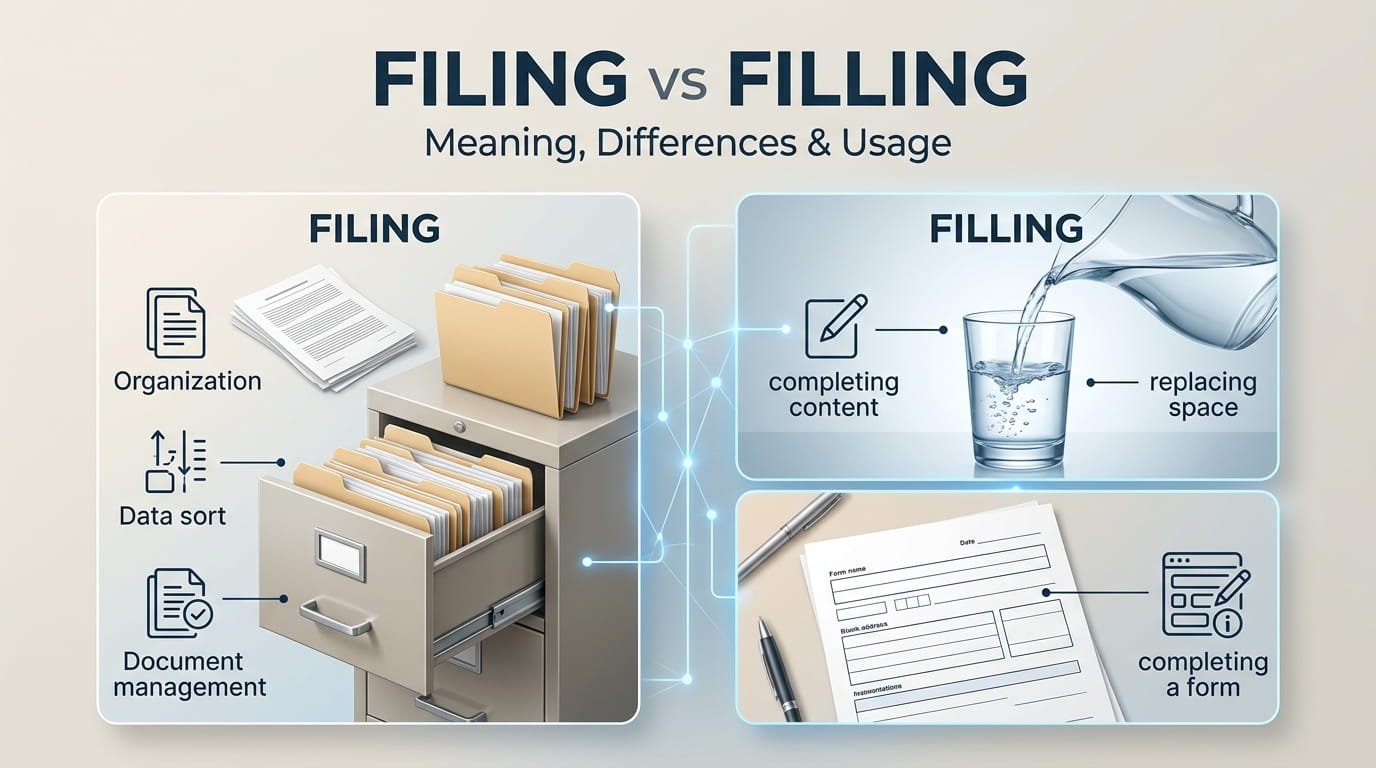
Filing vs Filling is a common English-language confusion because the two words look and sound very similar. However, they come from different verbs and describe different actions. Filing comes from file, usually referring to organizing, storing, or officially submitting documents. Filling comes from fill, meaning to make something full, add something to a space, or complete something such as a form.

The distinction becomes especially important in workplace emails, tax documents, legal writing, applications, and everyday communication. For example, you file a tax return, but you fill out a tax form. You file a complaint, but you fill in the details.

This guide explains the difference between filing and filling, shows how each word works grammatically, provides practical examples, and covers the mistakes that commonly cause confusion.

Filing vs Filling: The Basic Difference

The easiest way to distinguish the two words is to look at their root verbs:

  • File → filing: organizing, storing, or officially submitting something.
  • Fill → filling: making something full, adding material, or completing blanks.
Word Root verb Main meaning Common examples
Filing File Organizing or submitting documents Filing taxes, filing records
Filling Fill Making something full or completing it Filling a bottle, filling out a form
File File Organize, submit, or smooth with a tool File documents, file a complaint
Fill Fill Put something into a space or complete something Fill a container, fill in details

The difference is only one letter, but the meaning changes completely. Grammar references similarly distinguish filing as the present participle of file from filling as the present participle of fill.

What Does “Filing” Mean?

Filing is the -ing form of the verb file. Its most common meanings involve documents, records, information, or official submissions.

Filing documents

In an office, filing usually means organizing documents so they can be stored and retrieved later.

For example:

  • She is filing the invoices by date.
  • The assistant spent the morning filing records.
  • We are filing the documents in alphabetical order.

Here, filing does not mean making the documents full. It means putting them into an organized filing system.

Filing an official document

File also has an important formal meaning: to submit a document to an authority or organization.

Examples include:

  • filing a tax return
  • filing a lawsuit
  • filing a complaint
  • filing an application
  • filing a report
  • filing a claim
  • filing a motion

For instance:

The company is filing its annual report.

This means the company is officially submitting the report.

Similarly:

The attorney is filing a motion with the court.

The attorney is submitting the legal document through the appropriate process.

Filing as a physical process

There is another meaning of file that is less connected with paperwork. A file can be a tool used to smooth, shape, or remove material from a surface.

In that context, filing means using the tool.

For example:

  • He is filing the rough edge of the metal.
  • She spent several minutes filing her nails.

This meaning is easy to overlook because most people encounter filing in office or administrative contexts.

Filing as a noun

Filing can also function as a noun.

Examples include:

  • Filing documents takes time.
  • Electronic filing has reduced the need for paper records.
  • The company uses a digital filing system.

In these sentences, filing refers to the activity or process rather than simply describing an ongoing action.

What Does “Filling” Mean?

Filling is the -ing form of fill. Its central idea is adding something to a space, container, position, or requirement.

Examples include:

  • filling a glass with water
  • filling a tank with fuel
  • filling a box with books
  • filling a room with furniture
  • filling out an application

The basic concept is making something full or supplying what is needed.

Filling a physical container

This is one of the clearest uses of filling.

For example:

She is filling the bottle with water.

The person is putting water into the bottle.

Other examples:

  • He is filling the bucket with sand.
  • They are filling the tank with fuel.
  • I am filling my cup with coffee.

In each case, something is being added to a container.

Filling a space

Fill does not always involve a physical container.

A room, stadium, parking lot, or other space can also fill.

Examples:

  • The audience filled the theater.
  • People are filling the waiting room.
  • The smell of coffee filled the kitchen.

Here, filling means occupying or spreading throughout available space.

Filling in information

The word filling also appears frequently with forms and applications.

Examples:

  • filling in a form
  • filling in missing information
  • filling in the blanks
  • filling out an application
  • filling out a registration form

This is where confusion with filing becomes particularly common.

Completing a form and officially submitting it are two different actions.

You might:

  1. Fill out the application.
  2. Review the information.
  3. File the application with the relevant organization.

The exact process varies by context, but the language distinction remains useful.

Filing vs Filling in Forms

Forms create one of the biggest areas of confusion.

Suppose a university gives you an application form. You enter your name, address, qualifications, and other required information.

You are filling out or filling in the form.

After completing it, you may need to submit it. Depending on the context, that submission could be described as filing the application.

American English: “fill out”

American English commonly uses fill out a form.

Example:

Please fill out the application form before Friday.

British English: “fill in”

British English commonly uses fill in a form.

Example:

Please fill in the application form before Friday.

Both expressions refer to completing the required information. They should not be confused with filing, which generally refers to submitting or organizing documents.

This distinction is particularly useful for international English learners because the choice between fill in and fill out can vary by regional usage, while file retains its separate meaning.

Filing vs Filling in Tax Situations

Tax-related language is another area where the difference matters.

The standard expression is:

filing a tax return

For example:

I am filing my tax return this week.

This means officially submitting the tax return to the relevant tax authority.

However, you might fill out a tax form before filing it.

For example:

I spent an hour filling out the tax form before filing my return.

The two actions can therefore occur during the same process:

Fill out the form → review it → file the return.

Calling the entire process “filling taxes” is generally incorrect in standard English. Tax filing is the established expression for the submission process.

Filing vs Filling in Legal English

Legal writing makes the distinction especially important.

Legal professionals commonly use file for official submissions.

Examples:

  • filing a lawsuit
  • filing a complaint
  • filing a motion
  • filing an appeal
  • filing legal documents
  • filing a claim

Consider these two sentences:

The lawyer is filing a complaint.

This means the lawyer is officially submitting the complaint.

The lawyer is filling out the complaint form.

This means the lawyer is entering the required information into a form.

The actions may happen one after another, but they are not the same.

Using filling instead of filing in a legal context can therefore change the intended meaning.

Common Examples of Filing

Here are some natural examples of filing:

Office examples

  • She is filing the invoices.
  • The records are being filed by department.
  • He handles the filing for the company.
  • We are filing old documents electronically.

Legal examples

  • The attorney is filing a motion.
  • The company filed a complaint.
  • The claimant is filing an appeal.

Financial examples

  • She is filing her tax return.
  • The business filed its annual report.
  • The accountant completed the filing before the deadline.

General examples

  • The documents are ready for filing.
  • Digital filing makes records easier to retrieve.
  • Proper filing helps prevent documents from being lost.

Common Examples of Filling

Now compare those examples with filling:

Containers

  • She is filling the bottle with water.
  • He is filling the tank.
  • They are filling the boxes with supplies.

Spaces

  • The crowd is filling the stadium.
  • The room is filling with smoke.
  • New employees are filling the available seats.

Forms

  • She is filling out an application.
  • He is filling in the missing details.
  • Please fill in the blank.

Food

  • The chef is filling the pastry with cream.
  • They are preparing the filling for the cake.
  • The sandwich has a vegetable filling.

Dentistry

A filling can also refer to a material used to repair a tooth after decay has been removed. This is another noun meaning that has nothing to do with document filing.

Filing vs Filling: Grammar and Word Forms

Understanding the root verbs makes the spelling easier.

File

Common forms include:

  • file
  • files
  • filed
  • filing

Example:

She files the documents every Friday.

She is filing the documents now.

Fill

Common forms include:

  • fill
  • fills
  • filled
  • filling

Example:

He fills the bottles every morning.

He is filling the bottles now.

Notice the spelling difference in the -ing forms:

file + ing = filing

fill + ing = filling

The final e in file is dropped before adding -ing, while the double l in fill remains.

Why Is “Filing” Spelled With One L?

This is a useful spelling point for English learners.

The base verb is file, not fill. When adding -ing, the final silent e is normally removed:

file → filing

Compare:

  • make → making
  • write → writing
  • use → using
  • file → filing

By contrast, fill already ends in two consonant letters:

fill → filling

So:

  • filing = one l
  • filling = two ls

That spelling difference reflects their different base verbs rather than being an arbitrary variation.

Filing vs Filling: Quick Comparison

Situation Correct word Example
Organizing documents Filing Filing the records
Submitting taxes Filing Filing a tax return
Submitting a legal complaint Filing Filing a complaint
Putting water into a bottle Filling Filling the bottle
Completing an application Filling Filling out an application
Adding food to pastry Filling Filling the pastry
Making a room occupied Filling Filling the room
Organizing digital records Filing Filing electronic documents

The simplest rule is:

Documents, records, and official submissions → filing.

Making something full or completing information → filling.

The Important Difference Between “Filling a Form” and “Filing a Form”

This deserves special attention because both expressions can appear in discussions about paperwork.

Filling out a form means entering the requested information.

I am filling out the registration form.

Filing a document generally means submitting or officially recording it.

I am filing the completed application.

So a person can potentially do both.

For example:

Maria filled out the application and filed it with the university.

This sentence clearly separates the two actions: Maria completed the information first and then submitted the application.

In some contexts, people may say fill in a form rather than fill out a form, particularly in British English. Both refer to completing the form rather than officially filing it.

Common Mistakes With Filing and Filling

Because the words are so similar, several mistakes appear frequently.

Mistake 1: “Filling taxes”

Incorrect:

I am filling my taxes.

Better:

I am filing my taxes.

For the official submission process, filing is the appropriate word.

Mistake 2: “Filling a complaint”

Incorrect:

She is filling a complaint against the company.

Better:

She is filing a complaint against the company.

The complaint is being officially submitted, so filing is appropriate.

Mistake 3: “Filing a bottle”

Incorrect:

He is filing the bottle with water.

Better:

He is filling the bottle with water.

The action involves putting water into a container.

Mistake 4: “Filing out an application”

Incorrect:

Please file out this application.

Better:

Please fill out this application.

The applicant needs to complete the information, so fill out is correct.

Mistake 5: “Filling documents in a cabinet”

Usually incorrect when the intended meaning is organizing records.

Better:

She is filing the documents in the cabinet.

The documents are being organized into a filing system.

A Simple Memory Trick

A quick way to remember the difference is to connect each word to its root:

FILING → FILE → DOCUMENTS

Think of a filing cabinet full of folders.

FILLING → FILL → FULL

Think of filling a glass until it contains what you need.

Another useful pair is:

  • File a complaint
  • Fill out a form

If you remember those two expressions, many similar situations become easier.

When the Context Changes the Meaning

One overlooked point is that neither word is limited to a single situation.

Filing can refer to:

  • document organization
  • official submission
  • electronic records
  • financial reporting
  • legal paperwork
  • smoothing material with a file

Filling can refer to:

  • containers
  • rooms and spaces
  • forms
  • blanks
  • food
  • dental restorations
  • satisfying a need or requirement

So the best way to choose between them is not simply to memorize a list. Ask what action is actually taking place.

Is something being organized or officially submitted?

Use filing.

Is something being made full or completed with information/material?

Use filling.

A Practical Test for Choosing the Correct Word

When writing an email, report, assignment, or application, use this three-step test.

Step 1: Identify the root verb

Ask whether the action comes from file or fill.

Step 2: Identify the object

If the object is a complaint, tax return, legal document, record, or report, filing may be appropriate.

If the object is a bottle, room, container, blank, or form being completed, filling may be appropriate.

Step 3: Check the purpose

This is the most reliable test.

If the purpose is submission or organization, choose filing.

If the purpose is completion or adding something, choose filling.

For forms, remember that you can fill them out and later file them. That is why simply looking at the word “form” is not always enough.

A Less Obvious Meaning of “Filing”

Most people associate filing with paperwork, but filing can also describe particles produced by a file or similar tool.

For example:

Metal filings covered the workbench.

Here, filings are small particles removed from a material during filing. This is a completely different meaning from administrative filing.

This distinction shows why context matters even when the spelling stays exactly the same.

A Less Obvious Meaning of “Filling”

Filling can also be a noun rather than an action.

For example:

The pie has an apple filling.

Here, filling means the material placed inside something.

It can also describe food that satisfies hunger:

The meal was surprisingly filling.

And in dentistry:

The dentist replaced the old filling.

These meanings all connect to the central idea of fill: something is being added, occupied, or made complete.

Filing vs Filling in Digital Workplaces

The distinction remains relevant even though many modern records are digital.

A company might use cloud storage or document-management software rather than physical filing cabinets. Employees can still file documents, because filing refers to organizing or recording information, not necessarily placing paper into a cabinet.

For example:

The team is filing invoices in the company’s digital archive.

By contrast:

The employee is filling out an online expense form.

The first sentence concerns document organization. The second concerns entering information into a form.

This is a useful distinction because the physical environment has changed, but the meanings of the verbs have not.

Is Filing the Same as Submitting?

Not always.

In many contexts, filing means officially submitting or recording something, particularly with an authority or organization. But file also has the separate meaning of organizing documents.

For example:

She filed the reports in a cabinet.

Here, she organized them.

She filed the report with the agency.

Here, she officially submitted it.

The surrounding context tells you which meaning applies.

Are Filing and Filling Interchangeable?

No. Filing and filling are not interchangeable.

Although their pronunciation can be similar, their meanings are distinct.

Compare:

He is filing the report.

This means he is organizing or submitting the report, depending on context.

He is filling the report.

This would normally suggest that he is putting something into the report, and in many contexts it would sound unnatural. If the intended meaning is completing a form or entering information, filling out or filling in is usually clearer.

Likewise:

She is filing a complaint.

means officially submitting a complaint.

She is filling a complaint.

does not convey that standard meaning.

FAQs About Filing vs Filling

What is the main difference between filing and filling?

Filing comes from file and generally means organizing documents, records, or officially submitting something. Filling comes from fill and means making something full, adding material to a space, or completing information. For example, you file a tax return but fill out a tax form.

Is it “filing taxes” or “filling taxes”?

The standard expression is filing taxes or, more precisely in many contexts, filing a tax return. Filing refers to officially submitting tax information to the relevant authority. You may fill out tax forms before filing the return, so both words can describe different parts of the same process.

Do you fill out or file a form?

You normally fill out a form in American English and commonly fill in a form in British English. This means completing the requested information. If the completed form is then officially submitted or recorded, it may be filed, depending on the procedure.

Is “filing a complaint” correct?

Yes. Filing a complaint is the standard expression when someone formally submits a complaint to an organization, court, agency, or other authority. “Filling a complaint” is generally incorrect when the intended meaning is formal submission.

Why are filing and filling easy to confuse?

The words have very similar pronunciations, particularly in fast speech, and differ visually by only one letter. They also frequently appear in related administrative situations, such as forms and applications. Their meanings, however, come from different verbs: file means to organize or submit, while fill means to make full or complete.

Is “filling in a form” correct English?

Yes. Filling in a form is standard English, especially in British usage. It means entering the required information. American English commonly uses filling out a form for the same purpose. Neither expression normally means officially submitting the completed form.

Can filling be a noun?

Yes. Filling can be a noun referring to something placed inside another thing, such as a pie filling or sandwich filling. It can also refer to a dental filling. In contrast, filing can refer to the activity of organizing or submitting documents and, in another context, small particles removed by a file.

Conclusion

The difference between Filing vs Filling becomes straightforward once you focus on their root verbs. Filing comes from file and is associated with organizing records, storing documents, or making an official submission. Filling comes from fill and describes making something full, adding material, or completing information.

The most useful memory rule is simple: file documents; fill spaces and forms. You file a complaint, file a tax return, and file records. You fill a bottle, fill a room, and fill out or fill in a form.

Although the words sound similar, they are not interchangeable. Choosing the correct one depends on the action and purpose described by the sentence.

Continue Reading

Education

What Does “Mean in Text” Really Mean? : A Clear Guide

Published

on

What Does “Mean in Text” Really Mean explained with text message examples

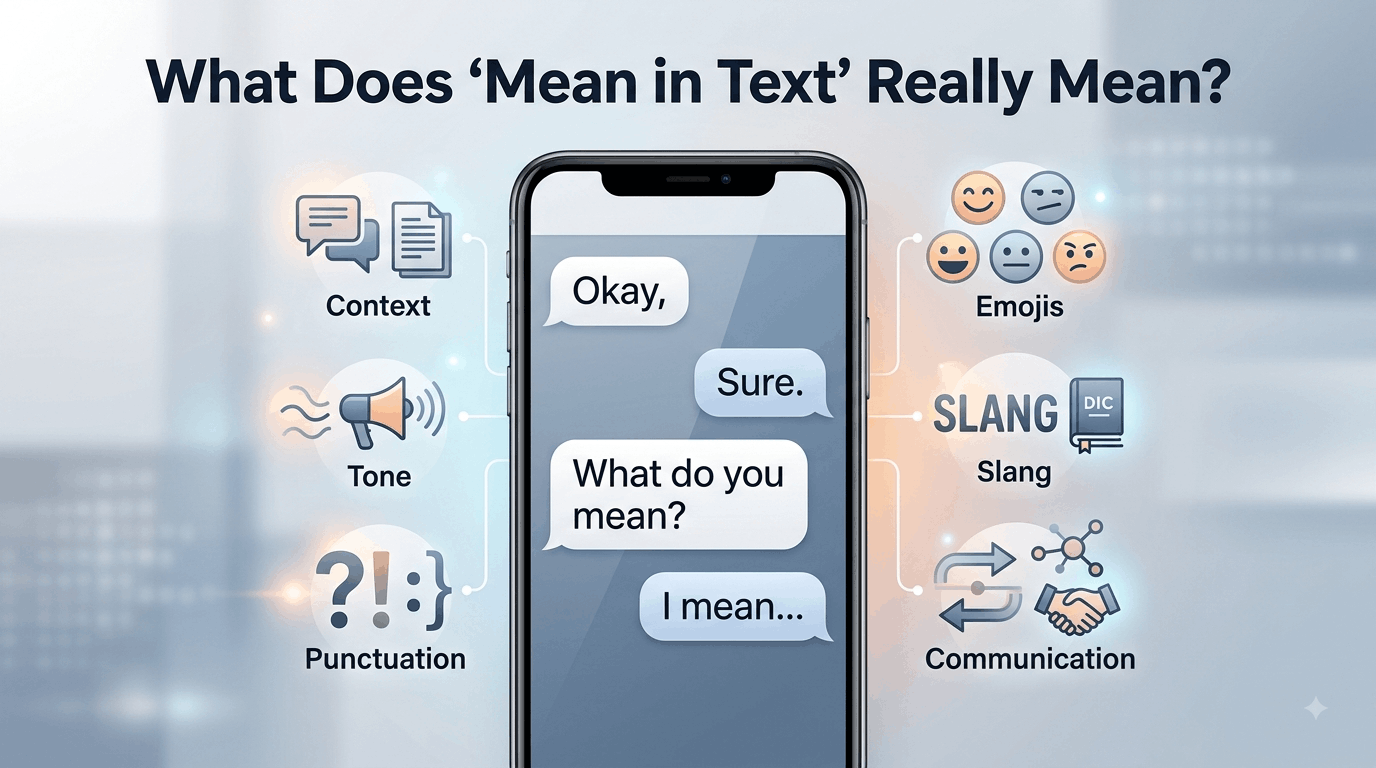
When someone searches “What Does ‘Mean in Text’ Really Mean?”, they are usually trying to understand what a word, phrase, abbreviation, emoji, or message is intended to communicate. In texting, “mean” can refer to a literal definition, a person’s intention, emotional tone, or even whether a message sounds rude.

The key is context. A short reply such as “okay,” “fine,” or “sure” does not automatically have one fixed emotional meaning. The relationship between the people, the previous messages, punctuation, timing, and even the sender’s usual writing style can change how the message is understood.

This guide explains the different meanings of “mean” in text, how to interpret tone, why misunderstandings happen, and how to respond when a message is unclear.

What Does “Mean in Text” Really Mean?

The phrase “What Does ‘Mean in Text’ Really Mean?” is slightly unusual as a standalone expression. In search queries, however, people generally use it to ask what a particular word, message, symbol, or phrase means when it appears in a text conversation.

There are several possible interpretations.

1. “Mean” as the definition of something

Someone may ask:

“What does LOL mean in text?”

Here, “mean” simply asks for the definition of LOL. The person wants to know what the abbreviation stands for and how people use it.

The same question can apply to:

  • Slang
  • Acronyms
  • Abbreviations
  • Emojis
  • Internet expressions
  • Symbols
  • Shortened words

2. “Mean” as someone’s intention

Consider the question:

“What did you mean by that?”

Here, “mean” refers to intention. The person is asking what the sender was trying to communicate.

This can be particularly important when a message has more than one possible interpretation.

3. “Mean” as unkind behavior

“Mean” can also be an adjective describing someone who behaves in a hurtful, rude, or unkind way.

For example:

“That was mean.”

In this sentence, the person is not asking for a definition. They are criticizing the tone or behavior behind a message.

4. “Mean” as an average

There is also a completely different mathematical meaning.

For example:

“The mean of 10, 20, and 30 is 20.”

Here, “mean” means the arithmetic average. This meaning is normally obvious from the surrounding context and is unrelated to texting slang.

Why Context Changes the Meaning of a Text

Text messages remove many of the signals people normally use during face-to-face conversations.

When people speak, they can hear:

  • Voice pitch
  • Volume
  • Pauses
  • Emphasis
  • Laughter
  • Hesitation

They can also see facial expressions and body language.

A text message removes most of those signals. As a result, readers have to infer tone from the words and the way they are presented.

For example:

“Okay”

could be completely neutral.

But:

“Okay.”

might feel more final or serious to some readers.

On the other hand, another person may use periods in every message and intend absolutely no negative tone.

This is why punctuation should be treated as a clue rather than proof of someone’s emotions.

The Four Main Meanings of “Mean” in Text

A useful way to understand the phrase is to separate definition, intention, tone, and implication.

Meaning What the person is asking Example
Definition What does this word or abbreviation stand for? “What does IDK mean in text?”
Intention What was the sender trying to say? “What do you mean?”
Tone Does the message sound rude, friendly, serious, or sarcastic? “Was she being mean?”
Implication Is there another idea behind the literal words? “What did he mean by that?”

These categories can overlap. A person might understand the literal definition of a message but still be unsure about the sender’s intention.

How Tone Works in Text Messages

Tone is one of the biggest reasons people search for explanations of text messages.

Suppose someone writes:

“Nice.”

Depending on context, that could mean genuine approval, mild enthusiasm, sarcasm, or indifference.

Now compare it with:

“Nice!! 😂”

The additional punctuation and emoji may make the message appear more enthusiastic or playful.

But there is no universal rule. People develop individual texting habits, and those habits can be more reliable than general assumptions about punctuation.

Message length can also affect perception

A person who normally sends long messages might suddenly respond:

“K.”

The short reply may feel unusual because it differs from their normal communication pattern.

However, a person who regularly uses short replies may simply be communicating normally.

The change from someone’s usual behavior can therefore be more informative than the individual word itself.

Common Texting Examples and Their Possible Meanings

“What do you mean?”

This usually asks the other person to clarify their statement.

Example:

Person A: “You already know why.”

Person B: “What do you mean?”

The second person is asking for more information.

“I didn’t mean that.”

Here, “mean” refers to intention.

The speaker is explaining that the message was interpreted differently from what they intended.

“That was mean.”

Here, “mean” describes behavior as hurtful or unkind.

It does not mean “definition” or “intention.”

“What does this mean?”

This is usually a straightforward request for clarification.

The question might concern a slang term, abbreviation, emoji, sentence, or unfamiliar expression.

“I mean…”

The expression “I mean” can introduce a clarification, correction, qualification, or additional thought.

For example:

“I mean, we could leave earlier if you want.”

It does not automatically indicate sarcasm or hostility. Its tone depends heavily on context and the relationship between the speakers. Discussions among English speakers also show that “I mean” can sometimes feel condescending in particular contexts, while remaining completely conversational in others.

Punctuation Can Influence How a Text Feels

Punctuation has a special role in digital communication because people sometimes use it to compensate for the lack of vocal tone.

Periods

A period can simply be normal grammar.

However, in some informal texting situations, a period at the end of a very short message may be perceived as unusually formal, serious, or even irritated.

That interpretation is not universal. Research and anecdotal discussion about texting show that people can perceive punctuation differently depending on age, habits, and context.

Exclamation marks

An exclamation mark can communicate enthusiasm:

“That’s great!”

It can also emphasize urgency or excitement.

But using several exclamation marks may produce a very different impression:

“WHAT!!!”

Again, context determines whether the effect is excitement, humor, surprise, or anger.

Ellipses

An ellipsis can indicate hesitation, an unfinished thought, or a pause:

“I thought you were going to…”

Some people also interpret ellipses as uncertainty or tension in informal messages.

The important point is that punctuation provides social cues, but those cues do not have fixed meanings in every conversation.

Emojis Can Change the Interpretation

Emojis often help communicate emotional information that words alone may not express.

Compare:

“Sure.”

with:

“Sure 😊”

The second version may appear warmer.

Likewise:

“Okay 😂”

can suggest that the sender is joking or responding playfully.

But emoji meanings can vary between communities, age groups, cultures, and platforms. A symbol that one person considers friendly may be interpreted differently by someone else.

Therefore, an emoji should not be treated as a universal translation.

Slang and Abbreviations Create Another Layer of Meaning

Texting has developed a large vocabulary of abbreviations and informal expressions.

Common examples include:

  • LOL — laughing out loud
  • BRB — be right back
  • IDK — I don’t know
  • TBH — to be honest
  • NGL — not gonna lie
  • FYI — for your information

The exact interpretation can still depend on context.

For example, “LOL” does not necessarily mean the sender is literally laughing. It can function as a conversational marker that makes a statement sound lighter or less serious.

This is one reason dictionary-style definitions are sometimes insufficient when interpreting digital language.

Why the Same Message Can Sound Friendly or Rude

Consider:

“You came.”

This could be a simple observation.

But depending on the previous conversation, it could also express surprise, relief, disappointment, or sarcasm.

Now consider:

“You actually came.”

The word “actually” changes the possible implication.

It might mean:

  • “I’m pleasantly surprised.”
  • “I wasn’t sure you would come.”
  • “I didn’t expect you to come.”
  • “I’m criticizing you for being late.”

The literal words alone do not provide enough information to determine which interpretation is correct.

A Better Way to Interpret an Unclear Text

Instead of immediately assuming what the sender intended, consider several factors.

1. Read the entire conversation

Do not interpret one sentence in isolation if previous messages are available.

The preceding conversation may explain an otherwise ambiguous response.

2. Consider the relationship

A close friend may use sarcasm that would sound rude coming from a coworker.

Similarly, a romantic partner, family member, colleague, and stranger may use the same words differently.

3. Compare the person’s normal style

Does the person usually use short messages?

Do they regularly use periods? or frequently use emojis?

Personal communication patterns provide useful context.

4. Look at the timing

A short response during a busy workday may simply mean the person is occupied.

It is risky to interpret a delayed or brief response as anger without additional evidence.

5. Ask for clarification when necessary

If the meaning genuinely matters, the simplest solution is often to ask.

For example:

“Just checking—what did you mean by that?”

Or:

“I’m not sure how to read that message. Can you clarify?”

This is usually more reliable than trying to decode every punctuation mark.

Common Misunderstandings About “Mean” in Text

A short message is not automatically rude

People may be busy, distracted, tired, or simply accustomed to concise communication.

A period does not automatically signal anger

Some people use conventional punctuation in every message.

An emoji does not guarantee a particular emotion

Emoji interpretation varies between people and communities.

“I mean” is not automatically passive-aggressive

It can simply introduce a clarification or conversational thought. The surrounding sentence and relationship matter.

Silence does not have one universal meaning

A person who does not reply may be busy, unsure how to respond, offline, or intentionally avoiding the conversation. Without additional context, the reason cannot be known with certainty.

Text Meaning Across Different Situations

The same wording can work differently depending on where it appears.

Situation What matters most Example
Friends Shared humor and personal habits “Sure 😂”
Family Familiar communication patterns “Okay, I’ll call later.”
Romantic conversation Emotional context and relationship history “Fine.”
Workplace Professional clarity and wording “Thanks, noted.”
Social media Community slang and platform culture “NGL, this is good.”
Group chats Audience and previous discussion “Wait, what?”

This distinction is especially useful when interpreting a message from someone whose communication style you do not know well.

Why People Overthink Text Messages

Texting encourages people to fill in missing information.

If someone says:

“We need to talk.”

the reader may immediately imagine a serious problem.

But the sentence itself does not specify what the conversation will concern.

The uncertainty comes from missing information, not necessarily from hidden hostility.

A useful rule is:

Separate what the message actually says from what you think the sender might mean.

That small distinction can prevent unnecessary misunderstandings.

When “Mean in Text” Has a Completely Different Meaning

Not every search involving the word “mean” is about texting tone.

The word has several established meanings in English.

Mean as a verb

It can describe intention:

“I mean what I said.”

Mean as an adjective

It can describe someone or something as unkind:

“That was a mean comment.”

Mean as a mathematical term

It can refer to an average:

“The mean of the numbers is 15.”

Mean as significance

It can indicate importance or significance:

“What does this decision mean for us?”

Recognizing the grammatical role of the word can quickly clarify which meaning applies.

The Most Important Clue Is Usually Context

One of the most overlooked aspects of digital communication is that there is no universal dictionary for tone.

Two people can receive the same message and interpret it differently.

For example:

“Sure.”

One reader may see agreement.

Another may see reluctance.

A third may see sarcasm.

The word itself has not changed. The surrounding context has.

This is why reliable interpretation should combine the actual words with the conversation, relationship, communication habits, and circumstances.

What Competitors Often Miss About Text Meaning

Many explanations of What Does “Mean in Text” Really Mean? focus mainly on slang and emojis. Those are useful, but they are only part of the problem.

A more important distinction is between literal meaning and inferred meaning.

Suppose someone writes:

“You’re early.”

The literal meaning is that the person arrived before an expected time.

The inferred meaning could be:

  • Genuine praise
  • Surprise
  • Sarcasm
  • Criticism
  • Simple observation

There is no reliable way to select one interpretation from the sentence alone.

The “baseline” matters

A particularly useful approach is to compare the message with the sender’s normal behavior.

If someone normally writes:

“Hey! How are you? 😊”

and suddenly sends:

“Hey.”

the change may be worth noticing.

But if that person always writes short messages, there may be nothing unusual at all.

This is a better approach than assigning fixed emotional meanings to individual punctuation marks or words.

How to Respond When You Are Unsure What Someone Means

If the message is low-stakes, you can simply respond normally and see how the conversation develops.

If clarification matters, ask directly.

Useful responses include:

  • “What do you mean?”
  • “Can you clarify what you mean by that?”
  • “Did you mean that seriously?”
  • “I’m not sure how you meant that.”
  • “Just checking—was that a joke?”
  • “I might be reading this wrong. What did you mean?”

These responses avoid making an accusation while giving the other person an opportunity to explain.

FAQs About What Does “Mean in Text” Really Mean?

What does “mean” usually mean in texting?

In texting, “mean” can refer to several things. It may ask for the definition of a word or abbreviation, describe someone’s unkind behavior, or refer to the intention behind a message. The exact meaning depends on the sentence and surrounding conversation.

Does “mean” mean rude in text?

Not necessarily. “Mean” can describe someone as rude or unkind, as in “That was mean.” However, in “What do you mean?” the word refers to intention, not rudeness. Context and grammar determine which meaning applies.

Why can a simple text sound rude?

Texting removes vocal tone, facial expressions, and body language. Readers therefore rely more heavily on wording, punctuation, message length, and emojis. A short response such as “fine” may sound neutral to one person but annoyed to another. Personal communication habits also influence interpretation.

Does a period make a text sound angry?

A period does not automatically mean anger. Some people use standard punctuation in every message. In certain informal conversations, however, a period after a very short response can feel more formal or serious. The sender’s normal writing style and the surrounding conversation provide better clues than punctuation alone.

What does “I mean” mean in a text?

“I mean” commonly introduces a clarification, correction, qualification, or additional thought. For example, “I mean, we could leave now” suggests the writer is adding or refining an idea. It does not automatically mean the person is being sarcastic, rude, or passive-aggressive.

How can I tell if someone is being sarcastic over text?

There is no foolproof method. Look at the surrounding conversation, the person’s normal communication style, word choice, emojis, punctuation, and whether the statement conflicts with the obvious situation. If the distinction matters, asking for clarification is more reliable than assuming sarcasm.

Why does the same text mean different things to different people?

People bring different experiences, communication habits, relationships, and expectations to digital conversations. Because text lacks many nonverbal cues, readers may infer tone differently. A phrase that sounds friendly to one person may sound cold or sarcastic to another.

Conclusion

What Does “Mean in Text” Really Mean? depends on what the person is trying to understand. The word “mean” can refer to a definition, intention, emotional tone, unkind behavior, or even a mathematical average.

When interpreting messages, do not rely on one word, emoji, or punctuation mark alone. Look at the complete conversation, the relationship, the sender’s normal communication style, and the situation. When the meaning remains unclear, a simple clarification is usually more accurate than guessing.

The biggest takeaway is simple: text has words, but context gives those words their meaning.

Continue Reading

Trending

Contact Us Email:- Team3brothers.uk@gmail.com