
Crypto
Bitcoin ETFs in Focus: What September Means for Investors

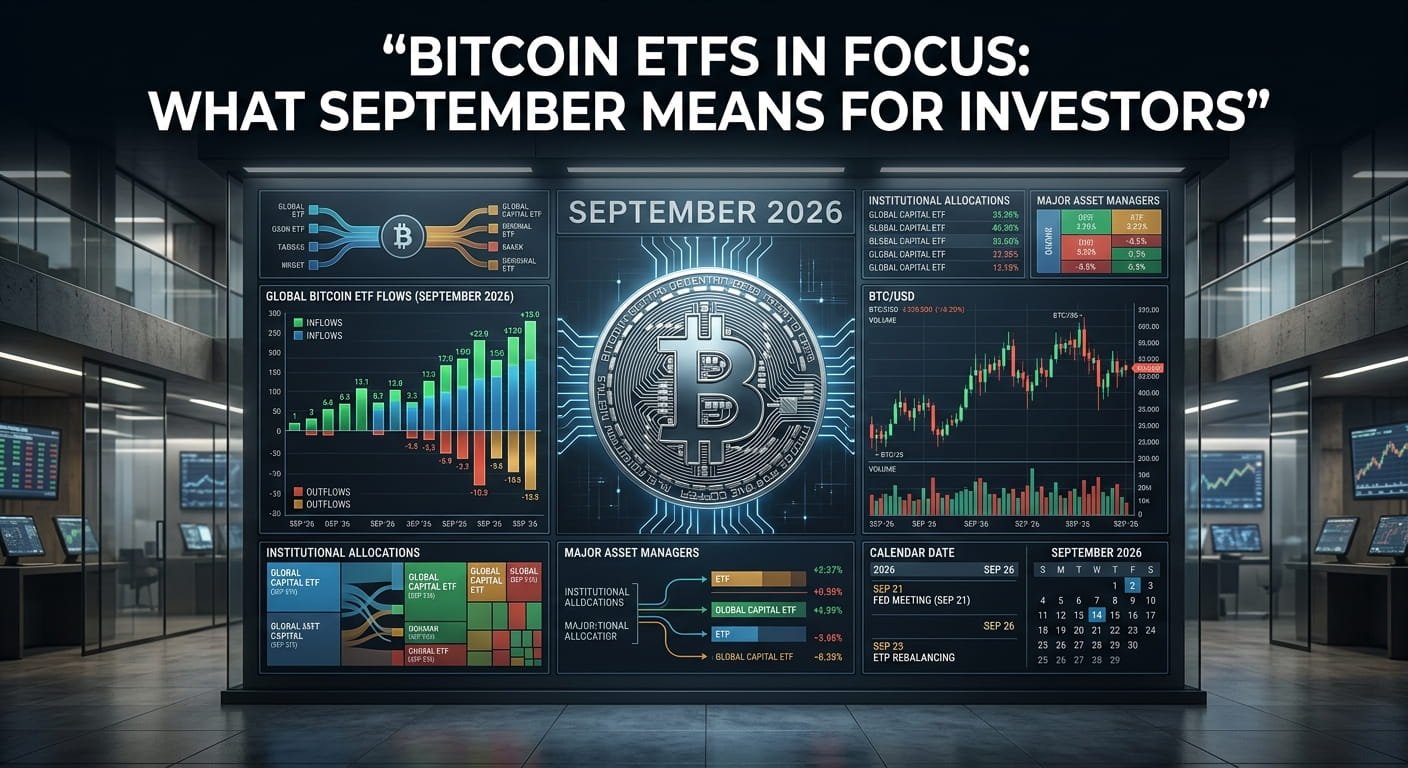
September has put Bitcoin ETFs back at the center of the cryptocurrency investment conversation. After a powerful August rally, investors are watching whether fresh ETF inflows can support Bitcoin’s recovery or whether seasonal weakness and macroeconomic uncertainty will interrupt the momentum.
The timing is important.
U.S. spot Bitcoin ETFs recorded roughly $730.87 million of net inflows on September 3, 2026, according to data cited from SoSoValue. That represented the strongest single-day inflow since January, while BlackRock’s iShares Bitcoin Trust led the move with about $453.96 million of inflows.
However, the September picture is not simply bullish.
Bitcoin has faced resistance around the $80,000-$82,000 area, while changing expectations for Federal Reserve policy continue to influence risk assets. Reuters also noted that Bitcoin’s recent rally pushed the cryptocurrency above several major moving averages, but warned that important technical levels could determine whether the recovery continues.
That creates a more complicated investment setup.
ETF inflows suggest institutional demand remains meaningful. At the same time, investors need to determine whether those inflows represent a durable change in demand or simply a short-term reaction to Bitcoin’s price movement.
This guide explains what the September trend actually means, why Bitcoin ETFs matter, what could drive the next move, and which indicators investors should monitor before making decisions.
Why Bitcoin ETFs Matter More to Investors in September 2026
The biggest change in the Bitcoin market over the past few years has been the growth of regulated investment vehicles.
In January 2024, the U.S. Securities and Exchange Commission approved the listing and trading of spot Bitcoin exchange-traded products. Those products began trading publicly on January 11, 2024.
That decision changed how many investors could obtain Bitcoin exposure.
Instead of creating a cryptocurrency wallet, managing private keys, transferring coins to an exchange, and handling custody themselves, investors can obtain Bitcoin exposure through a brokerage account using an exchange-traded product.
That difference matters particularly for institutional investors.
Pension funds, wealth managers, financial advisers, family offices, and other professional investors often operate within strict investment and custody frameworks. A regulated exchange-traded vehicle can fit more naturally into those systems.
Consequently, Bitcoin ETFs have become more than a convenient retail product.
They now provide an important window into traditional-market demand for Bitcoin.
When ETF assets increase, investors can interpret that as evidence that capital is moving into Bitcoin exposure through regulated financial products.
However, ETF flows should never be treated as a perfect prediction tool.
A large inflow does not guarantee that Bitcoin will rise the next day. Likewise, a single day of outflows does not automatically signal the end of a bull market.
The trend matters more than one number.
What the September Bitcoin ETF Trend Actually Shows
September began with mixed signals.
The first trading sessions demonstrated that investor demand could change quickly. Data cited by TheStreet showed a $236.5 million outflow on September 1, followed by a $101.15 million inflow on September 2 and then a much larger $730.87 million inflow on September 3.
That sequence tells investors something important.
Demand has not disappeared.
Instead, capital is moving aggressively in both directions as investors react to Bitcoin’s price, interest-rate expectations, economic data, and broader risk sentiment.
The September 3 inflow was particularly significant because BlackRock’s IBIT accounted for approximately 62% of that day’s total inflows, according to TheStreet’s reporting. ARKB and Fidelity’s FBTC also recorded substantial inflows.
This concentration deserves attention.
If the largest products continue attracting capital, the trend could indicate that institutional and professional investors remain comfortable using Bitcoin ETFs for exposure.
On the other hand, if flows become concentrated in short bursts followed by large withdrawals, investors should interpret the market more cautiously.
What ETF inflows can tell you
Strong inflows can indicate:
- Greater investor demand for Bitcoin exposure
- Increased institutional participation
- Growing confidence in the asset
- Portfolio allocation changes
- Increased acceptance of regulated crypto products
- Momentum following Bitcoin price gains
But inflows do not tell you everything.
They do not directly reveal whether investors are buying for the next day, next month, or next decade.
That distinction is critical.
Why Bitcoin’s September Price Action Matters
ETF flows cannot be separated from Bitcoin’s price.
When Bitcoin rises rapidly, investors often become more interested in ETFs because the asset appears to be regaining momentum.
That can create a feedback loop.
Bitcoin rises → ETF demand increases → more capital enters the market → sentiment improves → Bitcoin attracts additional attention.
The reverse can also happen.
Bitcoin falls → investors become cautious → ETF outflows increase → sentiment weakens → selling pressure increases.
This is why September’s price action matters so much.
Reuters reported that Bitcoin had recently climbed around 30% from a major low and moved above its 21-, 55-, 100-, and 200-day moving averages. However, the report identified approximately $82,793 as an important resistance area and noted that a breakdown below key support levels could renew downside pressure.
Therefore, investors should not analyze ETF flows in isolation.
A strong inflow combined with improving price structure is generally more meaningful than an inflow occurring while Bitcoin continues making lower highs.
Bitcoin ETFs and the $80,000 Question
The $80,000 level has become an important psychological area for Bitcoin traders during September.
Bitcoin recently moved above that threshold before pulling back. The cryptocurrency also briefly traded above $82,000 during the early-September rally.
Why does this matter?
Round numbers attract attention.
When Bitcoin trades around $80,000, traders, algorithms, options markets, and media coverage can all become more active around that level.
A sustained move above resistance could encourage additional momentum.
However, repeated failures around resistance can produce the opposite effect.
Investors should therefore distinguish between:
A temporary breakout: Bitcoin moves above resistance but quickly falls back.
A sustained breakout: Bitcoin holds above the level and continues attracting demand.
The second scenario would provide stronger confirmation that market sentiment has materially improved.
Why Institutional Demand Is the Biggest Bitcoin ETF Story
The most important long-term development may not be Bitcoin’s daily price.
It may be the continued integration of Bitcoin into traditional investment portfolios.
The approval of spot Bitcoin ETFs created a regulated bridge between conventional financial markets and cryptocurrency.
That bridge allows investors to gain exposure without directly handling Bitcoin.
As a result, institutions can evaluate Bitcoin alongside traditional assets such as equities, bonds, commodities, and gold.
This changes the investment conversation.
Bitcoin is no longer solely an asset traded on crypto-native platforms.
It has become part of the broader asset-allocation debate.
The scale of that shift explains why investors pay so much attention to ETF flows.
When billions of dollars move into or out of these products, the market receives a real-time indication of demand through a familiar investment structure.
What September ETF Inflows Mean for Long-Term Investors
A short-term trader might focus on daily ETF flows.
A long-term investor should think differently.
The more important question is whether Bitcoin ETFs continue accumulating assets over weeks, months, and years.
One strong day can result from:
- Short covering
- A sudden price breakout
- Portfolio rebalancing
- Macro news
- Institutional positioning
- Market timing
A sustained inflow trend is more significant.
For long-term investors, watch the following:
- Weekly net ETF flows
- Monthly cumulative flows
- Total ETF assets
- Bitcoin price relative to ETF demand
- Institutional participation
- Changes in macroeconomic expectations
This approach reduces the risk of reacting emotionally to one headline.
How Federal Reserve Policy Could Change the Bitcoin ETF Trend
Interest rates remain one of the most important macro factors for Bitcoin.
When investors expect easier monetary policy, risk assets can become more attractive because the opportunity cost of holding non-yielding assets may decline.
Bitcoin often responds to changes in liquidity and risk appetite.
That does not mean the relationship is perfectly consistent.
Crypto markets can move for many reasons, including regulation, ETF demand, leverage, dollar movements, geopolitical developments, and investor sentiment.
Still, Federal Reserve expectations remain important.
Recent market moves demonstrated this relationship again. Bitcoin rallied after Federal Reserve Governor Christopher Waller made comments that investors interpreted as supportive of holding rates steady if inflation continued improving.
The reaction was fast.
Bitcoin climbed sharply, while cryptocurrency-related equities also moved higher.
That demonstrates how quickly macroeconomic expectations can affect the entire crypto complex.
What investors should watch from the Fed
Pay attention to:
- Inflation data
- Employment reports
- Federal Reserve statements
- Interest-rate expectations
- Treasury yields
- U.S. dollar strength
- Liquidity conditions
A more supportive monetary environment could strengthen demand for Bitcoin ETFs.
Conversely, persistent inflation and expectations for tighter policy could pressure risk assets.
Why September Seasonality Deserves Attention
September has historically been a difficult month for Bitcoin.
MarketWatch reported that September has historically been Bitcoin’s weakest month since 2014, with an average decline of approximately 2.2%.
However, historical seasonality should not be treated as a forecast.
Markets do not follow calendars mechanically.
A seasonal pattern can become irrelevant when a major catalyst appears.
For example, strong ETF inflows, institutional demand, favorable monetary policy, or regulatory developments could overwhelm typical September weakness.
Therefore, investors should use seasonality as context rather than a trading signal.
The correct question is not:
“Does Bitcoin usually fall in September?”
Instead, ask:
“Are current demand and macroeconomic conditions strong enough to overcome historical September weakness?”
That is a much more useful framework.
How Bitcoin ETF Flows Can Affect Bitcoin’s Supply and Demand
Spot Bitcoin ETFs have an important structural connection to the underlying asset.
When investors put money into a spot Bitcoin ETF, the fund structure generally requires exposure to Bitcoin to reflect the product’s investment objective.
That means persistent net inflows can become an important source of demand for the underlying asset.
However, investors should avoid oversimplifying this relationship.
ETF flows do not translate into a fixed one-to-one daily increase in Bitcoin’s price.
Bitcoin trades globally across many markets.
Its price also responds to:
- Derivatives
- Exchange liquidity
- Miner activity
- Long-term holders
- Short-term traders
- Stablecoin liquidity
- Institutional transactions
- Macroeconomic events
Therefore, ETF demand is one major piece of the market rather than the entire market.
Why Bitcoin ETF Outflows Do Not Always Mean a Bear Market
This is one of the most common mistakes investors make.
A day of ETF outflows can look alarming.
But outflows may occur for many reasons.
Investors might take profits after a strong rally. A portfolio manager might rebalance. A fund could experience temporary redemptions. Or investors could rotate capital into another asset.
Therefore, one negative flow day should not automatically be interpreted as a structural change.
The September data illustrates this clearly.
After a significant outflow on September 1, Bitcoin ETFs attracted more than $100 million on September 2 and roughly $731 million on September 3.
The lesson is simple:
Follow the trend, not the headline.
What Bitcoin ETF Assets Tell Investors About Market Maturity
Another important metric is total assets held by Bitcoin ETFs.
As the asset base grows, these products become increasingly important within the investment ecosystem.
TheStreet reported that combined net assets across U.S. spot Bitcoin ETFs reached roughly $103.34 billion after the September 3 session.
That is a significant figure.
It shows that spot Bitcoin ETFs have moved beyond being a niche experiment.
They now represent a major channel for Bitcoin exposure.
However, growing assets also create new risks.
Large institutional positions can produce large flows in both directions. If investors suddenly become risk-averse, redemptions could accelerate.
Therefore, increasing ETF adoption can strengthen Bitcoin’s institutional presence while also making ETF flows an even more important market indicator.
Bitcoin ETFs vs. Buying Bitcoin Directly
Investors considering Bitcoin exposure have several options.
Bitcoin ETFs and direct Bitcoin ownership offer different experiences.
Bitcoin ETFs
Advantages include:
- Easy access through traditional brokerage accounts
- Familiar investment structure
- Simplified custody
- Easy portfolio tracking
- Potential integration with traditional investment strategies
Disadvantages include:
- Management fees
- No direct control over the underlying Bitcoin
- Product-specific risks
- Trading-price considerations
- Potential tax differences depending on jurisdiction
Direct Bitcoin ownership
Advantages can include:
- Direct ownership
- Control over private keys
- Ability to transfer Bitcoin directly
- Access to the broader Bitcoin ecosystem
However, direct ownership requires greater responsibility.
Investors must understand wallets, private keys, security, exchanges, transaction fees, and custody.
For many traditional investors, Bitcoin ETFs therefore offer a simpler route.
What Risks Investors Should Watch in September
The recent improvement in Bitcoin ETF flows does not remove investment risk.
Several risks remain particularly important.
1. Bitcoin volatility
Bitcoin can move thousands of dollars in a short period.
Even strong ETF inflows cannot eliminate volatility.
2. Macro uncertainty
Inflation, employment data, Treasury yields, and Federal Reserve policy can quickly change investor sentiment.
3. Valuation and momentum risk
A rapid rally can attract momentum traders.
If buying slows, those traders can also exit quickly.
4. Regulatory uncertainty
Crypto regulation continues to evolve.
Changes in securities rules, taxation, stablecoin legislation, custody requirements, or market structure could affect investor demand.
5. ETF concentration
Large products dominate the market.
Investors should monitor whether flows remain broad-based or become concentrated in only a few funds.
6. Liquidity risk
Bitcoin trades around the clock, but liquidity can vary significantly across exchanges and market conditions.
During periods of stress, price movements can become much larger.
How to Read Bitcoin ETF Data Like a Professional Investor
You do not need a complicated trading system to interpret ETF data.
Start with a simple framework.
Step 1: Look at the daily flow
Ask whether money entered or left the ETF market.
Step 2: Compare it with the previous week
One day is noisy.
A multi-day trend is more useful.
Step 3: Compare flows with Bitcoin’s price
If Bitcoin rises while ETF inflows increase, the relationship is supportive.
If Bitcoin rises while ETFs experience persistent outflows, investigate why.
Step 4: Examine total assets
Growing assets can indicate longer-term adoption.
Step 5: Check macroeconomic conditions
Look at Federal Reserve expectations, inflation, employment, Treasury yields, and the U.S. dollar.
Step 6: Avoid emotional decisions
Do not buy simply because an ETF records a large inflow.
Likewise, do not sell solely because one day produces an outflow.
This process provides a much more balanced view.
Could Bitcoin ETFs Push Bitcoin Higher From Here?
They could, but investors should avoid treating ETF inflows as a guarantee.
The bullish argument is straightforward.
If Bitcoin ETFs continue receiving significant net inflows, the market could experience persistent demand from investors who prefer regulated investment products.
That demand could become especially important if Bitcoin supply available for immediate sale remains limited.
The bearish argument is equally important.
If macroeconomic conditions deteriorate, investors could reduce risk exposure even while ETF products remain popular.
Bitcoin could then experience selling pressure despite the long-term growth of ETFs.
Therefore, the direction of Bitcoin may depend on the interaction between ETF demand, macro liquidity, investor positioning, and market sentiment.
What Would Confirm a Stronger Bitcoin ETF Trend?
Investors looking for confirmation should watch for several signals appearing together.
First, sustained positive ETF flows.
Several weeks of consistent inflows would be more meaningful than one exceptional day.
Second, Bitcoin holding important support levels.
Price stability would suggest that new demand is absorbing selling pressure.
Third, improving institutional participation.
Growing assets and broader adoption would strengthen the long-term case for Bitcoin ETFs.
Fourth, supportive macro conditions.
Lower inflation pressure and a less restrictive monetary environment could improve risk appetite.
Finally, healthy market structure.
A rally supported by spot demand is generally more encouraging than one driven primarily by excessive leverage.
What Could Send Bitcoin ETFs Back Into Outflows?
The opposite scenario deserves equal attention.
ETF outflows could accelerate if Bitcoin loses major support, macroeconomic conditions deteriorate, or investors become concerned about tighter monetary policy.
A sharp equity-market correction could also affect Bitcoin because many investors treat cryptocurrencies as part of their broader risk portfolio.
Additionally, a rapid Bitcoin rally can create profit-taking.
That means even a bullish market can experience significant ETF withdrawals.
Investors should therefore expect volatility rather than a straight line higher.
Is September a Good Time to Invest in Bitcoin ETFs?
There is no universal answer.
September’s historical weakness may make some investors cautious. However, current ETF flows show that institutional demand can remain strong even during a traditionally difficult period.
Instead of trying to predict the perfect entry point, investors should consider their:
- Risk tolerance
- Investment horizon
- Portfolio allocation
- Ability to tolerate volatility
- Existing cryptocurrency exposure
- Need for liquidity
A long-term investor may approach the market differently from a short-term trader.
The key is position sizing.
Bitcoin remains a highly volatile asset. Even if the long-term thesis looks attractive, investors should avoid allocating more capital than they can reasonably withstand losing during a major drawdown.
The Bigger Meaning of Bitcoin ETFs for the Crypto Market
The most important September story may extend beyond Bitcoin’s price.
It is about the continued institutionalization of cryptocurrency.
The arrival of spot Bitcoin ETFs created a bridge between crypto markets and traditional finance. That bridge has continued to expand as more investors gain access to Bitcoin through familiar investment channels.
The recent September flows demonstrate that this infrastructure remains active.
The market is no longer asking whether investors can obtain regulated Bitcoin exposure.
They can.
The more important question now is how much capital investors will allocate to it over time.
That shift represents a significant change in the cryptocurrency investment landscape.
Bitcoin ETFs: What Investors Should Watch Next
For the remainder of September, investors should focus on a short list of indicators.
ETF flows
Look for sustained net inflows rather than isolated spikes.
Bitcoin price structure
Watch whether Bitcoin can hold above important support and challenge resistance convincingly.
Federal Reserve policy
Rate expectations can influence the entire risk-asset environment.
Inflation and employment
These reports can change rate expectations rapidly.
Treasury yields
Higher yields can affect liquidity and investor appetite for speculative assets.
U.S. dollar
Bitcoin can respond to major changes in dollar strength.
Institutional activity
Growing ETF assets and broader adoption would support the long-term institutional thesis.
Market leverage
A rally driven primarily by excessive leverage may be less durable than one supported by genuine spot demand.
A Practical Bitcoin ETF Investor Checklist
Before making an investment decision, ask yourself:
1. Am I investing for days, months, or years?
Your time horizon should determine how much importance you place on daily ETF flows.
2. Can I tolerate a major Bitcoin correction?
If the answer is no, your allocation may be too large.
3. Am I following fundamentals or headlines?
A single $700 million inflow should not determine your entire investment strategy.
4. What is happening with interest rates?
Macro conditions can quickly change the risk environment.
5. Are ETF inflows persistent?
Consistency is more important than one extraordinary day.
6. Is Bitcoin holding key technical levels?
Price confirmation can help distinguish momentum from a temporary bounce.
7. Does Bitcoin fit my overall portfolio?
An investment can be attractive while still being unsuitable for a particular investor.
Conclusion: What September Really Means for Bitcoin ETF Investors
The September 2026 trend has put Bitcoin ETFs firmly back in focus, but the story is more nuanced than a simple “ETF inflows are bullish” headline.
The strongest evidence comes from the combination of large recent inflows, growing institutional access, and renewed Bitcoin price momentum. U.S. spot Bitcoin ETFs attracted approximately $730.87 million on September 3 alone, while combined ETF assets reached roughly $103.34 billion after that session, according to reporting based on SoSoValue and Farside data.
At the same time, September has already demonstrated how quickly sentiment can change.
Bitcoin faced resistance around the low-$80,000 area, while Federal Reserve expectations, inflation, employment data, Treasury yields, and broader risk appetite continue to influence the market.
For investors, the most useful takeaway is therefore not to chase the latest inflow number.
Instead, watch the trend.
If Bitcoin ETFs continue attracting capital over several weeks while Bitcoin holds important support and macroeconomic conditions remain favorable, the September recovery could develop into something more durable.
If flows reverse sharply, Bitcoin loses major technical levels, or monetary conditions become less supportive, the current momentum could weaken quickly.
The smartest approach is to treat ETF flows as one piece of a larger investment puzzle.
Watch the money, the macroeconomy, Bitcoin’s price structure. Most importantly, manage your risk.
That approach gives investors a much better foundation for navigating September’s Bitcoin market than simply reacting to the latest ETF headline.
FAQs About Bitcoin ETFs in September
1. Why are Bitcoin ETFs back in focus in September 2026?
Bitcoin ETFs are back in focus because recent U.S. spot ETF flows have strengthened alongside Bitcoin’s price recovery. On September 3, 2026, U.S. spot Bitcoin ETFs recorded approximately $730.87 million in net inflows, their strongest single-day inflow since January, according to reporting based on SoSoValue data.
The move has renewed attention on institutional demand and whether the recovery can continue.
2. Are Bitcoin ETF inflows bullish for Bitcoin?
Strong and sustained ETF inflows can be a positive signal because they indicate increasing demand for Bitcoin exposure through regulated investment products.
However, inflows do not guarantee higher Bitcoin prices. Investors should also consider macroeconomic conditions, market liquidity, derivatives activity, technical levels, and broader investor sentiment.
A multi-week inflow trend is generally more informative than one large trading day.
3. Is September historically a good month for Bitcoin?
Historically, September has been a difficult month for Bitcoin. MarketWatch reported that September has been Bitcoin’s weakest month on average since 2014, with an average decline of around 2.2%.
However, historical seasonality does not determine future performance. Strong ETF demand, institutional activity, monetary policy, or other catalysts can override seasonal patterns.
4. Should investors buy Bitcoin ETFs after the September inflows?
A large ETF inflow alone should not be treated as a buy signal.
Investors should first consider their risk tolerance, time horizon, portfolio allocation, Bitcoin’s current valuation, macroeconomic conditions, and whether ETF inflows remain consistent.
Bitcoin can experience substantial price swings even during long-term uptrends. Therefore, investors should avoid making decisions based solely on one day’s ETF data.
5. What should investors watch for the rest of September?
The most important indicators include daily and weekly Bitcoin ETF flows, Bitcoin’s support and resistance levels, Federal Reserve policy expectations, inflation data, employment reports, Treasury yields, the U.S. dollar, and institutional demand.
Investors should also watch whether ETF inflows remain consistent. Persistent demand combined with improving price structure would provide stronger evidence of a durable trend than a single large inflow.


Cryptocurrency wallets are essential for managing digital assets, but the word “wallet” can be misleading. Crypto does not sit inside an app like cash sits inside a physical wallet. Instead, wallets provide access to blockchain assets through cryptographic keys. ecryptobit.com Wallets is a search term associated with eCryptoBit’s cryptocurrency and blockchain information platform, which publishes guidance about wallet security, hot and cold storage, Bitcoin, Ethereum, NFTs, and other digital assets.
However, there is an important distinction between information about wallets and evidence that a website operates a fully verified wallet service. Publicly available information on ecryptobit.com clearly shows wallet-related educational content, but independent evidence confirming a dedicated eCryptoBit wallet product, its security audits, or a complete custody infrastructure is limited. That distinction matters before anyone transfers real cryptocurrency.
This guide explains how crypto wallets work, what ecryptobit.com publishes about digital asset storage, the difference between hot and cold wallets, what security questions users should ask, and how to evaluate a lesser-known crypto platform responsibly.
What Are ecryptobit.com Wallets?
The phrase ecryptobit.com Wallets generally refers to cryptocurrency wallet information associated with eCryptoBit. The site’s own material explains the fundamentals of crypto wallets, including public addresses, private keys, hot wallets, cold storage, backup phrases, and transaction signing.
eCryptoBit describes itself as a cryptocurrency and blockchain information website founded in 2024. Its published categories include Bitcoin, Ethereum, NFTs, stablecoins, tokens, and cryptocurrency investing.
That means readers should avoid automatically interpreting every online reference to “ecryptobit.com wallets” as proof of a standalone wallet application.
A wallet can refer to several different things:
- A mobile cryptocurrency application
- A desktop wallet
- A browser-based wallet
- A hardware wallet
- A custodial account
- A non-custodial wallet
- Educational information about wallet technology
The difference is significant because each model creates a different balance between convenience, control, and risk.
What Does a Crypto Wallet Actually Store?
One of the most frequently misunderstood aspects of cryptocurrency is the idea that coins are physically stored inside a wallet.
They are not.
Cryptocurrency ownership is recorded on a blockchain. A wallet manages the cryptographic credentials needed to interact with that blockchain.
A typical wallet involves:
Public address: The address other people can use to send cryptocurrency to you.
Private key: The secret cryptographic credential that authorizes transactions.
Recovery phrase: A human-readable backup that can allow a compatible wallet to regenerate the keys associated with an account.
This creates an important security rule: anyone who obtains the credentials controlling a wallet may be able to control its assets.
eCryptoBit’s own wallet guidance makes the same basic distinction between public information used to receive funds and private credentials that must remain confidential.
Why the distinction matters
Suppose you own Bitcoin in a self-custody wallet. The Bitcoin remains recorded on the Bitcoin blockchain. Your wallet gives you the ability to authorize a transaction that moves control of that Bitcoin to another address.
If your phone breaks, the blockchain does not lose your Bitcoin.
The problem arises if you also lose the private key or recovery information needed to access it.
That is why backup procedures are just as important as the wallet application itself.
How ecryptobit.com Explains Wallet Storage
eCryptoBit has published educational material explaining the two broad categories of crypto storage: hot wallets and cold wallets. Its guidance describes hot wallets as internet-connected options intended for accessibility, while cold storage keeps private keys offline and is generally more appropriate for long-term holdings.
The site also discusses factors such as:
- Security features
- Two-factor authentication
- Backup and recovery
- Hardware wallet compatibility
- Supported cryptocurrencies
- Ease of use
- Private-key management
- Storage strategy
These are useful criteria when evaluating any wallet, not just ecryptobit.com.
The important point is that a wallet’s advertised features should not automatically be treated as independently verified security claims. A security feature is meaningful only when users can establish how it works, who operates it, and whether independent testing or audits support the claim.
Hot Wallets vs. Cold Wallets
The choice between hot and cold storage is one of the most important decisions in digital asset security.
| Feature | Hot Wallet | Cold Wallet |
|---|---|---|
| Internet connection | Usually connected | Designed to remain offline |
| Convenience | High | Lower |
| Transaction speed | Generally convenient | Less convenient |
| Typical use | Daily transactions | Long-term storage |
| Online attack exposure | Higher | Lower |
| Setup complexity | Usually lower | Usually higher |
| Suitable for large holdings | Generally less suitable | Often preferred |
| Physical device required | Not always | Usually for hardware wallets |
Neither option is completely risk-free.
A hot wallet can be compromised through phishing, malware, malicious browser extensions, compromised devices, or stolen credentials.
A cold wallet reduces many online attack vectors, but users can still lose funds through poor backup practices, fraudulent addresses, compromised computers during transactions, or physical loss of recovery information.
When a hot wallet makes sense
Hot wallets are generally useful when accessibility matters.
For example, someone who regularly interacts with decentralized applications or makes frequent transactions may prefer a software wallet because it can be accessed quickly.
The sensible approach is usually to avoid keeping more money in an internet-connected wallet than is necessary for its intended purpose.
When cold storage makes more sense
Cold storage is generally better suited to assets that do not need frequent movement.
A hardware wallet keeps sensitive signing credentials isolated from an ordinary internet-connected environment. However, it does not eliminate every risk.
The recovery phrase remains extremely important.
If someone steals the recovery phrase, the hardware device itself may not protect the assets.
Custodial vs. Non-Custodial Wallets
Another distinction that receives less attention than hot versus cold storage is custody.
Custodial wallets
With a custodial arrangement, another organization controls the private keys or account infrastructure on the user’s behalf.
This can make account management easier, but it introduces counterparty risk.
If the provider freezes an account, suffers a security incident, becomes insolvent, or experiences operational problems, the user may have limited control over the outcome.
Non-custodial wallets
A non-custodial wallet gives the user control over the private keys.
That provides greater independence, but responsibility also shifts to the user.
If a recovery phrase disappears, there may be no company capable of restoring access.
eCryptoBit’s published material discusses custodial and self-managed wallet concepts as part of its broader cryptocurrency education, but users should verify the exact custody model of any specific service before transferring funds.
What Security Features Should Users Look For?
Anyone researching ecryptobit.com wallets should evaluate the underlying security architecture rather than relying on a feature list.
Two-factor authentication
Two-factor authentication adds another verification layer to an account.
However, 2FA protects an account login; it does not necessarily protect a blockchain private key that has already been exposed.
For this reason, 2FA should be viewed as one security layer rather than a complete solution.
Encryption
Encryption can protect sensitive information while it is stored or transmitted.
But the presence of the word “encrypted” does not automatically demonstrate that a wallet is secure.
Users should ask:
- What information is encrypted?
- Where are the keys stored?
- Who controls those keys?
- Is the implementation independently audited?
- What happens if the service is compromised?
Recovery phrases
A recovery phrase can restore access to a self-custody wallet.
It should never be:
- Posted online
- Sent by email
- Shared through messaging apps
- Entered into an unfamiliar website
- Given to customer support
- Stored in an ordinary cloud document
Anyone asking for a recovery phrase should be treated with extreme suspicion.
Is ecryptobit.com a Wallet Provider or an Information Website?
This is one of the most important distinctions surrounding the keyword.
The official eCryptoBit website describes itself as a guide to cryptocurrency and blockchain technology. Its homepage contains educational categories and articles covering Bitcoin, Ethereum, NFTs, stablecoins, tokens, and investing.
It also publishes articles explaining how to select cryptocurrency wallets and how hot and cold storage work.
However, publicly available evidence does not clearly establish the existence of a widely independently verified eCryptoBit-branded wallet application comparable to established hardware or software wallet providers.
That does not by itself prove that a service is fraudulent. It means users should distinguish between:
- A website publishing wallet education.
- A website recommending third-party wallets.
- A website operating its own wallet infrastructure.
- A company offering custodial cryptocurrency storage.
These are four different things.
What Should You Verify Before Using ecryptobit.com Wallets?
Before sending cryptocurrency to any relatively unfamiliar platform, perform several checks.
1. Confirm the official product
Look for an official wallet download page, application listing, documentation, or clearly documented wallet infrastructure.
Do not rely solely on third-party articles claiming that a wallet exists.
2. Verify custody
Find out whether the service is custodial or non-custodial.
If the company controls the private keys, you are relying on that company to safeguard your assets.
If you control the keys, you carry the recovery responsibility yourself.
3. Look for independent security audits
A platform may advertise encryption, 2FA, cold storage, or other protections.
Independent audits can provide stronger evidence than marketing descriptions.
At the time of research, publicly available third-party evidence verifying comprehensive security audits specifically for an eCryptoBit wallet service is limited. Several third-party articles also raise concerns about the lack of independently verifiable security information.
4. Check fees before transferring funds
A wallet may be free to download while transactions still incur blockchain network fees.
Other services may charge:
- Withdrawal fees
- Swap fees
- Account fees
- Service fees
- Network-related charges
Always confirm the exact cost before approving a transaction.
5. Test with a small transaction
If you decide to use an unfamiliar service, do not begin by transferring your entire portfolio.
A small test transaction can help verify:
- Deposit functionality
- Address accuracy
- Network compatibility
- Confirmation times
- Withdrawal functionality
This does not prove long-term reliability, but it can expose basic problems before larger amounts are involved.
Supported Assets Need Careful Verification
Crypto wallets do not automatically support every cryptocurrency.
Bitcoin, Ethereum, Solana, stablecoins, NFTs, and tokens can use different networks and standards.
For example, sending a token through an incompatible network can cause funds to become inaccessible.
Before making a transfer, confirm:
- The exact cryptocurrency
- The exact blockchain network
- The receiving address format
- Whether memo or tag information is required
- Minimum deposit requirements
- Withdrawal restrictions
eCryptoBit publishes educational content covering several major assets and blockchain concepts, but users should verify current support directly for any specific wallet or service rather than assuming that an article mentioning an asset means the platform supports it.
Common Misunderstandings About Crypto Wallets
“The wallet stores my Bitcoin.”
Technically, the blockchain records the Bitcoin. The wallet manages the credentials that allow you to control the associated assets.
“A wallet with 2FA cannot be hacked.”
No security measure provides absolute protection.
2FA can reduce account takeover risks, but phishing, malware, social engineering, compromised recovery phrases, and malicious transactions remain possible.
“Cold storage means zero risk.”
Cold storage reduces exposure to many online threats, but physical theft, loss, incorrect backups, compromised recovery phrases, and transaction mistakes can still cause losses.
“A professional-looking website proves legitimacy.”
A polished interface is not evidence of financial reliability.
Users should investigate ownership, operating history, security documentation, independent reviews, and transparency.
How to Choose a Wallet for Different Needs
| User situation | Generally suitable approach | Main priority |
|---|---|---|
| Occasional small transactions | Hot wallet | Convenience |
| Frequent DeFi activity | Reputable software wallet | Compatibility |
| Long-term Bitcoin holding | Hardware wallet/cold storage | Key security |
| Large portfolio | Layered storage strategy | Risk reduction |
| Business treasury | Multisignature or institutional setup | Shared control |
| Beginner | Established wallet with clear documentation | Ease of recovery |
The best wallet is not necessarily the one with the longest feature list.
It is the one whose security model you understand and can operate correctly.
A Safer Storage Strategy: Separate Convenience From Long-Term Security
One useful approach is to avoid putting every digital asset into one location.
For example, a user might maintain:
- A small hot-wallet balance for everyday transactions
- A hardware wallet for long-term holdings
- A separate backup of recovery information
- A secure process for verifying transaction addresses
This reduces the consequences of a single compromised device.
The same principle appears in eCryptoBit’s own educational material, which discusses combining hot and cold storage according to a user’s needs and risk tolerance.
However, diversification should not become unnecessarily complicated. Every additional wallet, backup, and recovery method creates another opportunity for human error.
Lesser-Known Security Detail: The Recovery Phrase Can Matter More Than the App
Many users spend considerable time comparing wallet interfaces but overlook the most important credential.
For a self-custody wallet, the recovery phrase may provide access to the underlying wallet regardless of the original device.
That means changing phones does not necessarily mean losing access.
Likewise, deleting an app does not necessarily delete the blockchain assets.
The real danger is losing or exposing the recovery information.
A strong setup therefore focuses on key management, not just choosing a visually attractive wallet.
Warning Signs to Watch For
Be particularly cautious if a supposed wallet service:
- Guarantees investment returns
- Pressures you to deposit immediately
- Requests your recovery phrase
- Requires payment to “unlock” withdrawals
- Promises unusually high rewards for deposits
- Uses unverifiable testimonials
- Provides vague company information
- Has no meaningful security documentation
- Has unexplained withdrawal restrictions
- Encourages you to move funds through unfamiliar networks
These warning signs do not automatically establish fraud, but they justify stopping and independently verifying the service.
Some third-party coverage of ecryptobit.com has raised concerns about transparency, independent security verification, and the limited availability of established user feedback. Those reports should themselves be treated as secondary evidence rather than definitive proof of wrongdoing.
How ecryptobit.com Compares With Established Wallet Categories
It is useful to compare the concept rather than assume that every wallet provider offers the same level of maturity.
| Factor | ecryptobit.com information | Established wallet provider |
|---|---|---|
| Wallet education | Clearly available | Usually available |
| Hot/cold storage guidance | Available | Common |
| Publicly documented wallet infrastructure | Not clearly established from available evidence | Usually documented |
| Independent security evidence | Limited public evidence found | Varies by provider |
| Long-term track record | Relatively limited | Depends on provider |
| User should verify custody | Yes | Yes |
| Recovery responsibility | Depends on wallet model | Depends on wallet model |
This comparison does not mean established providers are risk-free. It simply highlights why users should distinguish between an informational website and a proven wallet infrastructure.
Practical Checklist Before Storing Digital Assets
Before sending funds anywhere, check the following:
- Confirm the official domain and application.
- Verify whether the wallet is custodial or non-custodial.
- Confirm which blockchain networks are supported.
- Read the fee and withdrawal information.
- Check security documentation.
- Look for credible independent security assessments.
- Create and protect backups correctly.
- Never share a recovery phrase.
- Perform a small test transaction.
- Keep long-term holdings separate from funds used for everyday transactions.
This process may take a little longer, but it is much safer than choosing a wallet based only on a search result or promotional article.
Frequently Asked Questions
Are ecryptobit.com Wallets an official cryptocurrency wallet?
Public information confirms that eCryptoBit operates a cryptocurrency and blockchain information website and publishes extensive educational material about crypto wallets. However, publicly available evidence does not clearly establish a widely independently verified eCryptoBit-branded wallet application or custody service. Users should verify any specific wallet product directly through official documentation before transferring cryptocurrency.
Is ecryptobit.com safe for storing cryptocurrency?
There is not enough independently verified information to confidently characterize ecryptobit.com as a fully established cryptocurrency custody provider. Its website publishes security and wallet education, but users should independently verify any claimed wallet infrastructure, custody model, audits, fees, and withdrawal procedures before committing funds.
What is the difference between hot and cold wallets?
Hot wallets remain connected to the internet and are generally more convenient for frequent transactions. Cold wallets keep private keys offline and are commonly used for longer-term storage. Hot wallets prioritize accessibility, while cold storage generally reduces online attack exposure. Neither method eliminates all security risks.
Does a crypto wallet actually hold cryptocurrency?
No. Cryptocurrency remains recorded on its respective blockchain. A wallet stores or manages the cryptographic credentials needed to access and authorize transactions involving those assets. This is why losing a device does not necessarily mean losing cryptocurrency, provided the wallet can be recovered using the correct recovery credentials.
Should I store large amounts of crypto on an unfamiliar wallet?
It is generally safer to avoid transferring substantial amounts to an unfamiliar wallet until you have independently verified its security model, ownership, custody arrangements, reputation, and withdrawal functionality. If you decide to test a service, a small transaction can help establish whether basic deposits and withdrawals work as expected.
Can customer support recover a lost crypto recovery phrase?
For a genuine non-custodial wallet, customer support generally cannot recreate a lost recovery phrase because the user controls the wallet credentials. If someone claims they can recover a self-custody wallet by asking for your seed phrase, treat the request as a major security warning.
Are hardware wallets completely safe?
Hardware wallets can significantly reduce exposure to many online threats because private keys are designed to remain isolated from ordinary internet-connected devices. They are not completely risk-free, though. Users can still lose funds through stolen recovery phrases, malicious transactions, fake devices, phishing, or incorrect setup.
Conclusion
ecryptobit.com Wallets is a useful search term for people looking for information about cryptocurrency storage, but users should distinguish between eCryptoBit’s educational wallet content and independently verified evidence of a dedicated wallet or custody service. The official site clearly publishes material about hot wallets, cold storage, private keys, recovery phrases, and cryptocurrency security.
The safest approach is to evaluate the actual wallet infrastructure rather than rely on promotional descriptions. Check custody arrangements, security audits, supported networks, fees, recovery procedures, and withdrawal functionality before transferring funds.
For cryptocurrency storage, convenience matters, but control and verifiable security matter more. If a wallet’s ownership, security architecture, or operational history remains unclear, keeping significant digital assets elsewhere is the more cautious choice.
Financial disclaimer: Cryptocurrency is highly volatile and involves substantial risk, including the potential loss of funds. This article is informational and is not financial, investment, legal, or tax advice. eCryptoBit itself states that its website content should not be treated as professional financial advice.
Pavel Durov Announces Telegram’s Largest Non-Custodial Crypto Wallet
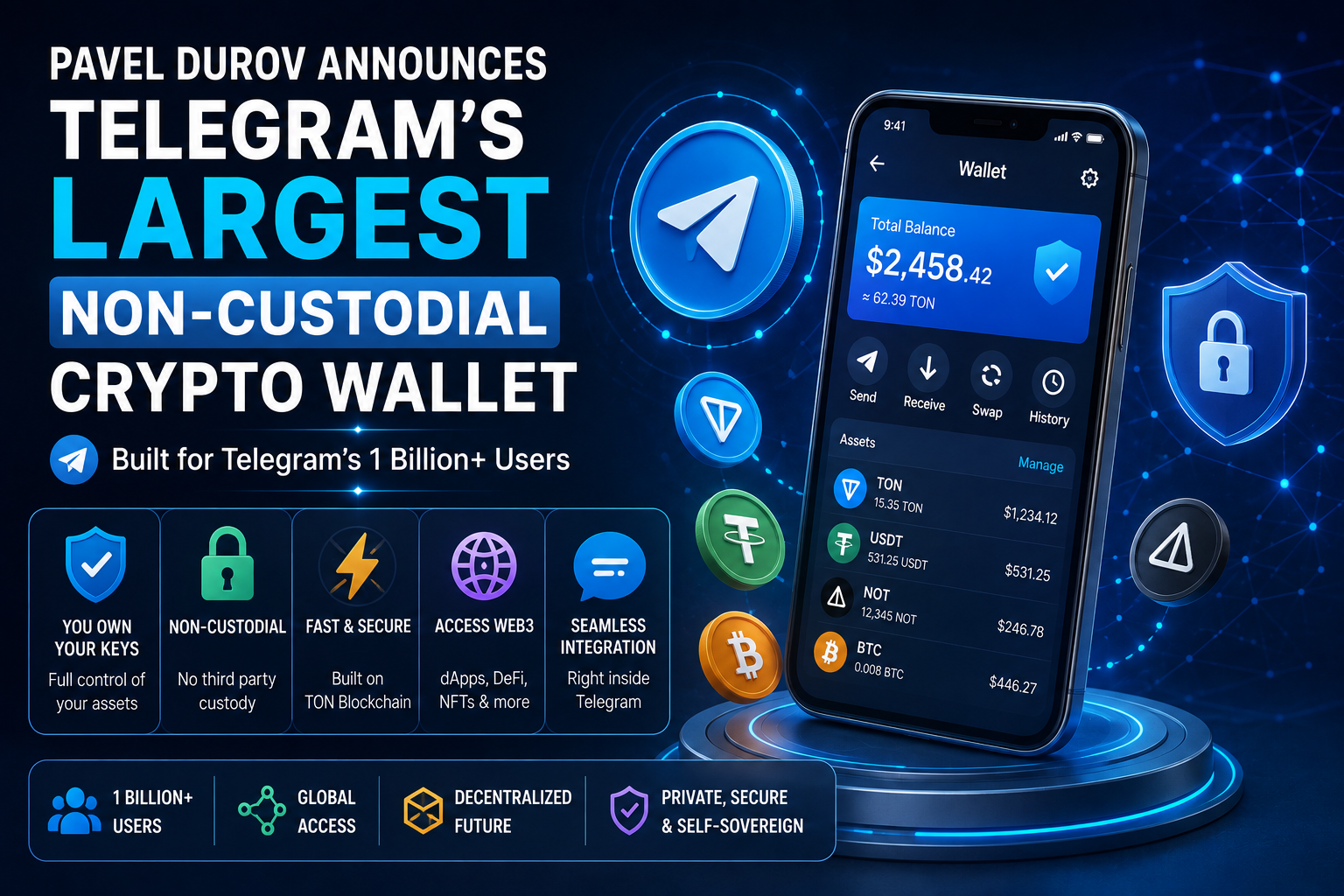
Pavel Durov Announces Telegram’s Largest Non-Custodial Crypto Wallet, marking one of the most significant developments in mainstream cryptocurrency adoption. The announcement introduces a self-custody wallet designed to bring blockchain technology directly into Telegram, potentially reaching over one billion users worldwide. Unlike traditional custodial wallets, this solution gives users greater control over their digital assets while remaining deeply integrated into one of the world’s most popular messaging platforms.
This article explains what the announcement means, how the wallet works, why it matters to the crypto industry, its advantages and limitations, and what users should know before using it.
What Is Telegram’s Non-Custodial Crypto Wallet?
A non-custodial crypto wallet allows users to own and control their private keys instead of relying on a third party.
Traditional crypto exchanges typically manage users’ private keys. While this makes account recovery easier, it also means users depend on the exchange for security and asset access.
Telegram’s announced wallet follows the opposite model.
With a non-custodial wallet:
- You control your private keys.
- Only you can authorize transactions.
- Funds remain under your ownership.
- There is no centralized custody of assets.
This approach aligns with one of cryptocurrency’s core principles: self-sovereign ownership.
Why Pavel Durov Announces Telegram’s Largest Non-Custodial Crypto Wallet Matters
The announcement is important because Telegram already has one of the world’s largest messaging communities.
Instead of asking users to install separate wallet applications, Telegram plans to integrate crypto functionality directly into its existing ecosystem.
Potential benefits include:
- Easier cryptocurrency adoption
- Faster peer-to-peer transfers
- Simplified blockchain onboarding
- Better integration with TON-based services
- Access to decentralized applications (dApps)
For many new users, this could become their first experience with blockchain technology.
How the Wallet Is Expected to Work
Although the rollout will continue over time, the wallet is expected to follow a familiar crypto workflow.
Step 1: Wallet Creation
Users create a wallet directly inside Telegram.
Unlike exchange accounts, the wallet generates private keys owned by the user.
Step 2: Secure Recovery
The wallet provides a recovery phrase or another secure backup method.
This step is extremely important.
Losing recovery credentials could permanently lock users out of their assets.
Step 3: Receive Cryptocurrency
Users receive crypto using a wallet address.
Supported assets are expected to include cryptocurrencies connected with Telegram’s blockchain ecosystem, particularly The Open Network (TON).
Step 4: Send Payments
Sending digital assets should work similarly to sending a Telegram message.
Users select a contact or wallet address, choose an amount, and approve the transaction.
Step 5: Connect to Web3
The wallet may also connect users with:
- NFT marketplaces
- Blockchain games
- Decentralized finance (DeFi)
- Token swaps
- Digital collectibles
This creates a bridge between Telegram and the broader Web3 ecosystem.
Key Features Expected in Telegram’s Wallet
Self-Custody
Users maintain full ownership of private keys instead of relying on centralized exchanges.
Native Telegram Integration
Crypto transactions happen inside an app already used by millions every day.
Fast Transfers
TON blockchain infrastructure is designed for quick transaction processing.
Web3 Compatibility
Users may access decentralized applications without installing additional wallet software.
Better User Experience
Telegram aims to simplify blockchain interactions for beginners who may have never owned cryptocurrency before.
Comparison Table
| Feature | Telegram Non-Custodial Wallet | Traditional Exchange Wallet |
|---|---|---|
| Private Keys | User controls keys | Exchange controls keys |
| Asset Ownership | Full user ownership | Custodian manages assets |
| Recovery Responsibility | User | Exchange |
| Account Freezing | Less likely | Possible |
| Web3 Access | Direct | Often limited |
| Privacy | Higher | Depends on provider |
| Blockchain Interaction | Native | Usually limited |
| Third-Party Dependence | Minimal | High |
Benefits of Telegram’s New Wallet
Greater Financial Control
Users no longer depend entirely on centralized platforms for asset storage.
This reduces counterparty risk while increasing personal responsibility.
Easier Crypto Adoption
One of crypto’s biggest barriers has always been complexity.
Telegram already has an intuitive interface, making onboarding significantly easier for beginners.
Massive Global Reach
Few blockchain products launch with access to such a large user base.
If widely adopted, Telegram could become one of the largest consumer gateways into Web3.
Faster Everyday Payments
The wallet could simplify:
- Sending money to friends
- Paying freelancers
- Cross-border transfers
- Micro-payments
- Digital tipping
without requiring traditional banking infrastructure.
Stronger TON Ecosystem
Telegram’s integration naturally strengthens the adoption of The Open Network.
This may encourage:
- More developers
- More decentralized apps
- Increased blockchain activity
- Expanded digital services
around the TON ecosystem.
Challenges Users Should Understand
While the announcement is promising, self-custody also introduces new responsibilities.
Losing Recovery Keys
Unlike banks or exchanges, there is usually no “Forgot Password” option.
If recovery credentials are lost, assets may become permanently inaccessible.
Security Risks
Users remain responsible for protecting:
- Recovery phrases
- Devices
- Passwords
- Backups
Scams and phishing attacks remain common throughout the cryptocurrency industry.
Learning Curve
Although Telegram aims to simplify crypto, new users still need to understand:
- Wallet addresses
- Blockchain confirmations
- Transaction fees
- Private key security
- Safe transfer practices
Understanding these basics reduces the risk of costly mistakes.


Introduction
The world of crypto never stands still. New platforms, tools, and ecosystems are constantly emerging, each promising better speed, scalability, and returns. One term that has recently gained attention is crypto30x.com avalanche. But what does it actually mean, and why are so many investors talking about it?
If you’re looking to explore high-growth crypto opportunities, especially within the Avalanche ecosystem, this guide will break everything down for you in a simple, human way—no confusing jargon, just real insights.
What is Crypto30x.com Avalanche?
At its core, crypto30x.com avalanche refers to a combination of two powerful ideas:
- A platform or concept focused on identifying high-return crypto investments (30x potential)
- The use of the Avalanche blockchain, known for its speed and low fees
Avalanche has quickly become one of the most efficient blockchain networks in the crypto space. When combined with a strategy focused on high-growth tokens, it creates a strong opportunity for investors seeking exponential returns.
Understanding the Avalanche Ecosystem
What Makes Avalanche Unique?
Avalanche stands out for several reasons:
- Ultra-fast transactions (finality in seconds)
- Low transaction fees
- Scalability without compromising decentralization
- Support for DeFi, NFTs, and custom blockchains
This makes it an ideal environment for projects aiming to scale quickly—exactly the type of projects that platforms like crypto30x.com tend to highlight.
Why Avalanche is Attracting Investors
Investors are increasingly moving toward Avalanche because:
- Ethereum gas fees can be expensive
- Avalanche offers similar functionality at a lower cost
- New projects launch frequently, creating early investment opportunities
In short, it’s a fertile ground for finding the next big crypto gem.
How Crypto30x.com Avalanche Works
Focus on High-Growth Tokens
The main idea behind crypto30x.com avalanche is simple:
Identify undervalued tokens in the Avalanche ecosystem that have the potential to grow 30x or more.
These tokens often:
- Have low market capitalization
- Are in early development stages
- Offer unique use cases (DeFi, gaming, AI, etc.)
Research-Driven Approach
Unlike random investing, the strategy involves:
- Analyzing project fundamentals
- Checking developer activity
- Reviewing tokenomics
- Studying market trends
This structured approach reduces guesswork and improves the chances of success.
Timing is Everything
Early entry is key. Most 30x gains happen when:
- The project is still under the radar
- Liquidity is low
- Community growth is just starting
Crypto30x.com avalanche emphasizes getting in before the hype.
Benefits of Using Crypto30x.com Avalanche Strategy
1. Massive Growth Potential
Let’s be honest—everyone wants high returns. The possibility of turning a small investment into something big is what attracts many users.
2. Access to Early Projects
You get exposure to projects before they hit mainstream exchanges. This gives you an edge over late investors.
3. Diversification Opportunities
Instead of putting all your money into Bitcoin or Ethereum, you can diversify across multiple Avalanche-based tokens.
4. Lower Transaction Costs
Avalanche’s low fees allow you to trade and invest without losing a big chunk to gas fees.
Risks You Should Not Ignore
While the potential is exciting, there are risks involved.
Market Volatility
Crypto markets are highly volatile. A token can rise quickly but also fall just as fast.
Project Failure
Not all projects succeed. Some may lack real use cases or strong teams.
Scams and Rug Pulls
Unfortunately, the crypto space still has bad actors. Always verify projects before investing.
Liquidity Issues
Low-cap tokens may be difficult to sell quickly without affecting the price.
How to Identify Strong Avalanche Projects
Look at the Team
A strong team with experience in blockchain or tech is a good sign.
Check Utility
Ask yourself:
Does this project solve a real problem?
Analyze Tokenomics
- Supply and demand
- Distribution
- Incentives
Good tokenomics can drive long-term growth.
Community Engagement
Active communities often indicate strong support and long-term potential.
Practical Tips for Beginners
If you’re new to crypto30x.com avalanche, start with these tips:
Start Small
Don’t invest everything at once. Begin with a small amount and learn as you go.
Use Reliable Wallets
Always store your assets in secure wallets compatible with Avalanche.
Stay Updated
Follow news, updates, and community discussions.
Avoid Emotional Decisions
Fear and greed can lead to bad choices. Stick to your strategy.
Real-World Example (Hypothetical Scenario)
Imagine investing $100 in a promising Avalanche token early on.
- The project gains traction
- More users join
- Price increases gradually
If it reaches 30x, your $100 becomes $3,000.
While not guaranteed, this is the kind of opportunity crypto30x.com avalanche aims to identify.
Tools to Support Your Strategy
To maximize success, use these tools:
- Blockchain explorers for tracking transactions
- Portfolio trackers for managing investments
- DeFi platforms for staking and earning rewards
These tools help you stay organized and informed.
Future of Crypto30x.com Avalanche
The future looks promising for several reasons:
Growing Adoption of Avalanche
More developers are building on Avalanche, increasing its ecosystem value.
Expansion of DeFi and NFTs
Avalanche is becoming a hub for decentralized finance and NFT projects.
Institutional Interest
As institutions explore blockchain technology, Avalanche could see increased investment.
Common Mistakes to Avoid
Even experienced investors make mistakes. Here are a few to watch out for:
- Investing without research
- Following hype blindly
- Ignoring risk management
- Holding losing tokens for too long
Avoiding these can save you a lot of trouble.
Is Crypto30x.com Avalanche Worth It?
The answer depends on your goals.
If you:
- Are willing to take calculated risks
- Can do proper research
- Understand market volatility
Then yes, it can be a powerful strategy for high returns.
However, it’s not a guaranteed path to success. Discipline and patience are essential.
Conclusion
Crypto30x.com avalanche represents a modern approach to crypto investing—one that focuses on early opportunities within a fast-growing ecosystem.
With Avalanche offering speed, scalability, and low fees, it has become a hotspot for innovative projects. When combined with a smart investment strategy, the potential for significant returns becomes real.
But remember, success in crypto isn’t just about luck. It’s about research, timing, and managing risks wisely.
If you approach it with the right mindset, crypto30x.com avalanche could open doors to exciting opportunities in the ever-evolving crypto world.
FAQs
1. What is crypto30x.com avalanche?
It refers to a strategy or platform focusing on identifying high-growth crypto projects within the Avalanche ecosystem that could potentially deliver 30x returns.
2. Is Avalanche better than Ethereum?
Avalanche offers faster transactions and lower fees, but Ethereum has a larger ecosystem. Both have their strengths.
3. Can beginners use crypto30x.com avalanche?
Yes, but beginners should start small, learn continuously, and avoid risky investments without proper research.
4. Are 30x returns realistic?
They are possible but rare. Most high returns come from early investments in strong projects.
5. How can I reduce risk while investing?
Diversify your portfolio, research projects thoroughly, and avoid investing more than you can afford to lose.


Bitcoin ETFs in Focus: What September Means for Investors

Why Bank Stocks Are Rising: What Investors Should Know

Galaxy Z Fold 8 vs Other Foldable Phones: What is Difference?
-

 Entertainment9 years ago
The final 6 ‘Game of Thrones’ episodes might feel like a full season
-

 lifestyle6 months ago
Creative Conference Room Ideas to Enhance Productivity and Collaboration in 2026
-
Fashion9 years ago
According to Dior Couture, this taboo fashion accessory is back
-
Entertainment9 years ago
The old and New Edition cast comes together to perform
-
Business9 years ago
The 9 worst mistakes you can ever make at work
-
Business9 years ago
Uber and Lyft are finally available in all of New York State
-
Entertainment9 years ago
Disney’s live-action Aladdin finally finds its stars
-
Sports9 years ago
Steph Curry finally got the contract he deserves from the Warriors