
Tech
iPhone 18 Launch 2026: What the New CEO’s First Event Means

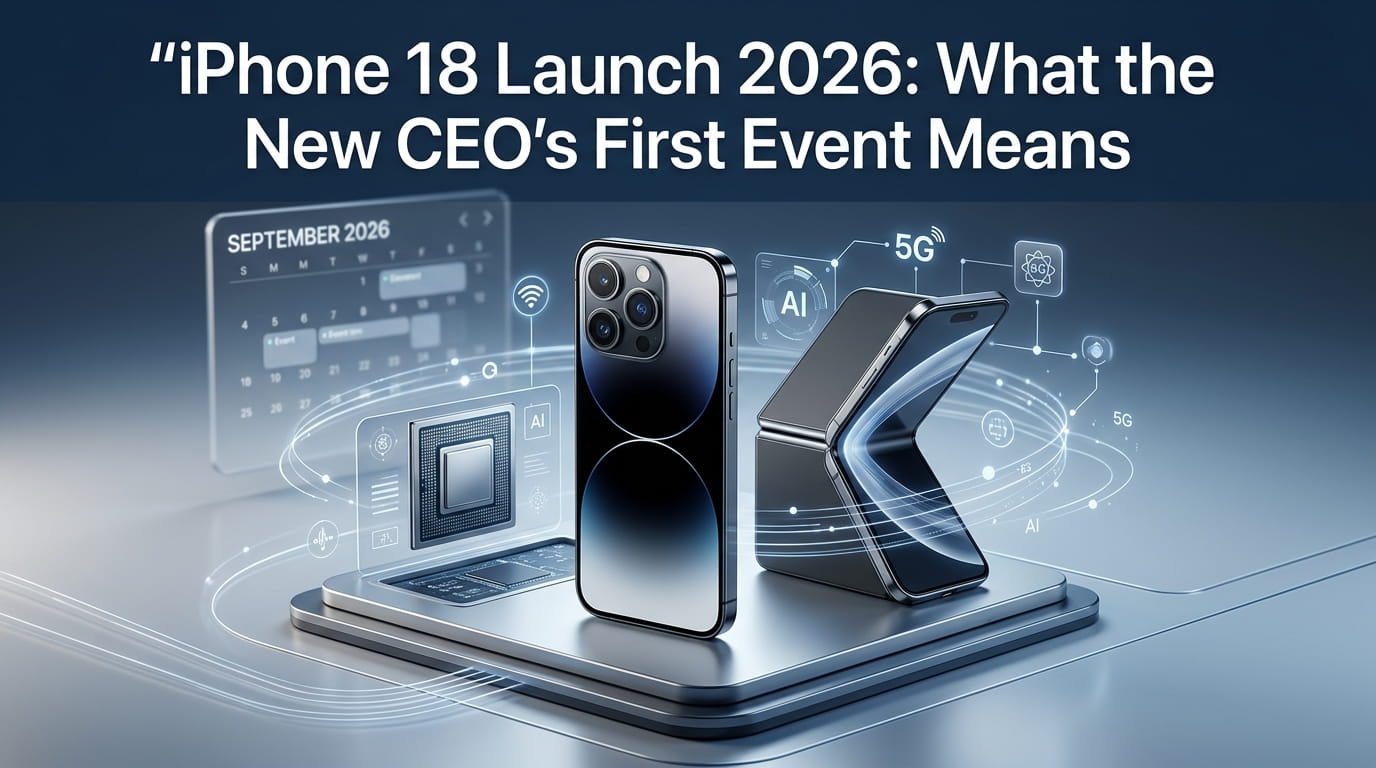
The iPhone 18 Launch 2026 is more than another annual iPhone upgrade. Apple’s September event arrives at a rare turning point: John Ternus has just taken over as CEO from Tim Cook, and his first major keynote comes with expectations of a new iPhone generation, premium Pro models, and potentially Apple’s long-awaited foldable iPhone.
Apple has officially scheduled its “Surprise and shine” event for September 9, 2026, at 10 a.m. Pacific Time. The company will stream the event through Apple’s website, Apple TV, and YouTube.
However, there is an important detail that could change how people understand the iPhone 18 Launch 2026. Current reports indicate that Apple may not release the standard iPhone 18 alongside the Pro models this September. Instead, Apple appears ready to shift its iPhone schedule, with premium models arriving first and lower-cost versions potentially following in 2027.
That makes this launch particularly important. Apple is not simply introducing new hardware. It is potentially changing how its most important product line reaches customers.
What the iPhone 18 Launch 2026 Could Actually Include
The first thing shoppers need to understand is that the iPhone 18 Launch 2026 may not mean the arrival of every iPhone 18 model at once.
Current reporting points toward a premium-focused September lineup consisting primarily of:
- iPhone 18 Pro
- iPhone 18 Pro Max
- Apple’s first foldable iPhone, potentially marketed under an “Ultra” name
- New Apple Watch models
- New AirPods or other accessories
- Software announcements connected to iOS 27 and Apple Intelligence
The standard iPhone 18, iPhone 18e and a second-generation iPhone Air are widely expected to move to a spring 2027 window instead. Apple has not publicly confirmed that entire product roadmap, so readers should treat the timing as reported rather than official.
This change matters because Apple has traditionally used September as the main stage for its broader iPhone lineup. A split schedule could allow the company to give its most expensive devices more attention while spreading other launches across the year.
For consumers, that means waiting could become more important than usual.
Someone shopping for a mainstream iPhone may not need to buy immediately after the September event. Meanwhile, customers who want Apple’s newest Pro technology may face a very different decision.
Why the iPhone 18 Launch 2026 Is a Major Test for John Ternus
John Ternus officially became Apple CEO on September 1, 2026, replacing Tim Cook, who moved into the role of executive chairman.
That timing creates an unusual situation.
Ternus does not have years to establish his leadership style before facing the world’s attention. His first major public product event arrives almost immediately, and the products on that stage could influence how investors, customers and employees view Apple’s next chapter.
Ternus is particularly interesting because his background differs from Cook’s.
Before becoming CEO, Ternus served as Apple’s hardware chief and worked on major product categories including the iPad, AirPods and other hardware initiatives. His career gives him deep experience with product development and engineering.
That does not automatically mean Apple will suddenly change direction.
Still, the iPhone 18 Launch 2026 gives Ternus an opportunity to communicate what he values most: hardware innovation, product quality, ecosystem integration, artificial intelligence, or some combination of all four.
What Ternus Needs to Prove
The new CEO faces several immediate questions.
Can Apple still create excitement around the iPhone?
Can Apple make artificial intelligence feel useful rather than experimental?
Can Apple enter the foldable market without simply copying competitors?
Can the company justify higher prices?
And perhaps most importantly, can Ternus convince consumers that Apple still has a long-term product vision?
Those questions will matter beyond one keynote.
The Foldable iPhone Could Become the Real Star
Although many people search for iPhone 18 Launch 2026 information expecting a conventional smartphone upgrade, the foldable iPhone could become the biggest story of the entire event.
Apple has watched Samsung, Google, Motorola and Huawei develop foldable smartphones for years. Rather than rushing into the category, Apple appears to have waited until the technology matured enough to meet its standards.
That strategy fits Apple’s historical approach.
The company rarely needs to be first. Instead, it often tries to enter a category with a product that feels more refined and tightly connected to its ecosystem.
Reports suggest Apple’s foldable device could use a book-style design. When closed, it would function like a conventional phone. When opened, it could provide a much larger internal display approaching small-tablet territory.
The exact specifications remain unconfirmed before the event.
However, the potential product could represent something more important than another iPhone model.
It could give Apple a completely new premium category.
Why Apple May Focus on Premium iPhones First
The premium focus behind the iPhone 18 Launch 2026 makes financial sense, especially in the current hardware environment.
Memory and storage costs have risen sharply as artificial intelligence infrastructure increases demand for advanced chips and memory components. At the same time, Apple faces broader supply-chain pressures.
Several reports therefore point to higher prices and a stronger emphasis on expensive devices.
A premium-first strategy gives Apple several potential advantages.
First, higher-priced products can generate more revenue per customer.
Second, a flagship launch creates more room for expensive new technology such as foldable displays, advanced camera systems and specialized components.
Third, delaying lower-cost models gives Apple another opportunity to generate attention later in the year.
That does not mean every iPhone will become dramatically more expensive. However, buyers should prepare for the possibility that the newest premium models will sit at higher price points than previous generations.
Will the Standard iPhone 18 Launch in September?
This is one of the biggest questions surrounding the iPhone 18 Launch 2026.
Based on current reporting, probably not.
Several outlets report that Apple may delay the standard iPhone 18 and other more affordable models until 2027. The strategy would separate Apple’s premium and mainstream iPhone launches rather than putting everything on the same September schedule.
If that happens, Apple’s September lineup could look very different from what consumers expect.
Instead of:
Standard iPhone + Pro + Pro Max + other models
Apple could focus September on:
Pro + Pro Max + Foldable + Wearables
Then, later, the company could introduce the more affordable models.
For shoppers, this creates a simple rule: do not assume that every product carrying the iPhone 18 name will arrive on the same day.
What to Expect From the iPhone 18 Pro
The iPhone 18 Launch 2026 is still expected to include major Pro models, even if the standard iPhone 18 waits.
The iPhone 18 Pro and Pro Max are widely expected to focus on refinement rather than a complete redesign. That means buyers should not necessarily expect the kind of dramatic physical change that a foldable iPhone would provide.
Instead, Apple could concentrate on several areas.
A More Powerful A-Series Chip
Apple’s next-generation chip is expected to improve performance and efficiency, although exact specifications should not be treated as confirmed until Apple announces them.
For everyday users, chip improvements matter less because of benchmark scores and more because of battery life, gaming performance, camera processing and on-device AI.
That last category has become especially important.
Apple now competes in a smartphone market where Google and Samsung increasingly use AI as a major selling point. Therefore, the processor inside the next Pro iPhone will likely play a central role in Apple’s broader AI strategy.
Camera Improvements Could Matter More Than Megapixels
The camera system remains one of the strongest reasons customers choose an iPhone Pro.
However, modern smartphone photography has moved beyond simple megapixel comparisons.
Image processing, computational photography, low-light performance, video stabilization, lens quality and AI-assisted editing increasingly determine the final result.
Therefore, a meaningful iPhone 18 Launch 2026 camera upgrade would not necessarily require Apple to dramatically increase every sensor’s resolution.
Instead, Apple could focus on better variable aperture technology, improved processing and more intelligent photography tools. Those features have appeared repeatedly in current reporting, although Apple has not confirmed the details.
Apple Intelligence Could Be More Important Than the Hardware
There is another reason the iPhone 18 Launch 2026 matters: Apple’s AI reputation.
Apple has faced criticism for moving more slowly than competitors in generative AI and AI assistants. The company has responded with Apple Intelligence improvements and planned Siri upgrades, but expectations remain high.
The next iPhone therefore needs to make AI feel practical.
Consumers do not necessarily want another chatbot buried inside their phone.
They want useful features such as:
- Better Siri conversations
- More reliable personal assistance
- Smarter notification management
- Improved photo editing
- Better writing assistance
- More useful on-device recommendations
- Context-aware actions
- Strong privacy controls
That last point could become one of Apple’s strongest differentiators.
Apple has repeatedly emphasized privacy as part of its AI approach. If Ternus can connect better AI with Apple’s privacy messaging, the company could create a clearer reason for customers to upgrade.
What the New CEO’s First Event Says About Apple’s Strategy
The most interesting part of the iPhone 18 Launch 2026 may not be a single specification.
It may be the overall product strategy.
Ternus inherits Apple at a complicated moment. The company remains enormously successful, but the smartphone market has matured. Meanwhile, AI has changed how consumers think about personal technology.
As a result, Apple needs to answer a bigger question:
What comes after the traditional smartphone upgrade cycle?
The foldable iPhone offers one possible answer.
AI offers another.
Wearables and spatial computing provide additional possibilities.
And a more carefully distributed product calendar could help Apple keep consumer attention throughout the year rather than concentrating everything around September.
Why Apple’s Foldable Strategy Could Be Different
Apple’s late entry into foldables could actually work in its favor.
Samsung and other manufacturers have already experienced several generations of foldable hardware. That gives Apple years of market feedback to study.
The company can observe:
- Hinge durability problems
- Screen-crease complaints
- Dust and water-resistance challenges
- High manufacturing costs
- Limited software optimization
- Customer concerns about weight
- Battery compromises
- Repairability issues
Apple’s challenge is therefore not simply to create a foldable phone.
It needs to make the device feel finished.
That distinction could determine whether the product becomes a successful new category or simply an expensive experiment.
How the iPhone 18 Launch 2026 Could Change Apple’s Product Calendar
A split iPhone schedule could have long-term consequences.
For years, Apple’s September event has effectively acted as the center of its consumer hardware calendar. Moving standard iPhones to a later window could create two major upgrade periods.
One could focus on premium technology.
The other could target mainstream customers.
That approach could also help Apple manage manufacturing capacity and supply constraints.
Furthermore, it could reduce the pressure to fit every major product into one September event.
For Apple, that is strategically valuable.
For consumers, however, it creates a more complicated buying calendar.
Should You Buy an iPhone 17 or Wait?
If you’re considering an iPhone purchase right now, the answer depends heavily on what you want.
Buy Now If:
- Your current phone has serious battery or hardware problems.
- You need a phone immediately.
- You can get a strong discount on an existing model.
- You do not care about foldable technology.
- You prefer proven hardware over first-generation products.
Wait for the iPhone 18 Launch 2026 If:
- You want the newest Pro model.
- You are interested in Apple’s foldable phone.
- You care about the latest Apple Intelligence features.
- You want the newest camera technology.
- You are comfortable paying a premium.
- You can wait until the September announcements clarify Apple’s roadmap.
However, waiting does not automatically mean buying.
A first-generation foldable iPhone could carry a high price, and early reviews may reveal compromises that specifications cannot show.
iPhone 18 Launch 2026: What Buyers Should Watch During the Keynote
Rather than focusing only on storage options and camera megapixels, watch for these signals.
1. Pricing
Price will tell you how aggressively Apple wants to position its premium products.
2. The foldable’s durability claims
Look closely at Apple’s discussion of the hinge, display and long-term reliability.
3. AI features
Pay attention to what Siri and Apple Intelligence can actually do, not just how many times Apple mentions AI.
4. Battery life
A more powerful processor means little if real-world battery life does not improve.
5. Software support
A foldable iPhone will need software that takes advantage of its larger display.
6. Product availability
The announcement date and actual shipping date may differ, especially for a brand-new product category.
7. The standard iPhone schedule
This could be one of the most important details for budget-conscious buyers.
iPhone 18 Launch 2026 vs Previous Apple Launches
| Area | Earlier iPhone launches | iPhone 18 Launch 2026 outlook |
|---|---|---|
| CEO | Tim Cook | John Ternus |
| Main focus | Broad iPhone lineup | Premium iPhones and possible foldable |
| Standard iPhone | Usually September | Potentially delayed to 2027 |
| Pro models | Major September products | Expected to remain central |
| Foldable | Not available | Potential first-generation model |
| AI | Increasingly important | Likely a major strategic focus |
| Pricing | Broad range | Potentially higher premium pricing |
| Product calendar | September-centered | Potentially split across the year |
The table highlights the bigger story: Apple may be changing not only the iPhone, but the way it launches the iPhone.
What the New CEO Must Get Right
John Ternus has a difficult balancing act.
He needs to preserve the qualities that made Apple successful while proving that the company can still introduce meaningful new technology.
The iPhone 18 Launch 2026 gives him a rare opportunity to establish that balance immediately.
The safest strategy would not be to chase every trend.
Instead, Apple needs to show why its products deserve their premium prices.
That means excellent hardware, useful software, strong privacy, reliable AI and an ecosystem that works together without unnecessary complexity.
The foldable iPhone could demonstrate Apple’s hardware ambitions.
Apple Intelligence could demonstrate its software ambitions.
The Pro models could demonstrate that the traditional iPhone still has room to evolve.
Together, those products could form a coherent story about Apple’s next decade.
What Could Go Wrong for Apple?
The launch also carries real risks.
High Prices
A premium foldable could push Apple’s pricing into territory that many consumers simply cannot justify.
First-Generation Hardware
Even Apple’s engineering resources cannot eliminate every risk associated with a brand-new form factor.
AI Expectations
Apple has little room for vague AI promises. Customers increasingly expect useful features that work immediately.
Upgrade Fatigue
If the iPhone 18 Pro looks too similar to its predecessor, customers may decide that their current iPhone remains good enough.
Supply Constraints
Memory and component shortages could increase production costs or limit availability.
Competitive Pressure
Samsung, Google and other manufacturers have already spent years improving foldable devices. Apple enters the category with a reputation to protect.
These risks explain why the iPhone 18 Launch 2026 is more significant than an ordinary annual upgrade.
The Bigger Meaning of Apple’s 2026 iPhone Strategy
The iPhone 18 Launch 2026 could represent the beginning of Apple’s transition from a smartphone-centered company toward a broader personal-technology ecosystem built around AI, advanced hardware and new computing formats.
The foldable iPhone would expand what the iPhone can physically become.
Apple Intelligence could change what the device can understand.
Wearables could move more computing away from the traditional smartphone screen.
Meanwhile, a split product calendar could allow Apple to introduce these technologies at different points throughout the year.
That combination could give Ternus more opportunities to define his leadership.
However, the first event still matters enormously because consumers will immediately compare his presentation and Apple’s products with the expectations created during the Cook era.
What the iPhone 18 Launch 2026 Means for Apple Fans
For existing iPhone owners, the most important takeaway is simple: do not judge the next generation only by the model number.
The bigger change may be Apple’s strategy.
A premium-first launch, a possible foldable, improved AI, new software capabilities and a new CEO create a much broader story than a routine processor upgrade.
If Apple delivers a polished foldable while improving AI and maintaining the quality customers expect, Ternus could begin his tenure with a powerful statement.
If the products feel expensive without offering meaningful advantages, the transition could look far less convincing.
That is why the September event deserves attention even from people who have no intention of buying an iPhone.
It will provide one of the clearest early signals of where Apple wants to go next.
Frequently Asked Questions About the iPhone 18 Launch 2026
When is the iPhone 18 Launch 2026?
Apple has officially scheduled its September 2026 event for September 9 at 10 a.m. PT. The event will be available through Apple’s official online channels, Apple TV and YouTube.
However, reports indicate that the standard iPhone 18 may not launch during this event. Apple is expected to focus on its Pro lineup and potentially its first foldable iPhone.
Will the standard iPhone 18 launch in September 2026?
Current reports suggest that Apple may delay the standard iPhone 18 until 2027. The company could also launch the iPhone 18e and second-generation iPhone Air during the same later window.
Apple has not publicly confirmed the complete 2027 schedule, so buyers should wait for official announcements.
Will Apple launch a foldable iPhone in 2026?
A foldable iPhone is widely expected to appear at the September 9 event, and Reuters reports that Apple is expected to unveil its first foldable device. However, Apple had not publicly confirmed the product’s existence before the event.
The device could use a book-style design and compete directly with premium foldable smartphones from Samsung and other manufacturers.
Who is Apple’s new CEO in 2026?
John Ternus became Apple’s CEO on September 1, 2026, succeeding Tim Cook. Cook moved into the role of executive chairman. Ternus previously served as Apple’s hardware chief and worked on several major Apple product categories.
The September 9 iPhone event therefore represents his first major product launch as CEO.
Should I buy an iPhone before the iPhone 18 Launch 2026?
If your current phone works well, waiting makes sense because Apple’s September event could significantly change the product lineup and pricing.
On the other hand, if you need a phone immediately, a discounted current-generation iPhone may offer better value than paying a premium for first-generation hardware.
Final Verdict: Why This iPhone Launch Matters
The iPhone 18 Launch 2026 is shaping up to be a leadership test, a product test and a strategy test at the same time.
John Ternus begins his CEO tenure during a period when Apple faces intense pressure from AI competitors, changing smartphone demand, supply-chain costs and the growing importance of foldable devices.
The September 9 event gives him an opportunity to answer those challenges through products rather than promises.
The most important announcement may ultimately be the foldable iPhone. Yet the bigger story will involve everything around it: pricing, Apple Intelligence, the Pro lineup, software, availability and the company’s new product calendar.
For consumers, the smartest approach is to wait for the official announcements before making a major purchase decision. For Apple watchers, meanwhile, this event could offer the clearest early indication of what the Ternus era will look like.
And that is what makes the iPhone 18 Launch 2026 worth watching: it is not simply the arrival of another iPhone generation. It could be the first real look at Apple’s next chapter.





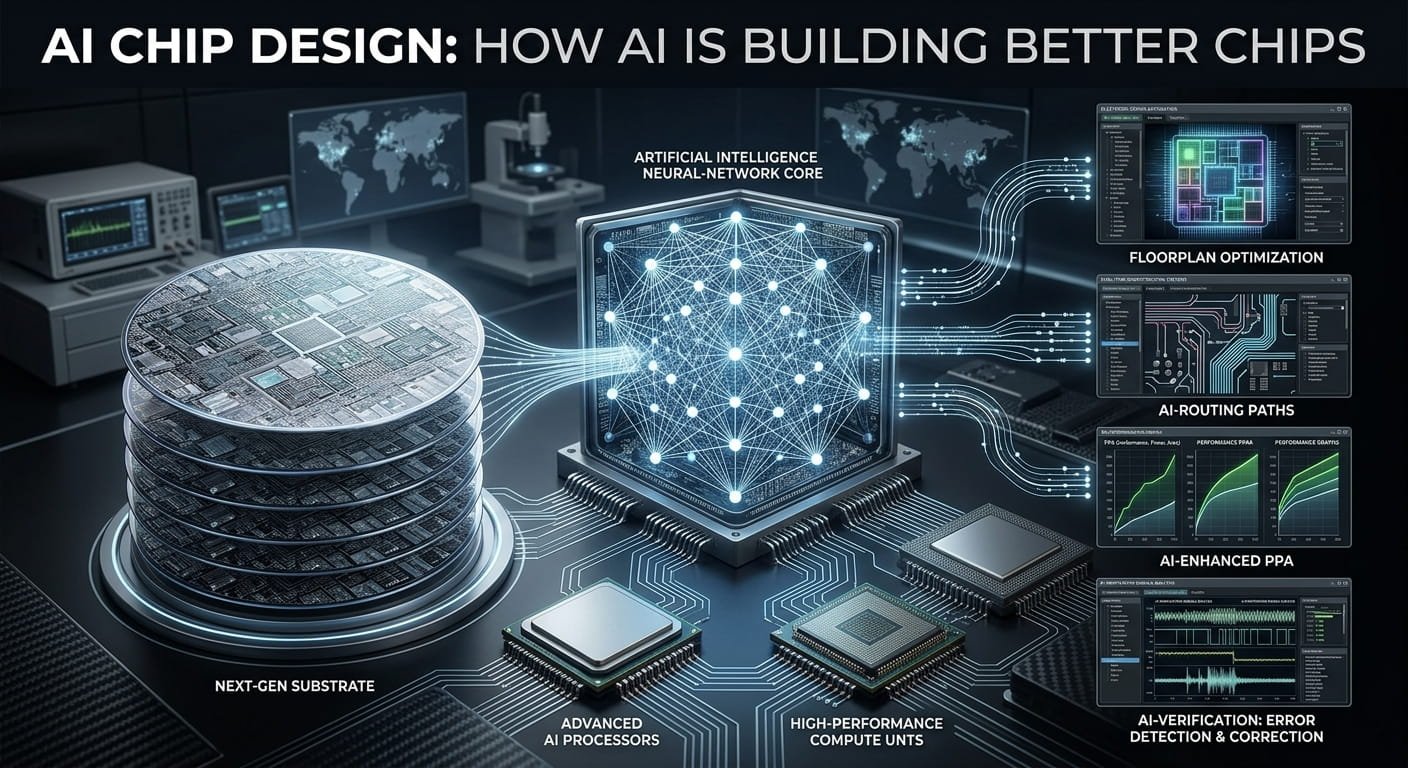
Artificial intelligence is changing much more than software. It is now helping engineers design the very chips that power AI systems, smartphones, data centers, automobiles, and other connected devices. This shift is making AI chip design one of the most important developments in modern semiconductor engineering.
For decades, chip designers relied heavily on human expertise, simulations, predefined rules, and electronic design automation (EDA) software. Those methods remain essential, but modern chips have become so complex that engineers increasingly need computational systems to explore design possibilities that would be impractical to test manually.
That is where AI enters the design process.
Companies and research teams are using machine learning, reinforcement learning, generative AI, and increasingly autonomous AI agents to explore chip layouts, optimize power and performance, assist verification, and accelerate parts of the semiconductor development cycle.
Google DeepMind’s AlphaChip provides one of the best-known examples. The system uses reinforcement learning to generate chip layouts and has been used across generations of Google’s Tensor Processing Units (TPUs). Google says AlphaChip can produce layouts in hours that previously required weeks or months of human effort.
However, the real story is bigger than one system.
AI chip design is becoming a broader approach to solving the enormous optimization problems inside modern electronic design automation.
What Is AI Chip Design and Why Does It Matter?
AI chip design means using artificial intelligence and machine learning techniques to assist, automate, optimize, or accelerate parts of the semiconductor design process.
The phrase can sound confusing because AI appears on both sides of the equation.
There are AI chips, such as GPUs, TPUs, and specialized accelerators, which run artificial intelligence workloads.
Then there is AI used to design chips.
These are related but different ideas.
In the second case, AI becomes part of the engineering workflow. It can search through thousands or millions of possible design choices and help identify combinations that satisfy competing requirements.
A chip designer may need to balance:
- Power consumption
- Performance
- Area
- Timing
- Heat
- Signal integrity
- Manufacturing constraints
- Reliability
- Cost
- Design complexity
Engineers commonly refer to the central trade-off as PPA: power, performance, and area.
Improving one metric can easily hurt another. A design that runs faster might consume more power. A smaller design might create routing difficulties. A lower-power architecture might sacrifice performance.
AI can help search this enormous design space more efficiently.
Synopsys describes AI-driven chip design as the use of reinforcement learning, generative AI, and AI agents across design, verification, and testing. The company notes that the number of possible design parameters can become too large for engineers to explore exhaustively within practical time limits.
That is the fundamental reason the technology matters.
How AI Chip Design Is Changing Traditional Semiconductor Engineering
Traditional semiconductor development involves many stages.
A simplified process looks like this:
Architecture → RTL design → logic synthesis → floorplanning → placement → routing → verification → physical signoff → manufacturing
Each stage involves specialized tools and engineering decisions.
AI does not necessarily replace this pipeline. Instead, it can operate inside it.
For example, an AI system might evaluate different floorplans and determine which arrangement produces better timing or lower wire length.
Another system might analyze verification results and identify patterns that deserve attention.
A generative AI assistant could help an engineer understand design documentation, generate code suggestions, or interact with EDA tools.
This creates a more important change than simple automation.
Instead of engineers manually testing every possible configuration, AI can search, rank, predict, and optimize potential solutions.
That allows human engineers to spend more time on architecture, trade-offs, validation, and decisions that require broader technical judgment.
1. AI Chip Design Can Optimize Chip Floorplanning
One of the clearest applications of AI chip design is floorplanning.
Floorplanning determines where major functional blocks sit on a chip.
Imagine trying to arrange hundreds of interconnected components on a tiny surface while keeping thousands of constraints under control. Moving one block can affect routing, timing, power, and neighboring components.
This is not a simple puzzle.
It is a massive optimization problem.
Google’s AlphaChip approaches chip floorplanning as a reinforcement-learning problem. The system places components on a grid and receives feedback based on the quality of the resulting layout. Over repeated training, it learns which placement strategies produce better results.
Google reports that AlphaChip has generated layouts for multiple generations of TPUs and has also been applied beyond AI accelerators, including Google’s Axion processors.
The important lesson is not that AI magically designs an entire chip without engineers.
Rather, AI can explore complicated placement decisions at a scale that would be difficult to reproduce manually.
Why better floorplanning matters
A better layout can influence:
- Wire length
- Signal timing
- Power consumption
- Routing congestion
- Chip area
- Thermal behavior
- Overall performance
Therefore, improving floorplanning can affect the final characteristics of the chip itself.
2. AI Chip Design Can Improve Power, Performance, and Area
PPA optimization sits at the heart of modern semiconductor engineering.
Design teams constantly search for better combinations of performance, power consumption, and physical area.
The problem is that the number of possible combinations can become enormous.
AI can help by learning from previous experiments and prioritizing promising configurations.
Synopsys describes design-space optimization as a generative optimization approach in which reinforcement learning can search large design spaces and help engineers reach PPA targets faster.
Cadence has taken a similar direction. Its Cerebrus Intelligent Chip Explorer uses reinforcement learning to optimize multiple steps in a digital design flow and target PPA improvements. Cadence says the system can scale through cloud computing and help designers handle the complexity of advanced nodes.
This matters because semiconductor development increasingly involves sophisticated architectures and smaller process nodes.
At advanced nodes, tiny changes can have meaningful consequences.
AI can therefore serve as a search engine for engineering decisions.
Instead of asking an engineer to test every possible configuration, the system can prioritize combinations that appear promising.
3. AI Chip Design Can Accelerate Verification
Designing a chip is only half the challenge.
Engineers must also prove that the design behaves correctly.
Verification can consume enormous amounts of engineering time because modern processors contain huge numbers of interacting components.
A tiny hardware error can become extremely expensive if engineers discover it after manufacturing.
That makes verification one of the most important areas for AI-assisted engineering.
AI systems can help analyze test results, prioritize verification tasks, identify unusual behavior, generate test scenarios, and summarize failures.
The technology becomes especially valuable when teams need to repeat simulations across many configurations.
Cadence announced in 2026 that its agentic AI capabilities could automate dynamic simulations and verification workflows. The company reported that NVIDIA engineers using the system could achieve substantially faster RTL validation cycles in its described workflow.
The broader trend is clear.
AI is moving from simply assisting engineers toward orchestrating portions of the verification process.
That does not remove the need for verification engineers. Instead, it can allow them to investigate higher-value problems while automated systems handle repetitive analysis.
4. AI Chip Design Can Help Engineers Explore More Possibilities
Human engineers have an obvious limitation: time.
Even an exceptionally skilled designer cannot test every possible architecture, parameter combination, placement strategy, and optimization path.
AI changes that equation.
A machine-learning system can run large numbers of experiments, compare results, learn from previous outcomes, and focus future searches on promising areas.
This approach is particularly useful for design-space exploration.
Consider a chip with dozens of configurable parameters.
If each parameter has several possible values, the number of combinations can quickly become enormous.
Testing every combination may be unrealistic.
Instead, an AI optimization system can search selectively.
It can ask:
Which experiment should we run next?
That question is surprisingly powerful.
The best AI-assisted engineering systems do not simply generate random alternatives. They use feedback to make the next experiment more informative.
As a result, engineers can potentially reach useful designs with fewer wasted iterations.
5. AI Chip Design Is Expanding Into Generative AI and Engineering Copilots
Reinforcement learning is not the only AI technique entering semiconductor workflows.
Generative AI is also becoming useful.
Large language models can help engineers interact with technical documentation, understand error messages, generate code suggestions, summarize results, and navigate complex design information.
Synopsys has expanded its AI capabilities to include generative AI and copilot-style tools for semiconductor engineering workflows. The company has described applications intended to accelerate tasks that previously took days or hours.
However, engineers must treat generative AI differently from traditional optimization algorithms.
A language model can produce plausible-looking technical output that contains errors.
That makes verification essential.
For example, an AI assistant might suggest RTL code that appears reasonable but fails under certain conditions.
Therefore, generative AI works best as an engineering copilot, not as an unquestioned authority.
The engineer remains responsible for checking the result.
6. AI Chip Design Is Moving Toward Autonomous Engineering Agents
The next major development involves AI agents.
An ordinary AI assistant might answer a question.
An AI agent can potentially perform a sequence of actions.
In semiconductor engineering, that could mean:
- Reading a design specification.
- Creating or modifying RTL.
- Running simulations.
- Reviewing errors.
- Adjusting the design.
- Running another test.
- Checking timing or physical constraints.
- Reporting the results.
This creates a fundamentally different workflow.
Instead of AI helping with one isolated task, an agent can coordinate multiple steps.
Cadence announced an agentic AI design system in 2026 aimed at autonomous semiconductor development workflows, including simulation and verification.
Meanwhile, IEEE Spectrum reported on an agentic AI system that was used to generate a RISC-V CPU core from a specification, illustrating how quickly autonomous approaches are moving toward broader portions of the design process.
Still, autonomy does not eliminate engineering risk.
An agent with access to more tools also has more opportunities to make mistakes.
That is why future AI engineering environments will need strong:
- Access controls
- Verification systems
- Audit trails
- Human approval checkpoints
- Simulation gates
- Security policies
- Reproducibility requirements
The objective should not be maximum autonomy.
It should be safe and measurable autonomy.
7. AI Chip Design Can Help With Advanced and Specialized Chips
Modern computing increasingly depends on specialized hardware.
General-purpose processors remain important, but companies now build specialized accelerators for AI inference, networking, graphics, signal processing, automotive applications, and other workloads.
That specialization increases design complexity.
AI can help engineers explore hardware architectures tailored to specific workloads.
This becomes especially important as AI models evolve.
Today’s AI workloads are not identical to tomorrow’s workloads. Training, inference, reasoning, multimodal processing, and edge AI can impose very different requirements on hardware.
Imec has highlighted the need for new compute architectures and semiconductor technologies as AI workloads become more demanding, particularly around density, power, memory, and system flexibility.
Therefore, AI chip design is not only about making existing chips faster.
It can help engineers explore what the next generation of specialized computing hardware should look like.
AI Chip Design vs Traditional Chip Design
AI does not completely replace conventional semiconductor engineering.
Instead, the two approaches increasingly work together.
| Area | Traditional Approach | AI-Assisted Approach |
|---|---|---|
| Floorplanning | Engineer-driven exploration | AI searches and ranks layouts |
| PPA optimization | Manual iteration and heuristics | Machine-learning optimization |
| Verification | Large manual test planning | AI-assisted test analysis |
| Design exploration | Limited by engineering time | Large-scale automated search |
| Documentation | Manual research | AI-assisted retrieval and summarization |
| RTL assistance | Human-written code | AI-generated suggestions with verification |
| Workflow automation | Script-based automation | Increasingly agentic automation |
| Final decisions | Engineering judgment | AI recommendations plus human reviewAI Chip Design, AI chip design 2026, artificial intelligence chip design, AI semiconductor design, AI chip technology, semiconductor design, chip design, AI hardware, semiconductor technology, AI chips, machine learning chip design, chip manufacturing, EDA software, electronic design automation, AI chip optimization, chip floorplanning, chip verification, PPA optimization, AI hardware design, semiconductor engineering, AI agents, generative AI, reinforcement learning, advanced chips, semiconductor industry, AI infrastructure, future of chip design |
The distinction matters.
AI is most useful when it augments engineering expertise.
The best semiconductor teams will likely combine domain knowledge with AI-driven exploration rather than choosing one over the other.
Why AI Is Particularly Useful for Chip Design
AI is well suited to chip design because the field contains many optimization problems.
There are often multiple acceptable solutions, but some solutions are substantially better than others.
That creates a natural environment for machine learning.
A simplified AI optimization loop looks like this:
Design → simulate → measure → learn → modify → simulate again
The system can repeat this cycle many times.
Humans remain important because they define objectives, constraints, acceptable trade-offs, and engineering requirements.
AI then helps search the space.
This division of responsibilities can be powerful.
Human engineers provide:
- System requirements
- Architectural judgment
- Constraints
- Safety requirements
- Business objectives
- Verification standards
- Final approval
AI systems can provide:
- Large-scale exploration
- Pattern recognition
- Optimization
- Automated iteration
- Result classification
- Predictive recommendations
- Workflow assistance
That partnership is one of the strongest reasons AI chip design is gaining attention.
What Are the Biggest Benefits of AI Chip Design?
Companies are interested in AI-assisted semiconductor development because it can potentially improve several important business and engineering outcomes.
Faster development
AI can automate repetitive experiments and reduce the time required to explore alternatives.
Better optimization
Machine-learning systems can examine large design spaces and identify combinations engineers might not test manually.
Higher engineering productivity
Engineers can spend less time on repetitive analysis and more time on architecture and problem-solving.
Potentially better PPA
AI optimization can target power, performance, and area simultaneously.
More design exploration
Teams can test more alternatives within a fixed development schedule.
Shorter feedback cycles
Automated simulation and analysis can provide results faster.
Support for complex chips
As chip architectures become more complicated, AI can help manage growing design-space complexity.
These benefits explain why major EDA companies and semiconductor organizations continue investing in AI-powered design tools.
What Are the Risks and Limitations of AI Chip Design?
The technology is promising, but it is not magic.
Several limitations remain important.
AI can produce incorrect results
An optimization system may identify a design that looks strong under one metric but fails another constraint.
Generative AI can also produce technically incorrect code or explanations.
Verification remains essential
A chip cannot be trusted simply because an AI system generated it.
Every important result still requires rigorous validation.
Proprietary data creates challenges
Leading chip companies often rely on confidential design databases.
Synopsys notes that public-data-trained LLMs are generally not sufficient by themselves for leading-edge chip design because companies depend heavily on proprietary information.
Infrastructure can be expensive
Large AI-driven optimization workloads may require substantial compute resources.
Explainability matters
Engineers may need to understand why a system selected a particular solution, especially when the result affects reliability or manufacturing.
Integration takes work
AI tools must work with existing EDA software, engineering databases, simulation systems, and organizational processes.
Therefore, companies should view AI as an engineering capability rather than a plug-and-play shortcut.
How Companies Can Adopt AI Chip Design More Effectively
A semiconductor company does not need to automate its entire design flow immediately.
A controlled approach makes more sense.
1. Start with a measurable bottleneck
Find a process that consumes substantial engineering time.
Floorplanning, verification analysis, regression management, or design-space exploration may provide useful starting points.
2. Define the objective
Do not simply ask for “better AI.”
Define what better means.
It might mean:
- Lower power
- Higher performance
- Smaller area
- Faster verification
- Fewer design iterations
- Shorter development time
3. Build reliable feedback loops
AI optimization depends heavily on evaluation.
If the system cannot accurately measure whether a design is good, it cannot reliably learn what to do next.
4. Keep engineers involved
Use human review for important decisions.
5. Protect proprietary information
Establish clear policies for what data AI systems can access.
6. Compare against existing workflows
An AI system should demonstrate measurable improvement over the current engineering process.
7. Scale only after validation
Once a pilot consistently produces useful results, integrate it into a broader workflow.
This approach reduces risk while allowing companies to capture practical benefits.
The Future of AI Chip Design
The long-term direction is becoming easier to see.
AI is moving deeper into the semiconductor stack.
Today, it can assist with specific optimization and engineering tasks.
Tomorrow, AI systems may coordinate increasingly large portions of the design workflow.
That does not necessarily mean that human chip designers disappear.
Instead, their responsibilities may shift.
Engineers could spend less time manually exploring low-level possibilities and more time defining architectures, constraints, system requirements, verification strategies, and higher-level trade-offs.
Google DeepMind says AlphaChip has already inspired research across additional stages of the chip-design flow, including logic synthesis, macro selection, and timing optimization.
Meanwhile, EDA companies are expanding AI from isolated optimization tasks toward integrated and agentic workflows.
That progression suggests an important future scenario:
AI may become a continuous optimization layer across the entire semiconductor development process.
Instead of using AI for one task, engineers could eventually work with systems that understand the relationships between architecture, RTL, physical design, verification, packaging, and manufacturing constraints.
That would represent a much deeper transformation than simply adding an AI assistant to an existing EDA tool.
AI Chip Design and the Race for Better AI Hardware
There is also a strategic reason this technology matters.
The AI industry is competing not only to build better models but also to build better hardware.
AI workloads require enormous amounts of computing power.
That creates pressure for chips that deliver more performance while controlling energy use, cost, and physical constraints.
Consequently, improving the chip-development process can create advantages throughout the technology stack.
- A company that designs a more efficient accelerator may reduce data-center energy requirements.
- A company that shortens its development cycle may bring new hardware to market faster.
- A company that can explore more architectures may discover designs competitors never considered.
This creates a feedback loop:
Better AI → greater demand for compute → more advanced chips → more sophisticated AI-assisted design → better hardware
That cycle could become increasingly important as AI workloads expand.
Frequently Asked Questions About AI Chip Design
1. What is AI chip design?
AI chip design refers to using artificial intelligence and machine-learning techniques to assist with semiconductor development. Applications can include floorplanning, placement, routing, PPA optimization, verification, design-space exploration, RTL assistance, and workflow automation.
2. How does AI improve chip design?
AI can explore large numbers of possible design configurations, identify patterns, optimize layouts, analyze simulation results, and automate repetitive engineering tasks. This can help engineers reach performance, power, and area targets more efficiently.
3. Can AI design a chip without human engineers?
AI systems are becoming increasingly capable, but fully autonomous chip development remains a developing area. Current systems can automate substantial portions of workflows, yet human engineers still provide requirements, constraints, validation, architectural judgment, and final oversight.
4. What is AlphaChip?
AlphaChip is Google’s reinforcement-learning approach to chip floorplanning. Google DeepMind says it has been used to generate layouts for multiple generations of Google’s TPU accelerators and has influenced broader research into AI-assisted chip design.
5. Will AI replace semiconductor engineers?
AI is more likely to change the responsibilities of semiconductor engineers than eliminate the profession entirely. Repetitive optimization and analysis can become increasingly automated, while human expertise remains important for architecture, system requirements, verification, trade-offs, safety, and final engineering decisions.
Conclusion: AI Is Becoming Part of the Chip Design Process
The semiconductor industry has reached a point where traditional engineering methods alone face enormous complexity.
Modern chips contain billions of transistors, intricate interconnections, demanding power requirements, and increasingly specialized architectures. Engineers need tools that can explore this complexity faster without sacrificing reliability.
That is why AI chip design matters.
AI can help optimize floorplans, explore PPA trade-offs, accelerate verification, search enormous design spaces, support engineers with generative AI, and coordinate increasingly complex workflows through AI agents.
However, the strongest results will not come from removing engineers from the process.
They will come from combining engineering expertise with machine-scale exploration.
Google’s AlphaChip demonstrates that reinforcement learning can tackle difficult physical-design problems. EDA companies such as Cadence and Synopsys are extending AI into broader design and verification workflows. Research is also moving toward AI-generated circuits, autonomous agents, and new approaches to analog and RF design.
The next generation of semiconductor engineering will therefore look different from the last.
The winning approach will not simply be “use more AI.”
It will be use AI where computation can explore what humans cannot practically explore alone, while keeping engineering judgment where it matters most.
That balance could help companies build chips that are faster, more efficient, more specialized, and potentially faster to develop.
And as AI itself demands increasingly capable hardware, the technology used to design those chips may become one of the most important competitive tools in the semiconductor industry.
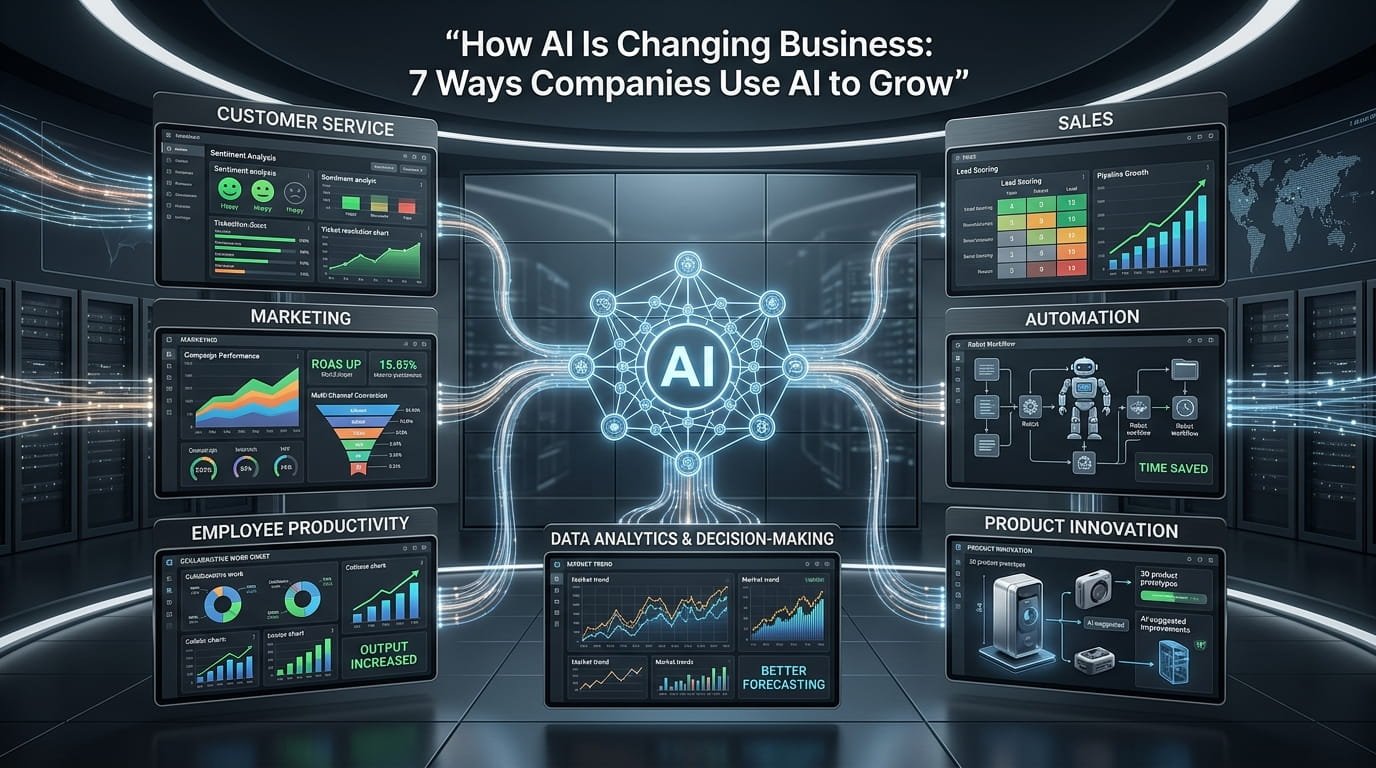
Artificial intelligence is no longer a technology that companies discuss only in innovation meetings. It is becoming part of everyday business operations, from answering customer questions and analyzing sales data to creating marketing campaigns and helping employees complete complex tasks.
That is why how AI is changing business has become an important question for companies of almost every size. The shift is not simply about replacing repetitive work with software. Businesses are increasingly using AI to make faster decisions, understand customers more deeply, develop products, reduce operational friction, and discover new sources of revenue.
Research supports that shift. McKinsey’s 2025 global survey found that 88% of respondents said their organizations regularly use AI in at least one business function, although most companies still have not scaled AI across the enterprise.
The more interesting question, therefore, is not whether businesses will use AI. It is where AI creates measurable value and how companies can deploy it responsibly.
This guide explains seven major ways AI is changing business, where companies are finding practical value, what the technology cannot solve by itself, and how organizations can build an AI strategy that supports sustainable growth.
How AI Is Changing Business: The Shift From Experiments to Everyday Work
Early business AI projects often focused on experimentation. A team might test a chatbot, generate a few marketing ideas, or use an AI assistant to summarize documents.
That approach is changing.
Companies increasingly connect AI with existing workflows, databases, customer systems, analytics platforms, and internal knowledge. Instead of treating AI as another standalone application, leading organizations are beginning to treat it as part of the operating model.
McKinsey’s 2025 research found that 23% of respondents said their organizations were scaling an agentic AI system somewhere in the enterprise, while another 39% were experimenting with AI agents.
At the same time, adoption does not automatically equal business success.
A company can have dozens of AI tools and still produce little measurable financial value. McKinsey reported that nearly two-thirds of surveyed organizations had not yet begun scaling AI across the enterprise.
The distinction matters:
- AI adoption means employees or teams use AI.
- AI integration means AI becomes part of business workflows.
- AI transformation means the company redesigns how work gets done around AI capabilities.
- AI-driven growth means the technology contributes to revenue, customer value, productivity, innovation, or competitive advantage.
The companies that benefit most are usually not the ones with the largest number of AI subscriptions. They are the ones that connect AI to important business problems.
1. How AI Is Changing Business Through Better Customer Service
Customer service is one of the clearest examples of how AI is changing business.
Customers expect quick answers, personalized support, and convenient communication. However, traditional support models can struggle when ticket volumes increase or customers need help outside normal business hours.
AI can handle a growing portion of that workload.
Businesses can use AI-powered customer service systems to:
- Answer frequently asked questions
- Summarize customer conversations
- Route support requests
- Identify urgent cases
- Recommend responses to human agents
- Search internal knowledge bases
- Translate customer messages
- Analyze customer sentiment
- Generate follow-up messages
- Provide support outside normal business hours
The important point is that AI does not always need to replace the human representative.
In many cases, the better model combines automation with human judgment. AI handles routine questions and gathers relevant information, while employees take over complicated, emotional, or high-risk cases.
McKinsey’s 2025 research identifies contact-center and customer-service automation among the common AI use cases businesses are pursuing.
Why this can support business growth
Better customer service can influence growth indirectly.
When customers receive faster answers, they may encounter fewer obstacles during the buying process. When support employees spend less time searching for information, they can devote more attention to difficult customer problems.
However, businesses should measure outcomes rather than simply counting automated conversations.
Useful metrics include:
- Customer satisfaction
- First-response time
- Resolution time
- Escalation rate
- Customer retention
- Support cost per interaction
- Conversion after support interactions
That measurement-first approach helps companies determine whether AI is actually improving the customer experience.
2. How AI Is Changing Business Through Smarter Marketing and Sales
Marketing has become another major area of AI adoption.
Businesses have more customer data than ever, yet collecting data is not the same as understanding it. AI can help marketing and sales teams analyze large amounts of information and turn it into practical recommendations.
For example, AI can help companies:
- Segment customers
- Analyze campaign performance
- Generate content ideas
- Personalize email campaigns
- Predict potential customer behavior
- Score leads
- Summarize sales calls
- Identify sales opportunities
- Create advertising variations
- Analyze customer feedback
Generative AI adds another layer because it can produce text, images, code, and other forms of content. McKinsey reported that marketing and sales remain among the business functions where organizations most frequently use generative AI.
Yet there is a major difference between producing more marketing content and producing better marketing outcomes.
A company could generate thousands of social posts and still fail to attract qualified customers.
A stronger strategy uses AI to improve the entire marketing process:
Customer data → audience insight → message → campaign → measurement → optimization
That creates a feedback loop.
For sales teams, AI can also reduce administrative work. A salesperson might spend less time summarizing meetings and updating records and more time talking with potential customers.
The best results therefore come when AI supports revenue-producing activities rather than simply increasing the amount of content employees produce.
3. How AI Is Changing Business by Improving Operations
Operations rarely receive the same attention as flashy AI applications, but they may offer some of the strongest opportunities for efficiency.
Companies operate through hundreds or thousands of interconnected processes. Procurement, inventory, logistics, scheduling, quality control, document processing, forecasting, and internal communication can all create delays.
AI can help identify patterns and automate parts of these processes.
For example, a retailer could use AI to forecast product demand. A manufacturer could analyze equipment data to identify potential maintenance problems. A logistics company could optimize routes based on changing conditions.
Other operational applications include:
- Demand forecasting
- Inventory optimization
- Supply-chain monitoring
- Predictive maintenance
- Fraud detection
- Document processing
- Workforce scheduling
- Quality inspection
- Delivery optimization
- Process monitoring
IBM similarly emphasizes practical AI use cases such as customer service, software development, supply-chain optimization, and employee assistance.
The bigger opportunity: workflow redesign
This is where how AI is changing business becomes more significant than simply adding automation.
Suppose an employee currently completes a process in eight steps.
AI may automate one step.
That is useful, but redesigning the workflow could eliminate unnecessary steps altogether.
McKinsey found that fundamental workflow redesign is strongly associated with organizations that achieve greater value from generative AI.
In other words, businesses should not ask only:
“Where can we add AI?”
They should also ask:
“If AI can handle part of this process, should we redesign the process itself?”
That question can reveal much larger opportunities.
4. How AI Is Changing Business by Increasing Employee Productivity
One of the most visible effects of AI is the way employees perform knowledge work.
Modern employees often spend significant amounts of time searching for information, writing routine documents, summarizing meetings, organizing data, preparing presentations, responding to messages, and completing administrative tasks.
AI assistants can help with many of these activities.
Employees can use AI to:
- Summarize long documents
- Draft emails
- Prepare meeting notes
- Analyze spreadsheets
- Generate reports
- Rewrite business communication
- Research internal information
- Create presentation outlines
- Write and review code
- Brainstorm solutions
- Translate content
- Extract information from documents
Microsoft’s Work Trend Index has highlighted the growing role of AI agents and human-agent collaboration as organizations reconsider how work gets distributed between people and software.
However, productivity should not mean simply making employees work faster.
A better definition is more valuable output per unit of time.
If AI helps an analyst finish a report in two hours instead of five, the company gains capacity. But the real advantage appears when that saved time moves toward higher-value activities such as strategic analysis, customer relationships, experimentation, or product development.
This is why employee training matters.
An organization that gives employees an AI tool without explaining verification, privacy, prompting, data handling, and appropriate use may create new risks instead of meaningful productivity.
5. How AI Is Changing Business Through Faster Decision-Making
Businesses make decisions constantly.
- Which products should receive more inventory?
- Which customers are most likely to leave?
- Which marketing campaign deserves additional budget?
- Which operational problem requires immediate attention?
- Which market should the company enter next?
AI can help decision-makers process these questions faster by analyzing patterns across large datasets.
Traditional analytics often tells a company what happened.
AI can go further by helping estimate what could happen next.
Depending on the system and data quality, companies can use predictive analytics and machine learning for:
- Demand forecasting
- Customer churn prediction
- Credit-risk assessment
- Fraud detection
- Sales forecasting
- Pricing analysis
- Financial planning
- Workforce planning
- Market analysis
- Operational forecasting
This does not mean AI should make every important decision independently.
High-impact decisions often require human oversight because historical data can contain bias, gaps, or unusual circumstances that a model cannot fully understand.
The strongest approach combines machine speed with human judgment.
AI identifies patterns.
People evaluate context.
Together, they can create better decisions than either approach alone.
6. How AI Is Changing Business Through Product and Service Innovation
AI is not only improving existing processes. It is also changing what businesses can build.
Companies can use AI during product research, design, testing, development, and customer feedback analysis.
For example, product teams can use AI to analyze thousands of customer comments and identify recurring complaints. Developers can use AI coding assistants to accelerate certain development tasks. Designers can use generative tools to explore concepts before investing heavily in production.
McKinsey’s research identifies product and service development as one of the major areas where organizations are using generative AI.
This creates an important distinction.
Efficiency-focused AI asks:
How can we perform the existing process faster?
Innovation-focused AI asks:
What could we build or offer that was previously difficult, expensive, or impossible?
The second question may create greater long-term competitive value.
A company that only uses AI to reduce administrative costs can improve margins. A company that uses AI to create a fundamentally better product can potentially create an entirely new revenue stream.
AI can shorten the experimentation cycle
Product innovation often requires repeated testing.
Idea → prototype → feedback → revision → testing → launch.
AI can accelerate several stages of that cycle.
As a result, businesses may be able to test more ideas without committing the same amount of time and resources to every experiment.
That does not guarantee successful innovation. In fact, easier experimentation can create more bad ideas alongside good ones.
The advantage comes from learning faster.
7. How AI Is Changing Business Through Automation and AI Agents
The next stage of business AI goes beyond generating answers.
AI agents are designed to perform sequences of tasks, interact with software, retrieve information, and execute actions according to defined objectives and permissions.
That makes agents particularly interesting for business workflows.
Imagine a sales process in which an AI system can:
- Identify a qualified lead.
- Research the company.
- Summarize relevant information.
- Prepare a personalized message.
- Add the lead to a CRM.
- Schedule a follow-up.
- Notify a salesperson when human intervention is required.
That is fundamentally different from asking a chatbot to write an email.
The agent participates in the workflow.
McKinsey’s 2025 research found that 62% of respondents said their organizations were at least experimenting with AI agents, while 23% reported scaling an agentic system somewhere in the enterprise.
Microsoft research also points toward increased human-agent collaboration, but emphasizes that organizations need the right foundations, including workflow mapping, unified data, and governance.
Why businesses should be careful with agents
More autonomy creates more potential value, but it also creates more potential failure points.
An agent that can access company systems can potentially make mistakes at scale.
Therefore, companies should define:
- What an agent can access
- What actions require approval
- What data it can use
- When it must escalate to a human
- How actions are logged
- How errors are detected
- How performance is evaluated
The goal is not maximum autonomy.
The goal is appropriate autonomy.
How AI Is Changing Business Across Different Company Sizes
AI adoption does not look identical for every organization.
A multinational company may have dedicated data scientists, AI engineers, legal teams, cloud infrastructure, and large proprietary datasets.
A small business may have only a few employees and a limited technology budget.
Nevertheless, the underlying principles remain similar.
| Business Type | Practical AI Opportunities | Primary Goal |
|---|---|---|
| Small business | Customer support, content, bookkeeping assistance, lead management | Save time and increase capacity |
| E-commerce company | Recommendations, customer service, demand forecasting | Increase conversion and retention |
| Marketing agency | Research, reporting, content workflows, analytics | Improve productivity |
| SaaS company | Product development, support, coding assistance | Accelerate product growth |
| Manufacturer | Predictive maintenance, quality control, forecasting | Reduce operational waste |
| Large enterprise | Agents, predictive analytics, knowledge systems, automation | Transform workflows at scale |
The important lesson is simple: AI strategy should match the company’s actual constraints.
A small company does not need to copy the AI architecture of a global corporation.
Instead, it should identify one high-value process where better information, automation, or prediction can produce measurable results.
What Companies Get Wrong About AI
Understanding how AI is changing business also requires understanding what can go wrong.
AI is powerful, but it is not automatically accurate, secure, unbiased, or profitable.
1. Buying tools before defining the problem
A company may purchase several AI products because competitors use them.
That reverses the proper order.
Start with the business problem. Then determine whether AI is actually the right solution.
2. Measuring activity instead of outcomes
The number of AI-generated documents is not a meaningful business metric by itself.
Companies should track results such as:
- Revenue
- Conversion rate
- Cost per transaction
- Resolution time
- Customer retention
- Employee productivity
- Error rates
- Profit margin
3. Ignoring data quality
AI cannot compensate indefinitely for poor data.
Incomplete customer records, inconsistent databases, outdated information, and disconnected systems can undermine otherwise sophisticated AI applications.
4. Removing human oversight too quickly
Some processes require judgment, empathy, accountability, or regulatory oversight.
AI should not automatically control high-impact decisions simply because it can technically perform them.
5. Treating AI as an IT project
AI transformation affects employees, workflows, management, security, finance, legal teams, and customers.
It therefore requires cross-functional leadership.
McKinsey’s research suggests that organizations achieving greater value from AI tend to make organizational and workflow changes rather than treating AI as a collection of isolated experiments.
A Practical AI Growth Framework for Businesses
Companies do not need to transform everything at once.
A more realistic approach is to move through several stages.
Step 1: Find repetitive or high-friction work
Look for processes that consume significant employee time or create frequent delays.
Step 2: Estimate the potential value
Ask:
- How much time could this save?
- Could it increase revenue?
- Could it reduce errors?
- Could it improve customer satisfaction?
- Could it improve decision quality?
Step 3: Select one measurable use case
Do not begin with ten unrelated experiments.
Choose one process where the outcome can be measured.
Step 4: Establish data and security requirements
Determine what information the AI system needs and whether that information contains confidential, personal, financial, or regulated data.
Step 5: Keep humans involved where necessary
Define approval points before deployment.
Step 6: Measure before scaling
Compare performance against the old process.
If AI improves the result, expand the implementation.
If it does not, determine why before spending more money.
Step 7: Redesign the workflow
Once the technology proves useful, rethink the entire process instead of simply inserting AI into the old workflow.
This final step is often where the largest gains appear.
The Future of How AI Is Changing Business
The next phase of business AI will likely involve deeper integration rather than simply more AI applications.
Companies are moving from individual assistants toward interconnected systems that can retrieve information, reason over business data, coordinate tasks, and interact with enterprise software.
At the same time, AI infrastructure and investment continue to expand. Stanford’s 2026 AI Index reports that organizational AI adoption reached 88% in its surveyed data for 2025, while generative AI was used in at least one business function at 70% of organizations. It also notes that AI agent deployment remained relatively early across individual business functions.
That combination tells us something important.
AI adoption is moving quickly, but business transformation is harder.
The companies that gain a lasting advantage may not simply be those that adopt AI first. Instead, they may be those that learn how to redesign operations, manage AI risk, train employees, connect proprietary data, and continuously measure business outcomes.
In other words, the competitive advantage may shift from having AI to knowing how to use AI better than competitors.
How AI Is Changing Business: The Bottom Line
The seven changes discussed here show why how AI is changing business is a much bigger question than automation alone.
AI can improve customer service, strengthen marketing and sales, streamline operations, increase employee productivity, support faster decisions, accelerate product innovation, and enable increasingly sophisticated AI agents.
However, technology alone does not create business growth.
The real value appears when companies connect AI to meaningful problems and redesign workflows around measurable outcomes.
Research from McKinsey reinforces this point: AI adoption is widespread, but many organizations are still struggling to scale it and capture enterprise-level financial impact.
That creates an opportunity for businesses of every size.
A company does not need to automate everything tomorrow. It needs to identify where better prediction, faster execution, stronger customer understanding, or smarter decision-making could create a genuine advantage.
Start with one valuable workflow.
Measure the result.
Improve the process.
Then scale what works.
That is the practical path to turning AI from an interesting technology into a genuine engine for business growth.
Frequently Asked Questions
1. How is AI changing business today?
AI is changing business by automating repetitive tasks, improving customer service, supporting marketing and sales, analyzing large datasets, helping employees work more efficiently, improving forecasting, accelerating product development, and enabling AI agents to perform multi-step workflows. However, adoption alone does not guarantee financial results. Companies need to connect AI projects to measurable business objectives.
2. What are the biggest ways companies use AI to grow?
The most important applications include customer-service automation, personalized marketing, sales assistance, operational optimization, employee productivity, predictive analytics, product development, and AI-powered workflow automation. The best opportunity depends on the company’s industry, data, customers, and existing processes.
3. Can small businesses benefit from AI?
Yes. Small businesses can use AI without building complex enterprise systems. Customer support, content creation, lead management, document processing, scheduling, data analysis, and administrative assistance can provide practical starting points. Small companies should focus on affordable tools that solve specific problems rather than adopting AI simply because it is popular.
4. Will AI replace employees?
AI will automate some tasks, but the effect on individual jobs will vary considerably by occupation and industry. Many businesses are using AI to augment employees rather than eliminate entire roles. The more useful question is often which parts of a job AI can handle and which activities still require human judgment, creativity, relationships, accountability, or domain expertise.
5. What is the biggest mistake companies make when adopting AI?
One of the biggest mistakes is adopting AI before identifying a clear business problem. Companies can spend heavily on tools without generating meaningful value. A stronger approach starts with a measurable objective, evaluates data and security requirements, tests one use case, measures the outcome, and then scales successful workflows.
6. What is the future of AI in business?
The future is likely to involve deeper integration of AI into everyday workflows, including AI assistants, predictive systems, automated processes, and increasingly capable AI agents. However, businesses will also need stronger governance, cybersecurity, data management, employee training, and human oversight as AI becomes more autonomous.
7. How can a company start using AI effectively?
Start by identifying a repetitive, expensive, slow, or data-heavy business process. Estimate its potential value, choose an AI application that directly addresses the problem, establish security and human-review requirements, and define measurable success metrics. Once the pilot produces reliable results, redesign the workflow and expand it gradually.

Apple’s Foldable iPhone is finally expected to become real after years of speculation. Apple has confirmed a September 9, 2026 launch event, and the latest reporting indicates that its first foldable could take center stage alongside the iPhone 18 Pro and iPhone 18 Pro Max.
This is not simply another yearly iPhone upgrade.
Apple appears to be entering a category that Samsung, Google, Huawei, Xiaomi and other manufacturers have already explored for years. However, Apple seems determined to approach the category differently, with a focus on thinness, hinge engineering, display quality and the overall software experience.
The rumored device could open like a book, turning a conventional smartphone into a much larger screen. Reports point to an outer display of roughly 5.5 inches and an inner screen around 7.7 to 7.8 inches.
The price, however, could make the biggest headlines.
Current estimates generally place the starting price around $2,000 or higher, while some analysts expect configurations to reach well beyond $2,300. Reuters reports that the device is expected to cost more than $2,500 according to some market expectations.
So, is Apple’s first foldable worth that kind of money?
Here is everything you need to know before Apple officially reveals it.
When Will Apple’s Foldable iPhone Launch?
Apple has officially scheduled its next major iPhone event for September 9, 2026. The event will take place at Apple Park, and Apple is expected to unveil its next-generation iPhone lineup.
Multiple reports now point to the foldable iPhone appearing at that event.
MacRumors expects the foldable to form part of Apple’s fall 2026 iPhone lineup, while Macworld reports that the device is expected alongside the iPhone 18 Pro and Pro Max.
That timing is important because Apple reportedly plans a different release schedule for its lower-cost iPhones.
Instead of launching every new iPhone model simultaneously, reports suggest Apple could reserve the September event for its premium models and introduce the standard iPhone 18 and other lower-tier devices later.
For consumers, that means Apple’s September event could feel more premium than usual.
Expected Apple foldable launch timeline
| Event | Expected timing |
|---|---|
| Apple announcement | September 9, 2026 |
| Foldable iPhone unveiling | September 9 |
| Preorders | Expected shortly after announcement |
| Retail availability | Potentially later in September |
| Initial supply | Expected to be limited |
| Standard iPhone 18 models | Reportedly delayed until spring 2027 |
Apple has not yet confirmed the preorder or retail dates, so those details should remain treated as expectations rather than official information.
What Will Apple’s Foldable iPhone Be Called?
The final name remains one of the last major mysteries.
For years, people have casually called it the iPhone Fold. That name is useful for describing the product, but it may not be Apple’s actual branding.
Current reporting increasingly points toward iPhone Ultra.
Macworld says iPhone Ultra has become the more credible name among current reports, while MacRumors continues to use “iPhone Fold” as a descriptive name.
Apple could still surprise everyone.
Other names have appeared in rumors over the years, including iPhone Fold, iPhone Duo and iPhone Passport.
The name matters less than Apple’s positioning.
If Apple calls it an Ultra product, the branding would immediately place it above the regular iPhone and potentially above the Pro Max in terms of prestige and price.
That would make sense for a device expected to cost around twice as much as a conventional premium iPhone.
How Will Apple’s Foldable iPhone Fold?
The biggest design difference is straightforward.
It is expected to use a book-style folding design.
When closed, the device would function like a conventional smartphone. When opened, the internal display would expand into something closer to a small tablet.
Current reports put the inner screen at roughly 7.7 to 7.8 inches, while the external display could measure approximately 5.3 to 5.5 inches.
That gives Apple a very different product proposition.
You would not simply get a bigger iPhone.
You would get two experiences in one device.
The outside screen would handle quick tasks such as:
- Calls
- Messages
- Maps
- Notifications
- Social media
- Quick searches
- Music controls
Then, when you need more space, you could open the phone for:
- Multitasking
- Video
- Web browsing
- Document work
- Photo editing
- Gaming
- Reading
That is the core reason foldables exist.
They turn pocket size into a larger workspace.
Why Apple’s Foldable iPhone Could Look Different From Samsung’s Foldables
Apple is entering the market late.
That is not necessarily a disadvantage.
Samsung has already spent years refining its Galaxy Z Fold design. Google, Huawei, Xiaomi and other manufacturers have also experimented with different hinge systems and display formats.
Apple therefore has the benefit of watching the category mature before committing to its own design.
Current reports suggest Apple is concentrating heavily on thinness and crease reduction. MacRumors says the device could be around 4.5mm thick when unfolded, although other estimates vary.
That would be extremely thin.
For context, Apple’s iPhone Air currently holds the company’s thinnest iPhone distinction at around 5.6mm, according to Apple’s product information.
A foldable that becomes thinner than that when open would demonstrate just how aggressively Apple has approached miniaturization.
However, thinness creates trade-offs.
A thinner body leaves less room for:
- Battery cells
- Cameras
- Cooling hardware
- Speakers
- Structural reinforcement
- Hinge components
So the real achievement will not be making the phone thin.
The real achievement will be making it thin without making it fragile or frustrating.
Will Apple’s Foldable iPhone Have a Visible Screen Crease?
This could become one of Apple’s biggest selling points.
Foldable OLED displays naturally face mechanical stress because the screen repeatedly bends around the hinge.
That can create a visible crease.
Apple reportedly wants the crease to be far less noticeable than what consumers have come to expect from some competing foldables. MacRumors reports that Apple has invested heavily in hinge and display technology to minimize the crease.
Reports have also discussed specialized support structures and advanced materials designed to distribute stress across the folding area.
Macworld reports that Apple has explored technologies involving metal support plates, variable-thickness glass and specialized adhesive approaches.
That would be important for one simple reason.
A foldable is still a display first.
If the crease is distracting every time you read, watch a video or browse the web, the novelty quickly disappears.
Apple’s challenge is therefore not merely creating a screen that folds.
It needs to create a screen that feels normal when you use it.
How Big Will the Foldable iPhone Display Be?
The current consensus points toward two displays.
The outer screen could measure approximately 5.5 inches, while the internal folding display could approach 7.8 inches.
The internal panel is expected to use a relatively wide aspect ratio, with reports pointing toward something close to 4:3.
That choice could be particularly important for productivity.
A wide internal display makes more sense for:
- Two-column layouts
- Documents
- Web pages
- Photos
- Video calls
- Multitasking
It also gives the phone a more tablet-like personality.
That is probably intentional.
Apple is not simply trying to make a large phone. It appears to be creating a device that can bridge the gap between the iPhone and iPad.
Will Apple’s Foldable iPhone Support Multitasking?
Software could ultimately determine whether the foldable succeeds.
A large internal display creates space for multiple apps, sidebars and larger controls. Current reports suggest Apple is developing foldable-specific iOS features rather than simply stretching the normal iPhone interface.
That could include layouts inspired by iPadOS.
However, reports indicate the device would still run iOS, rather than simply running iPadOS.
This distinction matters.
Apple has spent years keeping iPhone and iPad software experiences separate. A foldable creates pressure to rethink that separation without completely eliminating it.
The best implementation would allow users to open the phone and immediately gain useful functionality.
For example:
Closed: Read an email.
Open: Read the email on one side while viewing the calendar or attachments on the other.
Closed: Watch a video.
Open: Watch while accessing controls or related information on the larger screen.
Closed: Browse a website.
Open: Browse while comparing information in another panel.
That is where a foldable can offer something a traditional iPhone cannot.
Will Apple’s Foldable iPhone Have Face ID?
This is one of the most surprising reported compromises.
Current reports suggest the foldable may not include Face ID.
Instead, Apple could use Touch ID integrated into the side button. MacRumors reports that the device may lack the TrueDepth camera system because of the extremely thin design.
If accurate, this would be a major departure.
Apple has made Face ID a core part of the modern iPhone experience since the iPhone X.
Removing it would indicate that the company considers thinness and internal space more important for this particular product.
Touch ID could also make sense from an engineering perspective.
A side-mounted fingerprint sensor requires significantly less space than a complete TrueDepth system.
Still, consumers may have mixed feelings.
Face ID has become extremely convenient for unlocking phones, approving payments and authenticating applications.
Therefore, Apple would need to make Touch ID exceptionally fast and reliable.
What Cameras Will Apple’s Foldable iPhone Have?
The camera system could reveal one of the biggest compromises.
Current reports point toward two rear cameras, rather than the three-camera arrangement found on Apple’s Pro models. MacRumors reports that the foldable could use a Wide and Ultra Wide camera while dropping the dedicated Telephoto lens.
Macworld similarly reports expectations of two 48MP rear cameras.
Why would Apple remove a camera from its most expensive iPhone?
Space.
Foldable engineering forces Apple to distribute components across two halves of the device.
A telephoto camera needs physical room for its optics.
When the phone becomes extremely thin, fitting a large camera module becomes more difficult.
This is a fascinating contradiction.
The foldable could cost more than the iPhone 18 Pro Max while offering fewer rear cameras.
That means Apple will need to compensate through computational photography and overall versatility.
The reported camera setup
Potentially:
- 48MP main camera
- 48MP Ultra Wide camera
- Two selfie cameras
- Advanced computational photography
- Improved video processing
- Foldable-specific camera software
The absence of a telephoto lens may be the most obvious hardware compromise.
Will Apple’s Foldable iPhone Have a Huge Battery?
Battery capacity remains less certain than the display size or general design.
Some early rumors suggested an unusually large battery, but more recent reporting has moved toward a figure around 4,800–5,000mAh. PhoneArena reports that previous estimates above 5,500mAh have been revised downward.
The number alone does not tell the whole story.
Battery life depends on:
- Display efficiency
- Processor efficiency
- Modem efficiency
- Software optimization
- Screen brightness
- Wireless connectivity
- Camera usage
- Gaming
Apple has historically relied heavily on hardware-software integration to optimize battery life.
Therefore, the real question is not whether the foldable has the largest battery.
It is whether the device can deliver all-day endurance despite having a large internal screen.
That will be a much harder engineering challenge.
What Processor Will Apple’s Foldable iPhone Use?
Current reports generally point toward some version of Apple’s A20-generation chip.
MacRumors expects an A20-class processor and around 12GB of RAM.
The processor will have several jobs.
It needs to handle normal iPhone workloads, but it also has to manage a much larger display, multitasking, advanced camera processing and Apple’s increasingly important AI workloads.
More RAM could be particularly useful.
A foldable with a tablet-sized display benefits from keeping more applications active in memory.
That could make switching between apps feel faster and reduce reloads.
However, Apple has not officially confirmed the processor configuration yet.
Will Apple’s Foldable iPhone Use the C2 Modem?
Reports suggest that Apple’s first foldable could use the company’s C2 cellular modem.
That would represent an important step in Apple’s broader effort to reduce reliance on third-party modem technology.
A proprietary modem could eventually give Apple more control over:
- Power consumption
- Cellular integration
- Hardware design
- Network optimization
- Component planning
For the first generation, though, reliability matters more than branding.
Consumers will care about whether the phone maintains a strong cellular connection and delivers good battery efficiency.
If Apple achieves that, the C2 modem could become a quiet but important part of the device.
How Much Will Apple’s Foldable iPhone Cost?
This is where things get serious.
Current estimates put the starting price at approximately $2,000 or more.
MacRumors cites estimates ranging from around $2,000 to $2,500, while TrendForce has reportedly estimated a starting range of approximately $2,099 to $2,299. Higher-storage versions could move beyond $3,000.
Reuters is even more aggressive, reporting that the foldable is expected to cost above $2,500 according to market expectations.
That does not mean Apple will officially charge $2,500.
Apple has not announced the price yet.
Instead, these estimates reflect the expected cost of the folding display, hinge, specialized components and Apple’s premium positioning.
Potential pricing scenarios
| Storage | Possible price range |
|---|---|
| 256GB | Around $2,000–$2,300 |
| 512GB | Around $2,300–$2,600 |
| 1TB | Potentially $2,700–$3,000+ |
These are rumored estimates, not Apple’s official prices.
For buyers outside the United States, taxes, duties, currency conversion and regional pricing could push the final retail cost considerably higher.
Why Is the Foldable iPhone So Expensive?
A conventional flagship phone uses mature components and manufacturing processes.
A foldable requires considerably more complicated engineering.
Apple needs:
- Two display sections
- A precision hinge
- Flexible OLED technology
- Reinforced structural components
- Specialized internal cabling
- Thin batteries
- Additional mechanical testing
- New software optimization
The hinge alone can become a major engineering challenge.
It needs to open smoothly while surviving thousands of folding cycles.
At the same time, it must remain thin.
The display must bend without developing unacceptable damage.
And the entire device must remain rigid when opened.
Therefore, the premium price is not simply an Apple branding exercise.
The hardware itself costs more to design and manufacture.
Will Apple’s Foldable iPhone Be Worth $2,000?
For most people, probably not immediately.
That does not mean the product will be bad.
Its mean the value proposition depends heavily on how you use your phone.
It could make sense for:
- Heavy mobile professionals
- Frequent travelers
- Content consumers
- Multitaskers
- Early adopters
- People replacing both a phone and small tablet
- Users who want the newest Apple hardware
It may not make sense for:
- Casual smartphone users
- People who prioritize cameras
- Budget-conscious buyers
- Users who already own a recent Pro Max
- People who dislike bulky folded devices
- Buyers concerned about first-generation hardware
A $2,000 phone has a much higher burden of proof than a $999 phone.
Apple therefore needs to make the foldable feel like more than an expensive novelty.
Apple’s Foldable iPhone vs iPhone 18 Pro Max
The choice could become surprisingly difficult.
| Feature | Foldable iPhone | iPhone 18 Pro Max |
|---|---|---|
| Form factor | Book-style foldable | Traditional smartphone |
| Main screen | ~7.7–7.8 inches unfolded | Large fixed display |
| Outer display | ~5.3–5.5 inches | Not applicable |
| Cameras | Likely two rear cameras | More advanced Pro camera system |
| Face ID | Reportedly absent | Expected |
| Touch ID | Reportedly integrated into side button | Not expected |
| Price | Around $2,000+ rumored | Lower than foldable |
| Multitasking | Major advantage | Traditional iPhone experience |
| Thickness | Extremely thin unfolded | Conventional flagship design |
| Durability | New folding mechanism | Mature non-folding design |
The foldable is therefore not automatically the better iPhone.
It is a different type of iPhone.
The Pro Max will likely remain the safer option for buyers who prioritize cameras, conventional ergonomics and proven hardware.
The foldable will appeal to people who value screen size and multitasking above everything else.
What Makes Apple’s Foldable iPhone Different?
Several things could separate Apple’s approach from existing foldables.
1. Apple is prioritizing thinness
A reported unfolded thickness around 4.5mm would be remarkable.
2. The crease could be dramatically reduced
Apple reportedly wants the internal display to look much more natural when opened.
3. The software could matter as much as the hardware
Apple can integrate the folding mechanism directly into iOS rather than simply adapting an existing phone interface.
4. It could create a new premium tier
An estimated $2,000-plus starting price would put the device above Apple’s conventional iPhone range.
5. Apple is willing to compromise
The reported lack of Face ID and telephoto hardware suggests Apple is prioritizing thinness and folding engineering over simply maximizing specifications.
That final point may be the most revealing.
Apple does not appear to be building a foldable iPhone by simply adding a hinge to an existing Pro Max.
It appears to be designing a different product.
What Are the Biggest Risks for Apple’s Foldable iPhone?
The technology also comes with obvious risks.
Durability
A folding screen has more mechanical stress than a conventional glass display.
Price
At $2,000 or more, the target market becomes much smaller.
Camera compromises
Losing the telephoto camera could frustrate buyers who expect the most expensive iPhone to have the best camera system.
Touch ID
Returning to fingerprint authentication could feel like a step backward for some users.
Battery
The large internal screen could consume significant power.
First-generation problems
Even Apple’s engineering resources cannot eliminate every risk associated with a completely new product category.
These factors make the first generation particularly interesting.
Apple’s reputation means consumers will expect the device to feel polished from day one.
Why Apple Waited So Long to Release a Foldable
This may be the most important question of all.
Apple has watched competitors release multiple generations of foldable phones.
That means the company has had years to study:
- Hinge failures
- Display creases
- Software limitations
- Battery constraints
- Consumer demand
- Repair costs
- Manufacturing problems
Instead of being first, Apple appears to be trying to enter when the technology has matured.
That strategy has worked for Apple before.
The company does not always invent a category.
Instead, it often enters later and tries to make the category easier for mainstream consumers to understand.
The Apple Watch is one example of a product category Apple refined rather than invented.
The iPhone itself was not the first smartphone.
Therefore, Apple’s late arrival in foldables does not automatically make the device irrelevant.
In fact, it may be the reason people are paying so much attention.
Should You Buy Apple’s Foldable iPhone?
The best answer is to wait for the official launch and early reviews.
If Apple delivers a nearly crease-free display, strong battery life, reliable hinge, excellent software and a genuinely useful tablet-style interface, the product could justify its premium positioning.
If those elements fall short, the price becomes much harder to defend.
For most buyers, there is little reason to preorder blindly.
A first-generation foldable deserves real-world testing.
Look specifically for:
- Hinge durability
- Crease visibility
- Battery endurance
- Camera quality
- Heat management
- App compatibility
- Multitasking performance
- Repair costs
- Weight and folded thickness
- Actual price by storage tier
Those factors will tell you much more than Apple’s launch-stage marketing.
Frequently Asked Questions About Apple’s Foldable iPhone
When is Apple’s Foldable iPhone expected to launch?
Apple has confirmed a September 9, 2026 event, and multiple credible reports expect the company’s first foldable iPhone to be unveiled at that event alongside the iPhone 18 Pro series.
How much will Apple’s Foldable iPhone cost?
Current reports generally place the starting price around $2,000 or higher. TrendForce estimates have reportedly placed the starting range around $2,099–$2,299, while some analysts expect prices above $2,500. Apple has not officially announced pricing yet.
How big is Apple’s Foldable iPhone screen?
Current reports point toward an outer display of approximately 5.3–5.5 inches and an internal folding display of around 7.7–7.8 inches. The internal display could use a relatively wide 4:3-style aspect ratio.
Will Apple’s Foldable iPhone have Face ID?
Current rumors suggest that Apple could replace Face ID with Touch ID built into the side button because the device’s thin design may not leave enough room for the TrueDepth camera system. Apple has not confirmed this feature.
Will Apple’s Foldable iPhone replace the iPhone Pro Max?
Probably not. The foldable is expected to create a separate premium category rather than simply replace the Pro Max. The Pro Max should remain the more conventional option, while the foldable targets buyers who prioritize a large internal display, multitasking and a new form factor.
Final Verdict: Is Apple’s Foldable iPhone Really Different?
Apple’s Foldable iPhone could become one of the company’s most important product launches in years.
Not because foldable phones are new. They are not.
Samsung, Google, Huawei and other manufacturers have already demonstrated that folding smartphones can work. Apple is entering the category after watching those companies solve many of the industry’s early problems.
What makes Apple’s entry different is the company’s apparent priorities.
The rumored device is extremely thin. Its internal display could approach 8 inches. Apple reportedly wants to minimize the crease, redesign iOS around the larger screen and integrate the folding experience into its wider ecosystem.
At the same time, Apple may accept compromises.
The device could lose Face ID. It may lack a telephoto camera. Battery capacity could remain challenging. And the price could easily exceed $2,000.
That combination tells us something important.
Apple is not trying to win the foldable market simply by adding the most specifications.
It appears to be trying to make the foldable feel like an iPhone first and a foldable second.
That could be the product’s biggest advantage.
If Apple succeeds, consumers may stop thinking about the hinge and start thinking about what the larger display lets them accomplish.
If it fails, the device could become an extraordinarily expensive first-generation experiment.
The September 9 launch should finally settle the biggest questions around pricing, specifications, cameras, authentication, battery life and availability.
Until then, the smartest approach is to treat the rumored specifications as expectations rather than guarantees.
For anyone considering spending $2,000 or more, wait for Apple’s official specifications and independent hands-on reviews before buying. The foldable iPhone has the potential to change Apple’s product lineup, but its real success will depend on one thing above all else: whether the folding design genuinely makes everyday iPhone use better.


AI Chip Design: How AI Is Building Better Chips

How AI Is Changing Business: 7 Ways Companies Use AI to Grow

iPhone 18 Launch 2026: What the New CEO’s First Event Means
-

 Entertainment9 years ago
The final 6 ‘Game of Thrones’ episodes might feel like a full season
-

 lifestyle6 months ago
Creative Conference Room Ideas to Enhance Productivity and Collaboration in 2026
-
Fashion9 years ago
According to Dior Couture, this taboo fashion accessory is back
-
Business9 years ago
The 9 worst mistakes you can ever make at work
-
Entertainment9 years ago
The old and New Edition cast comes together to perform
-
Business9 years ago
Uber and Lyft are finally available in all of New York State
-
Entertainment9 years ago
Disney’s live-action Aladdin finally finds its stars
-
Entertainment9 years ago
Mod turns ‘Counter-Strike’ into a ‘Tekken’ clone with fighting chickens