
Tech
How AI Is Changing Business: 7 Ways Companies Use AI to Grow

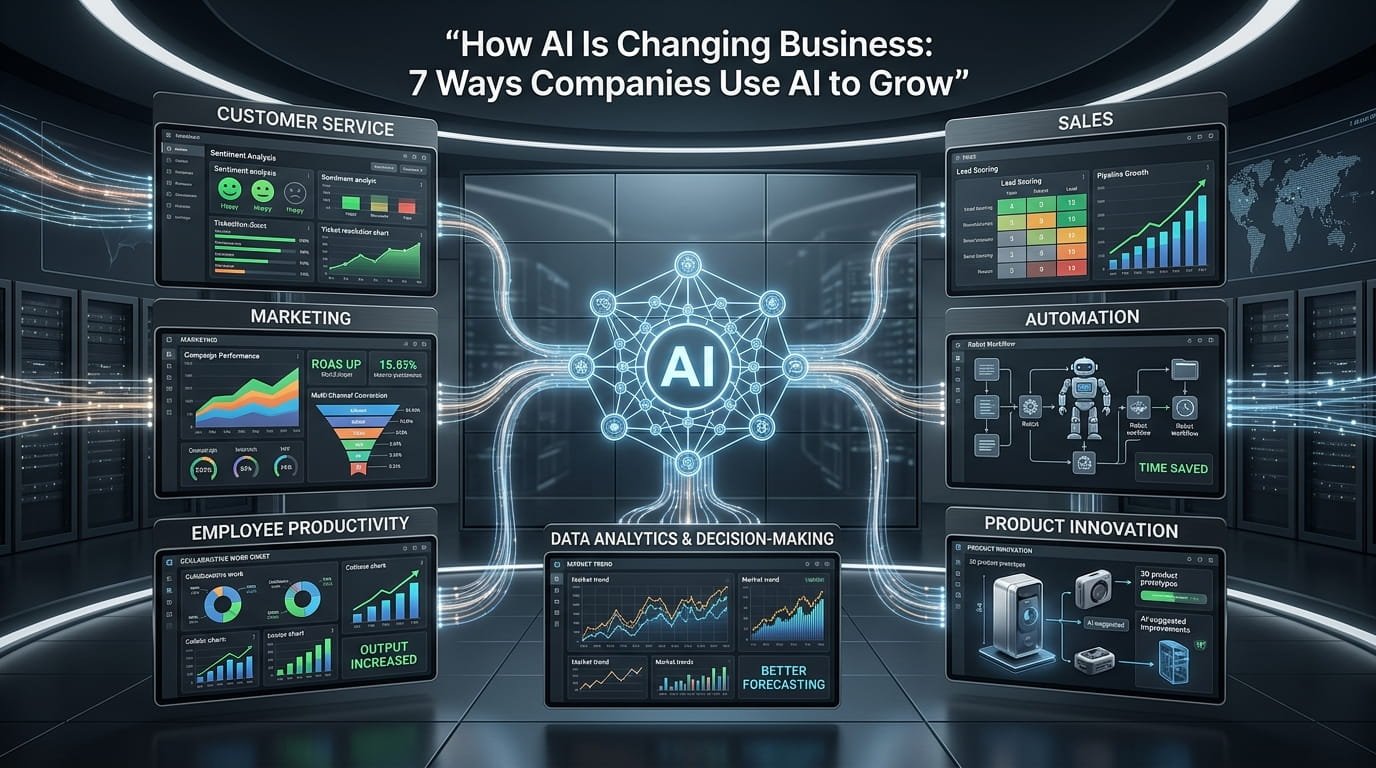
Artificial intelligence is no longer a technology that companies discuss only in innovation meetings. It is becoming part of everyday business operations, from answering customer questions and analyzing sales data to creating marketing campaigns and helping employees complete complex tasks.
That is why how AI is changing business has become an important question for companies of almost every size. The shift is not simply about replacing repetitive work with software. Businesses are increasingly using AI to make faster decisions, understand customers more deeply, develop products, reduce operational friction, and discover new sources of revenue.
Research supports that shift. McKinsey’s 2025 global survey found that 88% of respondents said their organizations regularly use AI in at least one business function, although most companies still have not scaled AI across the enterprise.
The more interesting question, therefore, is not whether businesses will use AI. It is where AI creates measurable value and how companies can deploy it responsibly.
This guide explains seven major ways AI is changing business, where companies are finding practical value, what the technology cannot solve by itself, and how organizations can build an AI strategy that supports sustainable growth.
How AI Is Changing Business: The Shift From Experiments to Everyday Work
Early business AI projects often focused on experimentation. A team might test a chatbot, generate a few marketing ideas, or use an AI assistant to summarize documents.
That approach is changing.
Companies increasingly connect AI with existing workflows, databases, customer systems, analytics platforms, and internal knowledge. Instead of treating AI as another standalone application, leading organizations are beginning to treat it as part of the operating model.
McKinsey’s 2025 research found that 23% of respondents said their organizations were scaling an agentic AI system somewhere in the enterprise, while another 39% were experimenting with AI agents.
At the same time, adoption does not automatically equal business success.
A company can have dozens of AI tools and still produce little measurable financial value. McKinsey reported that nearly two-thirds of surveyed organizations had not yet begun scaling AI across the enterprise.
The distinction matters:
- AI adoption means employees or teams use AI.
- AI integration means AI becomes part of business workflows.
- AI transformation means the company redesigns how work gets done around AI capabilities.
- AI-driven growth means the technology contributes to revenue, customer value, productivity, innovation, or competitive advantage.
The companies that benefit most are usually not the ones with the largest number of AI subscriptions. They are the ones that connect AI to important business problems.
1. How AI Is Changing Business Through Better Customer Service
Customer service is one of the clearest examples of how AI is changing business.
Customers expect quick answers, personalized support, and convenient communication. However, traditional support models can struggle when ticket volumes increase or customers need help outside normal business hours.
AI can handle a growing portion of that workload.
Businesses can use AI-powered customer service systems to:
- Answer frequently asked questions
- Summarize customer conversations
- Route support requests
- Identify urgent cases
- Recommend responses to human agents
- Search internal knowledge bases
- Translate customer messages
- Analyze customer sentiment
- Generate follow-up messages
- Provide support outside normal business hours
The important point is that AI does not always need to replace the human representative.
In many cases, the better model combines automation with human judgment. AI handles routine questions and gathers relevant information, while employees take over complicated, emotional, or high-risk cases.
McKinsey’s 2025 research identifies contact-center and customer-service automation among the common AI use cases businesses are pursuing.
Why this can support business growth
Better customer service can influence growth indirectly.
When customers receive faster answers, they may encounter fewer obstacles during the buying process. When support employees spend less time searching for information, they can devote more attention to difficult customer problems.
However, businesses should measure outcomes rather than simply counting automated conversations.
Useful metrics include:
- Customer satisfaction
- First-response time
- Resolution time
- Escalation rate
- Customer retention
- Support cost per interaction
- Conversion after support interactions
That measurement-first approach helps companies determine whether AI is actually improving the customer experience.
2. How AI Is Changing Business Through Smarter Marketing and Sales
Marketing has become another major area of AI adoption.
Businesses have more customer data than ever, yet collecting data is not the same as understanding it. AI can help marketing and sales teams analyze large amounts of information and turn it into practical recommendations.
For example, AI can help companies:
- Segment customers
- Analyze campaign performance
- Generate content ideas
- Personalize email campaigns
- Predict potential customer behavior
- Score leads
- Summarize sales calls
- Identify sales opportunities
- Create advertising variations
- Analyze customer feedback
Generative AI adds another layer because it can produce text, images, code, and other forms of content. McKinsey reported that marketing and sales remain among the business functions where organizations most frequently use generative AI.
Yet there is a major difference between producing more marketing content and producing better marketing outcomes.
A company could generate thousands of social posts and still fail to attract qualified customers.
A stronger strategy uses AI to improve the entire marketing process:
Customer data → audience insight → message → campaign → measurement → optimization
That creates a feedback loop.
For sales teams, AI can also reduce administrative work. A salesperson might spend less time summarizing meetings and updating records and more time talking with potential customers.
The best results therefore come when AI supports revenue-producing activities rather than simply increasing the amount of content employees produce.
3. How AI Is Changing Business by Improving Operations
Operations rarely receive the same attention as flashy AI applications, but they may offer some of the strongest opportunities for efficiency.
Companies operate through hundreds or thousands of interconnected processes. Procurement, inventory, logistics, scheduling, quality control, document processing, forecasting, and internal communication can all create delays.
AI can help identify patterns and automate parts of these processes.
For example, a retailer could use AI to forecast product demand. A manufacturer could analyze equipment data to identify potential maintenance problems. A logistics company could optimize routes based on changing conditions.
Other operational applications include:
- Demand forecasting
- Inventory optimization
- Supply-chain monitoring
- Predictive maintenance
- Fraud detection
- Document processing
- Workforce scheduling
- Quality inspection
- Delivery optimization
- Process monitoring
IBM similarly emphasizes practical AI use cases such as customer service, software development, supply-chain optimization, and employee assistance.
The bigger opportunity: workflow redesign
This is where how AI is changing business becomes more significant than simply adding automation.
Suppose an employee currently completes a process in eight steps.
AI may automate one step.
That is useful, but redesigning the workflow could eliminate unnecessary steps altogether.
McKinsey found that fundamental workflow redesign is strongly associated with organizations that achieve greater value from generative AI.
In other words, businesses should not ask only:
“Where can we add AI?”
They should also ask:
“If AI can handle part of this process, should we redesign the process itself?”
That question can reveal much larger opportunities.
4. How AI Is Changing Business by Increasing Employee Productivity
One of the most visible effects of AI is the way employees perform knowledge work.
Modern employees often spend significant amounts of time searching for information, writing routine documents, summarizing meetings, organizing data, preparing presentations, responding to messages, and completing administrative tasks.
AI assistants can help with many of these activities.
Employees can use AI to:
- Summarize long documents
- Draft emails
- Prepare meeting notes
- Analyze spreadsheets
- Generate reports
- Rewrite business communication
- Research internal information
- Create presentation outlines
- Write and review code
- Brainstorm solutions
- Translate content
- Extract information from documents
Microsoft’s Work Trend Index has highlighted the growing role of AI agents and human-agent collaboration as organizations reconsider how work gets distributed between people and software.
However, productivity should not mean simply making employees work faster.
A better definition is more valuable output per unit of time.
If AI helps an analyst finish a report in two hours instead of five, the company gains capacity. But the real advantage appears when that saved time moves toward higher-value activities such as strategic analysis, customer relationships, experimentation, or product development.
This is why employee training matters.
An organization that gives employees an AI tool without explaining verification, privacy, prompting, data handling, and appropriate use may create new risks instead of meaningful productivity.
5. How AI Is Changing Business Through Faster Decision-Making
Businesses make decisions constantly.
- Which products should receive more inventory?
- Which customers are most likely to leave?
- Which marketing campaign deserves additional budget?
- Which operational problem requires immediate attention?
- Which market should the company enter next?
AI can help decision-makers process these questions faster by analyzing patterns across large datasets.
Traditional analytics often tells a company what happened.
AI can go further by helping estimate what could happen next.
Depending on the system and data quality, companies can use predictive analytics and machine learning for:
- Demand forecasting
- Customer churn prediction
- Credit-risk assessment
- Fraud detection
- Sales forecasting
- Pricing analysis
- Financial planning
- Workforce planning
- Market analysis
- Operational forecasting
This does not mean AI should make every important decision independently.
High-impact decisions often require human oversight because historical data can contain bias, gaps, or unusual circumstances that a model cannot fully understand.
The strongest approach combines machine speed with human judgment.
AI identifies patterns.
People evaluate context.
Together, they can create better decisions than either approach alone.
6. How AI Is Changing Business Through Product and Service Innovation
AI is not only improving existing processes. It is also changing what businesses can build.
Companies can use AI during product research, design, testing, development, and customer feedback analysis.
For example, product teams can use AI to analyze thousands of customer comments and identify recurring complaints. Developers can use AI coding assistants to accelerate certain development tasks. Designers can use generative tools to explore concepts before investing heavily in production.
McKinsey’s research identifies product and service development as one of the major areas where organizations are using generative AI.
This creates an important distinction.
Efficiency-focused AI asks:
How can we perform the existing process faster?
Innovation-focused AI asks:
What could we build or offer that was previously difficult, expensive, or impossible?
The second question may create greater long-term competitive value.
A company that only uses AI to reduce administrative costs can improve margins. A company that uses AI to create a fundamentally better product can potentially create an entirely new revenue stream.
AI can shorten the experimentation cycle
Product innovation often requires repeated testing.
Idea → prototype → feedback → revision → testing → launch.
AI can accelerate several stages of that cycle.
As a result, businesses may be able to test more ideas without committing the same amount of time and resources to every experiment.
That does not guarantee successful innovation. In fact, easier experimentation can create more bad ideas alongside good ones.
The advantage comes from learning faster.
7. How AI Is Changing Business Through Automation and AI Agents
The next stage of business AI goes beyond generating answers.
AI agents are designed to perform sequences of tasks, interact with software, retrieve information, and execute actions according to defined objectives and permissions.
That makes agents particularly interesting for business workflows.
Imagine a sales process in which an AI system can:
- Identify a qualified lead.
- Research the company.
- Summarize relevant information.
- Prepare a personalized message.
- Add the lead to a CRM.
- Schedule a follow-up.
- Notify a salesperson when human intervention is required.
That is fundamentally different from asking a chatbot to write an email.
The agent participates in the workflow.
McKinsey’s 2025 research found that 62% of respondents said their organizations were at least experimenting with AI agents, while 23% reported scaling an agentic system somewhere in the enterprise.
Microsoft research also points toward increased human-agent collaboration, but emphasizes that organizations need the right foundations, including workflow mapping, unified data, and governance.
Why businesses should be careful with agents
More autonomy creates more potential value, but it also creates more potential failure points.
An agent that can access company systems can potentially make mistakes at scale.
Therefore, companies should define:
- What an agent can access
- What actions require approval
- What data it can use
- When it must escalate to a human
- How actions are logged
- How errors are detected
- How performance is evaluated
The goal is not maximum autonomy.
The goal is appropriate autonomy.
How AI Is Changing Business Across Different Company Sizes
AI adoption does not look identical for every organization.
A multinational company may have dedicated data scientists, AI engineers, legal teams, cloud infrastructure, and large proprietary datasets.
A small business may have only a few employees and a limited technology budget.
Nevertheless, the underlying principles remain similar.
| Business Type | Practical AI Opportunities | Primary Goal |
|---|---|---|
| Small business | Customer support, content, bookkeeping assistance, lead management | Save time and increase capacity |
| E-commerce company | Recommendations, customer service, demand forecasting | Increase conversion and retention |
| Marketing agency | Research, reporting, content workflows, analytics | Improve productivity |
| SaaS company | Product development, support, coding assistance | Accelerate product growth |
| Manufacturer | Predictive maintenance, quality control, forecasting | Reduce operational waste |
| Large enterprise | Agents, predictive analytics, knowledge systems, automation | Transform workflows at scale |
The important lesson is simple: AI strategy should match the company’s actual constraints.
A small company does not need to copy the AI architecture of a global corporation.
Instead, it should identify one high-value process where better information, automation, or prediction can produce measurable results.
What Companies Get Wrong About AI
Understanding how AI is changing business also requires understanding what can go wrong.
AI is powerful, but it is not automatically accurate, secure, unbiased, or profitable.
1. Buying tools before defining the problem
A company may purchase several AI products because competitors use them.
That reverses the proper order.
Start with the business problem. Then determine whether AI is actually the right solution.
2. Measuring activity instead of outcomes
The number of AI-generated documents is not a meaningful business metric by itself.
Companies should track results such as:
- Revenue
- Conversion rate
- Cost per transaction
- Resolution time
- Customer retention
- Employee productivity
- Error rates
- Profit margin
3. Ignoring data quality
AI cannot compensate indefinitely for poor data.
Incomplete customer records, inconsistent databases, outdated information, and disconnected systems can undermine otherwise sophisticated AI applications.
4. Removing human oversight too quickly
Some processes require judgment, empathy, accountability, or regulatory oversight.
AI should not automatically control high-impact decisions simply because it can technically perform them.
5. Treating AI as an IT project
AI transformation affects employees, workflows, management, security, finance, legal teams, and customers.
It therefore requires cross-functional leadership.
McKinsey’s research suggests that organizations achieving greater value from AI tend to make organizational and workflow changes rather than treating AI as a collection of isolated experiments.
A Practical AI Growth Framework for Businesses
Companies do not need to transform everything at once.
A more realistic approach is to move through several stages.
Step 1: Find repetitive or high-friction work
Look for processes that consume significant employee time or create frequent delays.
Step 2: Estimate the potential value
Ask:
- How much time could this save?
- Could it increase revenue?
- Could it reduce errors?
- Could it improve customer satisfaction?
- Could it improve decision quality?
Step 3: Select one measurable use case
Do not begin with ten unrelated experiments.
Choose one process where the outcome can be measured.
Step 4: Establish data and security requirements
Determine what information the AI system needs and whether that information contains confidential, personal, financial, or regulated data.
Step 5: Keep humans involved where necessary
Define approval points before deployment.
Step 6: Measure before scaling
Compare performance against the old process.
If AI improves the result, expand the implementation.
If it does not, determine why before spending more money.
Step 7: Redesign the workflow
Once the technology proves useful, rethink the entire process instead of simply inserting AI into the old workflow.
This final step is often where the largest gains appear.
The Future of How AI Is Changing Business
The next phase of business AI will likely involve deeper integration rather than simply more AI applications.
Companies are moving from individual assistants toward interconnected systems that can retrieve information, reason over business data, coordinate tasks, and interact with enterprise software.
At the same time, AI infrastructure and investment continue to expand. Stanford’s 2026 AI Index reports that organizational AI adoption reached 88% in its surveyed data for 2025, while generative AI was used in at least one business function at 70% of organizations. It also notes that AI agent deployment remained relatively early across individual business functions.
That combination tells us something important.
AI adoption is moving quickly, but business transformation is harder.
The companies that gain a lasting advantage may not simply be those that adopt AI first. Instead, they may be those that learn how to redesign operations, manage AI risk, train employees, connect proprietary data, and continuously measure business outcomes.
In other words, the competitive advantage may shift from having AI to knowing how to use AI better than competitors.
How AI Is Changing Business: The Bottom Line
The seven changes discussed here show why how AI is changing business is a much bigger question than automation alone.
AI can improve customer service, strengthen marketing and sales, streamline operations, increase employee productivity, support faster decisions, accelerate product innovation, and enable increasingly sophisticated AI agents.
However, technology alone does not create business growth.
The real value appears when companies connect AI to meaningful problems and redesign workflows around measurable outcomes.
Research from McKinsey reinforces this point: AI adoption is widespread, but many organizations are still struggling to scale it and capture enterprise-level financial impact.
That creates an opportunity for businesses of every size.
A company does not need to automate everything tomorrow. It needs to identify where better prediction, faster execution, stronger customer understanding, or smarter decision-making could create a genuine advantage.
Start with one valuable workflow.
Measure the result.
Improve the process.
Then scale what works.
That is the practical path to turning AI from an interesting technology into a genuine engine for business growth.
Frequently Asked Questions
1. How is AI changing business today?
AI is changing business by automating repetitive tasks, improving customer service, supporting marketing and sales, analyzing large datasets, helping employees work more efficiently, improving forecasting, accelerating product development, and enabling AI agents to perform multi-step workflows. However, adoption alone does not guarantee financial results. Companies need to connect AI projects to measurable business objectives.
2. What are the biggest ways companies use AI to grow?
The most important applications include customer-service automation, personalized marketing, sales assistance, operational optimization, employee productivity, predictive analytics, product development, and AI-powered workflow automation. The best opportunity depends on the company’s industry, data, customers, and existing processes.
3. Can small businesses benefit from AI?
Yes. Small businesses can use AI without building complex enterprise systems. Customer support, content creation, lead management, document processing, scheduling, data analysis, and administrative assistance can provide practical starting points. Small companies should focus on affordable tools that solve specific problems rather than adopting AI simply because it is popular.
4. Will AI replace employees?
AI will automate some tasks, but the effect on individual jobs will vary considerably by occupation and industry. Many businesses are using AI to augment employees rather than eliminate entire roles. The more useful question is often which parts of a job AI can handle and which activities still require human judgment, creativity, relationships, accountability, or domain expertise.
5. What is the biggest mistake companies make when adopting AI?
One of the biggest mistakes is adopting AI before identifying a clear business problem. Companies can spend heavily on tools without generating meaningful value. A stronger approach starts with a measurable objective, evaluates data and security requirements, tests one use case, measures the outcome, and then scales successful workflows.
6. What is the future of AI in business?
The future is likely to involve deeper integration of AI into everyday workflows, including AI assistants, predictive systems, automated processes, and increasingly capable AI agents. However, businesses will also need stronger governance, cybersecurity, data management, employee training, and human oversight as AI becomes more autonomous.
7. How can a company start using AI effectively?
Start by identifying a repetitive, expensive, slow, or data-heavy business process. Estimate its potential value, choose an AI application that directly addresses the problem, establish security and human-review requirements, and define measurable success metrics. Once the pilot produces reliable results, redesign the workflow and expand it gradually.














Technology companies operating in Britain are entering a much more demanding regulatory environment. UK Tech Regulation is moving beyond broad promises about online safety and toward detailed legal duties, age assurance, platform accountability, advertising controls and stronger enforcement.
The biggest change comes from the UK’s Online Safety Act. Many of its core duties are already active, while the government is preparing additional restrictions that could significantly change how major social platforms operate. The government plans to introduce regulations restricting social-media access for under-16s, with implementation expected in spring 2027.
At the same time, Ofcom is increasing pressure on platforms to improve child protection, tackle illegal content, address fraudulent advertising and demonstrate that their safety systems actually work.
For companies such as Meta, Google, TikTok, Snapchat, X and other large online services, this creates a fundamental shift.
The question is no longer simply whether a platform can attract users.
It increasingly has to demonstrate that it can manage the risks created by its algorithms, recommendation systems, advertising businesses and user-generated content.
What Is UK Tech Regulation and Why Is It Changing?
UK Tech Regulation refers to the growing body of laws, regulatory frameworks and government policies governing technology companies and digital services operating in the United Kingdom.
The Online Safety Act 2023 is one of the most important pieces of this framework. The Act gives providers of in-scope online services legal responsibilities relating to illegal content and material harmful to children.
However, the regulatory picture is broader than one law.
Companies increasingly have to consider:
- Online safety
- Child protection
- Age verification
- Illegal content
- Fraudulent advertising
- Algorithmic recommendations
- User reporting
- Platform transparency
- AI-related risks
- Data protection
- Competition
- Consumer protection
That combination makes Britain an important test market for technology regulation.
The UK is also moving toward a more interventionist approach to children’s online experiences. In June 2026, the government announced plans to prevent social-media platforms from offering their services to under-16s, with the first regulations expected before the end of 2026 and the restrictions expected to begin in spring 2027.
How the Online Safety Act Already Changes Big Tech
The most important thing to understand about UK Tech Regulation is that many requirements are not future proposals. Several obligations are already legally active.
The government’s Online Safety Act guidance states that platforms have had legal duties relating to illegal content since 17 March 2025. Child-safety duties followed on 25 July 2025.
This means large platforms have already had to change how they assess and manage risks.
For covered services, the framework requires companies to think systematically about the harms their services can create.
That includes:
- Identifying relevant risks.
- Assessing how those risks could affect users.
- Implementing proportionate safety measures.
- Maintaining records.
- Reviewing risk assessments.
- Providing reporting and complaints mechanisms.
- Explaining relevant safety measures through terms and policies.
The important shift is accountability.
Instead of simply saying that users should behave responsibly, platforms increasingly have to show that their systems and processes reduce foreseeable risks.
Why Ofcom Has Become So Important
Ofcom is the UK’s online-safety regulator.
Its role makes it one of the most important institutions for understanding where UK Tech Regulation is heading.
Ofcom does not simply publish recommendations and walk away. It can investigate regulated services, require remedial action and impose substantial financial penalties.
The regulator can impose fines of up to £18 million or 10% of qualifying worldwide revenue, whichever is greater, when companies breach relevant duties. In the most serious cases, Ofcom can also seek court orders for business-disruption measures.
Those disruption measures could potentially involve third parties such as payment providers, advertisers or internet service providers.
That gives the regulatory framework considerably more weight than a voluntary industry code.
Why the Financial Penalties Matter
For a small technology company, even a relatively modest regulatory penalty can create significant financial pressure.
For a global technology company, however, the bigger issue may be the operational and reputational consequences.
A major enforcement action can create:
- Legal costs
- Engineering expenses
- Compliance requirements
- Product redesigns
- Advertising consequences
- Reputation damage
- Investor scrutiny
- Management distraction
Therefore, compliance is becoming part of the business strategy rather than simply a legal department responsibility.
UK Tech Regulation Is Putting Child Safety at the Center
Child protection has become one of the strongest drivers of regulatory change.
Under the existing framework, services that are likely to be accessed by children have to conduct children’s access assessments. Where the duties apply, companies must then carry out children’s risk assessments and introduce appropriate protections.
The rules cover a broad range of harmful material.
Ofcom’s guidance includes risks involving:
- Bullying
- Hate
- Violence
- Self-harm
- Dangerous stunts
- Harmful substances
- Other content presenting a significant risk of harm to children
Platforms must also provide ways for users to report harmful content and must maintain appropriate complaints processes.
This creates a major engineering challenge.
A platform cannot simply create one safety filter and assume the problem is solved.
It has to consider how recommendation systems, search results, messaging functions, livestreaming, user-generated content and other features interact.
How Age Verification Could Change the Internet
One of the most visible effects of UK Tech Regulation is the growing importance of age assurance.
The UK framework requires certain services to use highly effective age assurance where the relevant duties apply. Ofcom describes age assurance as a cornerstone of child protection and expects systems to determine reliably whether a user is an adult or a child.
This has significant implications for technology companies.
Traditional internet services often allowed users to enter a birth date and continue.
That model is increasingly inadequate for services covered by stronger age-assurance obligations.
Companies may instead need technologies capable of estimating or verifying age using methods such as:
- Facial age estimation
- Identity documentation
- Credit-card signals
- Age-verified accounts
- Other approved or sufficiently effective mechanisms
However, stronger verification creates a competing concern: privacy.
Companies must therefore balance child protection with data minimisation, security and privacy requirements.
Ofcom’s 2026 age-assurance report specifically highlighted the importance of effective systems, vendor due diligence and compliance with privacy and data-protection obligations.
That tension will likely remain one of the biggest challenges in digital regulation.
The Proposed Under-16 Social Media Restrictions Could Be a Major Turning Point
The next major development could be even more disruptive.
The UK government announced in June 2026 that social-media companies would no longer be able to offer their services to children under 16. The government expects the first regulations to be introduced before the end of 2026, with the restrictions expected to take effect in spring 2027.
The proposed framework is intended to affect major social-media services.
Government materials have identified platforms such as:
- YouTube
- TikTok
- Snapchat
- X
The government has said messaging services such as WhatsApp and Signal are not intended to fall within the social-media ban.
However, the final regulatory scope and detailed definitions still matter.
That distinction is important for anyone writing about UK Tech Regulation because the announcement is not identical to a fully implemented law.
The government still has to lay regulations before Parliament, and the precise operation of the rules will determine how platforms implement them.
What Will Happen to 16- and 17-Year-Old Users?
The proposed changes do not simply create a wall between children and social media.
The government has also announced additional protections for 16- and 17-year-olds.
These include default overnight restrictions from midnight to 6 a.m., muted push notifications during the overnight period, and restrictions on features such as autoplay and personalised feeds by default.
The policy aims to prevent what the government describes as a “cliff edge” where protections suddenly disappear when a child turns 16.
This could force social platforms to redesign the user experience around age.
Instead of one product experience for everyone, platforms may increasingly operate with different safety configurations depending on a user’s age.
That could affect:
- Recommendation algorithms
- Notifications
- Livestreaming
- Messaging
- Advertising
- Account settings
- Content discovery
- Personalisation
In practical terms, age could become a major input into platform design.
UK Tech Regulation Could Force Changes to Recommendation Algorithms
Recommendation systems are at the heart of modern social media.
They decide which videos appear next, which posts users see and which content receives additional distribution.
Consequently, regulation that focuses on harmful content cannot ignore recommendation systems.
A platform might remove harmful content after users report it. Yet if an algorithm repeatedly recommends similar harmful material before users report it, the underlying system may still create risk.
That is why UK Tech Regulation is increasingly concerned with systems and processes rather than individual pieces of content alone.
For technology companies, this means safety teams may need to work much more closely with:
- Machine-learning engineers
- Product managers
- Data scientists
- Trust-and-safety teams
- Legal departments
- Policy teams
- Security specialists
The regulatory question becomes more sophisticated:
Does the platform’s design itself increase the probability that users will encounter harmful material?
That is considerably harder to answer than simply counting removed posts.
Scam Advertising Is Becoming Another Major Regulatory Pressure
Online fraud is another area where UK Tech Regulation is expanding.
In July 2026, Ofcom proposed additional measures for major platforms and search services to address paid-for scam advertising. The proposals include measures such as banning accounts associated with scam advertisements and making fraudulent adverts easier to report.
This matters because advertising is central to the business models of many major technology companies.
The UK digital advertising market is worth tens of billions of pounds annually, making advertising safety a major commercial issue as well as a consumer-protection issue.
For platforms, stronger fraud controls could mean:
- More advertiser verification
- Better identity checks
- Stronger automated detection
- Faster removal procedures
- More reporting tools
- Greater record keeping
- More scrutiny of advertising systems
The challenge is obvious.
A platform needs to prevent fraudulent advertisements without blocking legitimate businesses unnecessarily.
That requires increasingly sophisticated detection systems.
AI Chatbots Are Entering the Regulatory Debate
Artificial intelligence creates another layer of complexity.
Traditional online safety rules were largely designed around social networks, search engines and user-generated content.
AI chatbots complicate that model because the system itself can generate content.
The UK government has therefore started examining additional protections around AI services, particularly where children could encounter harmful material.
In July 2026, the government said it was considering measures involving AI chatbots, including mandatory breaks for under-18s and restrictions on chatbots that provide certain harmful or inappropriate experiences.
The government also announced that under-18s would be prevented from accessing AI chatbot services that primarily offer sexualised content.
This could become an important new chapter in UK Tech Regulation.
The key difference is that AI safety cannot rely entirely on removing existing content.
A generative AI system can produce a new response for every interaction.
That means companies may need stronger controls around:
- Model behaviour
- Prompt handling
- Age detection
- Safety filters
- Refusal systems
- Monitoring
- Product design
- High-risk use cases
What the Rules Could Mean for Google, Meta, TikTok and Other Big Platforms
The practical impact will vary between companies.
Meta
Meta operates large social platforms with extensive recommendation systems, advertising businesses and user-generated content.
Therefore, age restrictions, child safety and fraudulent advertising requirements could affect both product design and advertising operations.
TikTok
TikTok’s highly personalised recommendation system makes it particularly relevant to discussions around children and algorithmic content discovery.
The platform will need to demonstrate that its safety systems work within the UK’s regulatory framework.
Ofcom has already shown that it is willing to investigate major services when it identifies potential compliance concerns. For example, Ofcom opened an investigation into TikTok concerning duties to protect children from harmful content.
Google and YouTube
Google faces a particularly broad regulatory footprint because it operates search, advertising, video and other major digital services.
YouTube is also specifically identified in the government’s planned under-16 social-media restrictions.
That means age assurance and child-safety requirements could influence both user experience and content recommendation.
X
X has already attracted Ofcom attention.
In 2026, Ofcom investigated issues surrounding X and the Grok AI chatbot, including concerns about harmful deepfake imagery being generated and shared through the service.
The case demonstrates how AI can create new regulatory questions that traditional platform rules did not anticipate.
UK Tech Regulation Could Increase the Cost of Running a Platform
Compliance is not free.
A major platform may need to spend heavily on:
- Safety engineers
- Content moderation
- AI detection systems
- Age-assurance technology
- Legal teams
- Auditing
- Risk assessments
- Data governance
- Reporting infrastructure
- Compliance monitoring
For the largest companies, those costs may be manageable.
For smaller technology companies, they could become much more significant.
This creates a potential market effect.
Large companies may be better positioned to absorb regulatory costs, while smaller competitors could struggle to match their compliance capabilities.
Therefore, regulation intended to improve safety could indirectly influence competition in the technology sector.
Could UK Tech Regulation Make Big Tech More Accountable?
That is one of the central objectives of the regulatory framework.
Ofcom says it directly supervises around 40 of the highest-profile services across areas such as social media, gaming, search, dating and AI. It also regulates a much wider population of online services.
The regulator’s approach combines:
- Awareness and guidance
- Direct supervision
- Formal enforcement
That model matters because enforcement does not always begin with a fine.
Ofcom can engage with a company, examine its systems and push it toward compliance.
However, the existence of substantial penalties gives the regulator additional leverage.
This creates a more mature regulatory environment than one based entirely on voluntary promises.
What Are the Biggest Challenges for the New Rules?
The regulations may be ambitious, but implementation will not be simple.
Privacy vs. Age Verification
Age checks can improve child protection.
At the same time, they can create privacy concerns if platforms collect or retain sensitive information unnecessarily.
The solution will require systems that verify age effectively while limiting data exposure.
Enforcement Across Global Companies
Many major technology companies are headquartered outside Britain.
Nevertheless, Ofcom makes clear that companies serving UK users can fall within the Online Safety Act even when they are based abroad.
That makes cross-border enforcement critical.
Children May Try to Circumvent Restrictions
The government has already identified circumvention as an important issue.
Potential methods include:
- False ages
- Parent accounts
- VPNs
- Shared devices
- Alternative services
The government has said it plans further measures to reduce circumvention of the new restrictions.
Technology Changes Faster Than Legislation
This may be the hardest problem.
A law can take years to develop.
A technology product can change within weeks.
AI illustrates the problem particularly well.
New models, agents, synthetic media and AI companions can create risks that lawmakers did not anticipate when legislation was originally drafted.
Therefore, regulators need frameworks that can adapt without becoming so vague that companies cannot understand their obligations.
UK Tech Regulation and the Future of AI
The rise of AI could fundamentally reshape technology regulation.
Traditional platforms primarily distributed content created by users.
AI platforms can generate content themselves.
That difference raises difficult questions.
Who is responsible when an AI system generates harmful content?
How should regulators determine whether a model is safe enough for children?
Should an AI companion be treated like a social platform?
How should age restrictions work when a chatbot can adapt its behaviour to an individual user?
These questions are likely to become increasingly important.
The UK government’s 2026 policy work already shows that AI chatbots are being brought into the wider child-safety discussion.
For technology companies, this means AI safety cannot remain separate from product development.
It needs to become part of the product itself.
How Businesses Can Prepare for UK Tech Regulation
Companies operating digital services in Britain should not wait for enforcement action before reviewing their systems.
A practical compliance framework should include the following.
1. Map the Regulatory Scope
Determine whether the service falls within the Online Safety Act and which specific duties apply.
2. Conduct Regular Risk Assessments
Do not treat a risk assessment as a one-time document.
Ofcom expects services to keep assessments updated, including when significant changes occur.
3. Review Age Assurance
Companies should evaluate whether their age-assurance technology meets the required effectiveness standard.
They should also assess third-party vendors carefully.
4. Audit Recommendation Systems
Platforms should understand what their algorithms amplify.
A recommendation system should not be evaluated solely on engagement.
Safety outcomes matter too.
5. Strengthen Reporting Tools
Users should be able to report harmful or illegal material without unnecessary friction.
6. Prepare for Regulatory Evidence Requests
Companies should maintain appropriate documentation showing how their systems operate and how they respond to identified risks.
7. Build Safety Into Product Development
Safety should not be added after a product launches.
Instead, it should form part of product design, testing and deployment.
What Investors Should Watch as UK Tech Regulation Expands
Regulation can create both risks and opportunities for technology investors.
Investors should watch several indicators.
Compliance spending: Rising regulatory requirements can increase operating costs.
Product changes: Major platform redesigns can affect engagement and advertising revenue.
Age verification: Stronger checks could influence user numbers and conversion rates.
Advertising controls: Fraud rules could increase advertiser verification costs while potentially improving user trust.
AI regulation: New requirements could affect the economics of AI products.
Enforcement actions: Ofcom investigations can reveal where regulatory risks are becoming concentrated.
Competitive effects: Smaller companies may struggle to match the compliance budgets of global platforms.
The key is to separate short-term headlines from structural changes.
A fine may affect one company.
A new regulatory standard can affect an entire industry.
UK Tech Regulation Could Influence Other Countries
Britain’s regulatory approach may matter beyond the UK.
Large technology companies rarely build completely separate products for every individual market.
When a major market introduces a significant requirement, companies may sometimes decide that changing the product globally is more efficient than maintaining separate systems.
That means British regulation could influence international technology design.
Age assurance is a good example.
If companies develop robust systems to meet UK requirements, those systems could potentially be reused elsewhere.
The same could apply to:
- Fraud detection
- Content moderation
- Child-safety controls
- AI safety systems
- User reporting
- Algorithmic risk management
This gives UK Tech Regulation importance beyond Britain’s population.
UK Tech Regulation: What Happens Next?
The regulatory story is far from finished.
Several developments deserve close attention through 2026 and 2027.
Social Media Age Restrictions
The government expects the first regulations to reach Parliament before the end of 2026, with the social-media restrictions expected to take effect in spring 2027.
Stronger Teen Protections
The government intends to introduce additional safeguards for 16- and 17-year-olds, including overnight restrictions and changes to addictive platform features.
AI Chatbot Rules
Additional measures targeting harmful AI chatbot experiences could develop as the government continues its work on online safety.
Fraudulent Advertising
Ofcom’s proposed fraudulent-advertising code is another major development. The consultation is scheduled to close on 2 October 2026, so the final requirements could evolve after industry and stakeholder responses.
Continued Ofcom Enforcement
Ofcom has already launched multiple investigations and enforcement programmes.
Its 2026 activity indicates that enforcement is becoming an increasingly visible part of Britain’s digital regulatory regime.
Frequently Asked Questions About UK Tech Regulation
1. What is UK Tech Regulation?
UK Tech Regulation is the collection of laws, rules and regulatory frameworks governing technology companies and online services operating in Britain. The Online Safety Act is one of the most important parts of this framework, covering areas such as illegal content, child safety, age assurance and platform responsibilities.
2. What is the UK’s Online Safety Act?
The Online Safety Act 2023 creates legal duties for certain online services to protect users from illegal content and children from harmful material. Key illegal-content duties began in March 2025, while major child-safety duties took effect in July 2025.
3. Will the UK ban social media for children under 16?
The UK government has announced plans to prevent social-media services from offering their services to under-16s. The first regulations are expected before the end of 2026, with implementation planned for spring 2027. The precise legal scope will depend on the regulations approved by Parliament.
4. Will adults have to prove their age to use social media?
Not necessarily in every case. The government’s current fact sheet says some adults may not need additional checks if their accounts already provide sufficient age-related signals, while others could encounter age-verification methods. The exact implementation will depend on the final rules and platform systems.
5. What happens if a technology company breaks UK online safety rules?
Ofcom can require companies to take remedial action and can impose penalties of up to £18 million or 10% of qualifying worldwide revenue, whichever is greater. In the most serious circumstances, it can also seek court orders for business-disruption measures.
Conclusion: UK Tech Regulation Is Changing How Big Tech Operates
UK Tech Regulation is entering a more consequential phase.
The Online Safety Act has already moved online safety from voluntary commitments toward enforceable legal responsibilities. Now, the UK government is preparing another major step by introducing proposed restrictions on social-media access for under-16s, alongside stronger protections for teenagers and additional measures addressing harmful AI services.
At the same time, Ofcom is pushing platforms to improve age assurance, tackle illegal content, strengthen child protection and address fraudulent advertising.
For Big Tech, the message is becoming difficult to ignore: growth alone is no longer enough.
Technology companies increasingly need to demonstrate that their products, algorithms and business systems can manage the risks they create.
That could increase compliance costs. It could force product redesigns. It could even change how social platforms make money.
However, stronger regulation could also create a more trustworthy digital environment if companies implement the rules effectively.
The most important period may therefore be the transition from legislation to real-world enforcement.
As the UK moves toward 2027, businesses, investors and users should watch three things closely: how the under-16 restrictions are finalized, how Ofcom enforces existing duties, and how regulators adapt the rules to rapidly developing AI technology.
Those developments will determine whether Britain’s new digital-safety framework becomes a model for responsible technology regulation—or a continuing battleground between regulators, platforms and users.
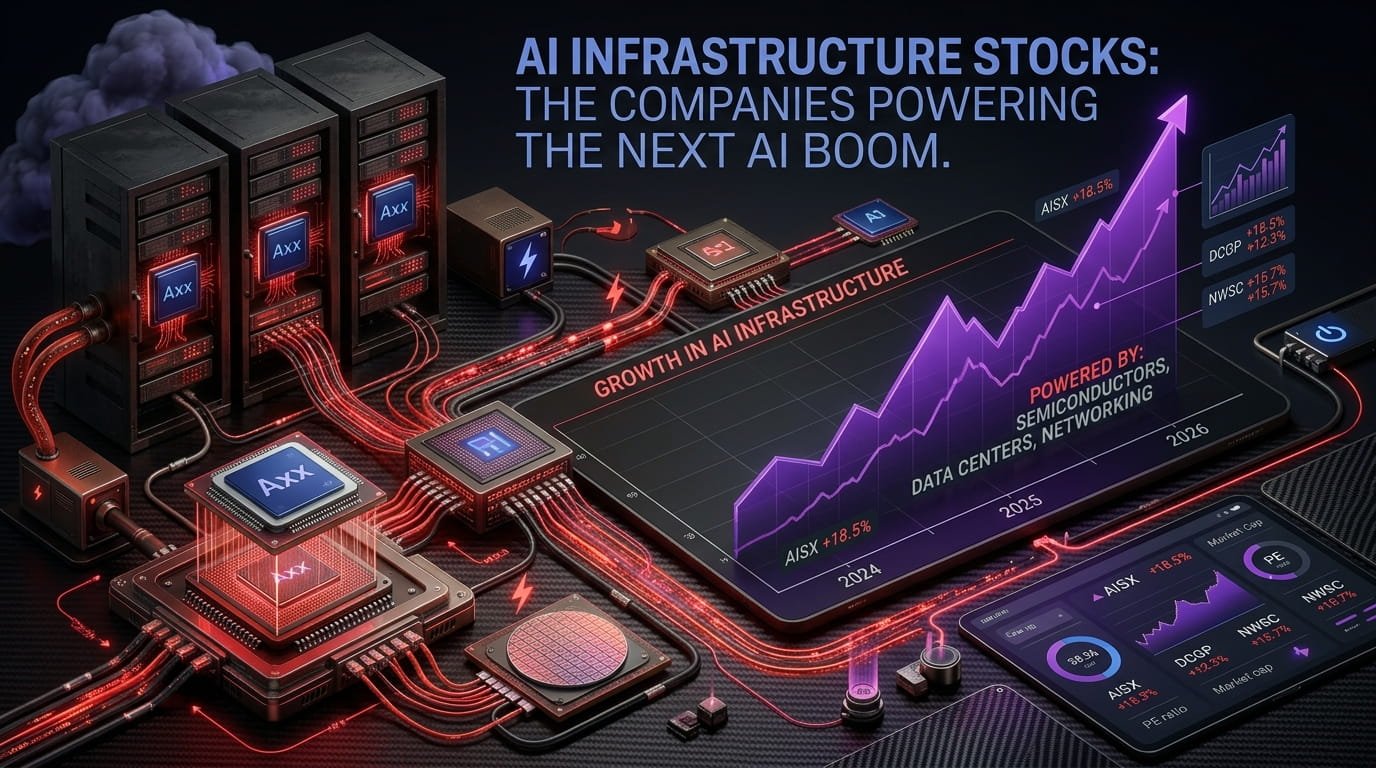
Artificial intelligence is moving into a more demanding phase. The first wave focused heavily on AI models and applications. Now, the bigger question is what happens underneath them: Who supplies the chips, networking systems, power equipment, cooling technology, data centers, and custom processors required to run AI at enormous scale?
That is where AI infrastructure stocks come into focus.
The opportunity is much broader than NVIDIA. Hyperscalers are spending hundreds of billions of dollars on computing infrastructure, while companies such as Broadcom, Arista Networks, Vertiv, AMD and other specialized suppliers are building the physical and semiconductor backbone behind the AI economy. TrendForce estimated that the combined 2026 capital expenditure of nine major cloud-service providers could exceed $886.7 billion, with AI server shipments expected to rise nearly 31% year over year.
That spending creates a powerful investment theme. However, it also creates risks. High valuations, enormous capital requirements, supply constraints, interest rates, energy availability and the possibility of slower AI monetization can all affect returns.
So rather than simply asking which AI stock could rise next, investors should understand which companies sell the infrastructure that the entire AI ecosystem needs.
What Are AI Infrastructure Stocks and Why Do They Matter?
AI infrastructure stocks represent companies that provide the hardware, software, networking, power, cooling, semiconductor components and data-center systems required to build and operate modern AI workloads.
That includes several layers:
- AI accelerators: GPUs, CPUs and custom AI processors
- Semiconductor manufacturing: advanced foundries and chip-production equipment
- High-bandwidth memory: memory required by large AI systems
- Networking: switches, optical connectivity and high-speed interconnects
- Power infrastructure: electrical systems, backup power and distribution
- Cooling: liquid cooling, thermal management and heat-rejection systems
- Data centers: facilities that house AI computing equipment
- Cloud infrastructure: platforms that allow customers to rent AI computing capacity
This distinction matters because AI spending does not stop at the processor.
A new AI data center needs electricity. It needs networking. It needs cooling. It needs racks, storage, memory, power management and specialized software. As models become larger and inference workloads increase, the infrastructure surrounding the processors can become just as strategically important.
In other words, the AI boom is creating a technology supply chain, not simply a market for AI applications.
Why AI Infrastructure Stocks Could Benefit From the Next AI Expansion
The strongest argument for AI infrastructure stocks comes from the scale of spending taking place across the industry.
The four major U.S. technology companies—Google, Amazon, Microsoft and Meta—were expected to spend around $760 billion in combined capital expenditure during 2026, according to data compiled by Statista. That spending is increasingly directed toward data centers, chips, networking and other AI-related infrastructure.
TrendForce offered another indication of the scale. Its August 2026 estimate put combined 2026 capital expenditure from nine major cloud providers above $886.7 billion.
However, investors should not assume that every dollar of this spending automatically becomes revenue for one company.
The money flows through a long chain of suppliers.
For example:
Cloud provider → data center → power systems → cooling → racks → networking → processors → memory → storage → software
That structure creates multiple potential winners.
It also explains why looking beyond the most famous AI companies can reveal businesses with different growth drivers.
AI Infrastructure Stocks: NVIDIA Remains the Core Compute Leader
Any discussion of AI infrastructure stocks has to begin with NVIDIA.
The company has become central to accelerated computing because its GPUs, networking products and software ecosystem form a major part of modern AI data centers.
NVIDIA’s latest results show just how large this business has become. For its fiscal second quarter of 2027, NVIDIA reported $96.2 billion in total revenue, up 106% year over year. Data Center revenue reached $89.0 billion, an increase of 117%.
Those numbers are significant because they demonstrate that AI infrastructure demand is not merely an early-stage experiment.
It is producing enormous commercial revenue.
NVIDIA also guided for approximately $108 billion in fiscal Q3 revenue, although its outlook did not assume Data Center compute revenue from China.
The company is also expanding beyond GPUs.
Its newer platforms combine CPUs, GPUs, networking and system-level architecture. That approach matters because AI workloads increasingly require entire computing systems rather than isolated processors.
What Investors Should Watch With NVIDIA
NVIDIA’s opportunity remains substantial, but investors should avoid treating its growth as risk-free.
Important factors include:
- AI data-center spending
- GPU demand
- networking adoption
- customer concentration
- export restrictions
- competition from custom accelerators
- valuation
- supply-chain capacity
- AI model economics
The key question is no longer simply whether AI needs computing power.
It does.
The more difficult question is whether the rate of infrastructure spending can remain high enough to justify current expectations.
AI Infrastructure Stocks: Broadcom Is Becoming a Major Custom-Chip Winner
Broadcom is one of the most interesting companies in the AI infrastructure supply chain because it provides exposure to custom AI accelerators and networking.
Unlike a company that depends primarily on selling general-purpose GPUs, Broadcom works with major technology companies developing customized silicon.
That business is becoming increasingly important as hyperscalers look for ways to optimize AI workloads for specific applications.
Broadcom’s latest numbers illustrate the acceleration.
For fiscal Q3 2026, Broadcom reported $29.6 billion in revenue, up 86% year over year. More importantly for the AI infrastructure story, AI semiconductor revenue reached $16.7 billion, increasing 221% year over year and 54% sequentially.
Broadcom expects Q4 AI semiconductor revenue to reach approximately $21.7 billion, representing 236% year-over-year growth.
That makes Broadcom particularly relevant to investors looking beyond conventional GPU exposure.
Its AI opportunity includes:
- Custom accelerators
- AI networking
- Ethernet connectivity
- Optical infrastructure
- High-speed interconnects
- Semiconductor design expertise
The company therefore represents a different part of the AI infrastructure equation.
Why Custom AI Chips Could Become More Important
Hyperscalers operate enormous data centers. At that scale, even small improvements in performance, power consumption or cost can become financially significant.
That creates an incentive to develop custom silicon.
Google has its TPU architecture. Other major cloud companies are also developing or deploying proprietary accelerators. TrendForce expects cloud providers to continue increasing their use of in-house ASICs alongside NVIDIA and AMD platforms.
This does not necessarily mean custom chips will replace GPUs.
A more realistic scenario is coexistence.
General-purpose accelerators can support a broad range of workloads, while custom processors can target specific workloads where efficiency matters most.
That dynamic could make custom-chip suppliers an important segment of AI infrastructure stocks for years.
AI Infrastructure Stocks: AMD Offers a Major Alternative
AMD is another important company in the accelerated-computing market.
Its EPYC server CPUs and Instinct accelerators give customers an alternative to NVIDIA-based infrastructure.
The investment thesis is relatively straightforward: If AI computing continues expanding, cloud providers and enterprise customers may want multiple accelerator platforms rather than relying on one supplier.
That creates opportunities for AMD.
However, investors should distinguish between having a competitive product and capturing a large share of the AI accelerator market.
NVIDIA has a significant ecosystem advantage. Its CUDA software platform, developer base, networking products and established data-center relationships make competition difficult.
Therefore, the key metrics to monitor include AMD’s data-center revenue, accelerator adoption, margins, product launches and relationships with major cloud providers.
AMD could benefit from AI infrastructure growth even without becoming the dominant accelerator provider.
AI Infrastructure Stocks: Arista Networks Powers the AI Networking Layer
AI models require enormous amounts of data movement.
That makes networking increasingly important.
Arista Networks is one company positioned around this layer. Its high-speed Ethernet switching products connect servers and data-center infrastructure, including large AI environments.
The company’s recent performance highlights the strength of this demand.
Arista reported $3 billion of revenue in the second quarter of 2026, its first quarter above that threshold, while non-GAAP EPS increased 40% year over year. It also introduced 1.6 Tbps AI fabric platforms designed for scale-up, scale-out and scale-across networks.
Arista’s role is easy to underestimate.
A powerful AI accelerator is only useful when the surrounding infrastructure can move data quickly enough.
As AI clusters grow, networking requirements increase as well.
That creates a second-order AI infrastructure opportunity.
Instead of asking only, “Who makes the AI processor?” investors should also ask:
Who connects thousands of processors together?
Arista is one of the companies answering that question.
Why Networking Could Become an AI Bottleneck
AI workloads create unusual networking demands.
Traditional enterprise applications often involve relatively predictable traffic patterns. Large AI clusters can generate massive amounts of communication between processors during training and inference.
That creates pressure for:
- Higher bandwidth
- Lower latency
- Faster switching
- Better congestion management
- More efficient optical connectivity
- Larger AI fabrics
Consequently, networking can become a bottleneck if it fails to keep pace with compute.
That is one reason AI infrastructure stocks connected to networking deserve attention even when the headlines focus on GPUs.
AI Infrastructure Stocks: Vertiv Benefits From Power and Cooling Demand
AI data centers create another problem: heat and electricity.
Modern accelerated computing systems consume enormous amounts of power, and the energy eventually becomes heat that has to be removed.
Vertiv operates in this critical infrastructure layer.
Its portfolio includes power management, cooling and data-center infrastructure solutions. The company reported $3.274 billion in second-quarter 2026 revenue, up 24% year over year, and raised its full-year 2026 sales guidance to approximately $14 billion at the midpoint.
Vertiv also reported strong cash-flow growth during the quarter and said the data-center market continued to show strong momentum.
That matters because AI infrastructure cannot scale indefinitely without addressing physical constraints.
You can order more GPUs.
But you still need enough:
- Electricity
- Transformers
- Power distribution
- Cooling capacity
- Backup systems
- Data-center space
- Grid connections
This is why power and thermal-management companies may represent an underappreciated part of the AI investment cycle.
The Hidden AI Infrastructure Opportunity: Power
Electricity could become one of the defining constraints of AI expansion.
Large AI facilities require much more power density than many traditional data centers. At the same time, new data centers often need years of planning, permitting and grid upgrades.
That creates opportunities for companies involved in:
- Electrical equipment
- Power distribution
- Backup generation
- Cooling
- Grid infrastructure
- Energy management
- Data-center construction
It also introduces a major risk.
If power availability prevents new data centers from coming online, AI infrastructure spending could be delayed even when demand remains strong.
Therefore, investors should treat electricity availability as part of the AI supply chain.
AI Infrastructure Stocks: The Semiconductor Manufacturing Supply Chain Matters
AI processors do not appear from nowhere.
They depend on advanced semiconductor manufacturing, packaging, memory and equipment.
That brings companies such as TSMC and ASML into the broader AI infrastructure story.
TSMC is particularly important because many advanced processors rely on its manufacturing capabilities.
Meanwhile, ASML supplies advanced lithography equipment required to manufacture cutting-edge chips.
This creates an important distinction between AI chip companies and companies that enable AI chip production.
The second group may not receive as much attention, but it can benefit from broad industry demand.
If multiple AI chip designers increase production, the manufacturing ecosystem can benefit across several customers.
High-Bandwidth Memory Is Another Critical Piece
AI accelerators need fast memory.
Large AI workloads move enormous amounts of data between computing and memory systems. As a result, high-bandwidth memory, commonly known as HBM, has become an increasingly important component of AI infrastructure.
Memory manufacturers can therefore participate in the AI boom without designing the main processor.
This illustrates a broader investment principle:
The strongest AI infrastructure opportunities are not always the companies with the most recognizable AI branding.
Sometimes the critical supplier sits one or two layers deeper in the hardware stack.
AI Infrastructure Stocks and the Rise of Hyperscaler Spending
The biggest customers in this ecosystem are often the hyperscalers.
Amazon, Microsoft, Google, Meta and Oracle are spending aggressively to build computing capacity.
Reuters reported that major U.S. technology companies are investing heavily in AI infrastructure, while rising capital expenditure is putting pressure on free cash flow.
That creates a fascinating investment tension.
High spending benefits infrastructure suppliers.
However, customers eventually need to generate sufficient returns from those investments.
If AI revenue grows fast enough, infrastructure suppliers can continue benefiting.
If AI monetization disappoints, hyperscalers could eventually become more selective.
Therefore, investors should monitor both sides of the equation.
The AI Infrastructure Spending Cycle
A typical infrastructure cycle can look like this:
- AI demand increases
- Cloud providers forecast greater computing requirements
- Hyperscalers increase capital expenditure
- Chip orders rise
- Networking demand increases
- Data-center construction accelerates
- Power and cooling equipment orders rise
- AI capacity becomes available
- AI services generate revenue
- Customers decide whether additional capacity is justified
The cycle can repeat for several years, but it does not move upward forever.
That is why financial discipline matters.
Comparing Major AI Infrastructure Stocks
| Company | Primary AI Infrastructure Role | Key Opportunity | Major Risk |
|---|---|---|---|
| NVIDIA | GPUs, networking, AI systems | Accelerated computing | Valuation, competition, export restrictions |
| Broadcom | Custom AI accelerators, networking | Hyperscaler custom silicon | Customer concentration |
| AMD | CPUs and AI accelerators | Alternative compute platforms | Competitive pressure |
| Arista Networks | Data-center networking | AI cluster connectivity | Hyperscaler concentration |
| Vertiv | Power and cooling | AI data-center expansion | Infrastructure cycle |
| TSMC | Advanced chip manufacturing | Growing AI semiconductor demand | Geopolitical risk |
| ASML | Semiconductor manufacturing equipment | Advanced-node expansion | Semiconductor cycle |
| Micron | HBM and memory | AI memory demand | Memory-cycle volatility |
The table shows why the AI infrastructure theme is broader than a simple list of AI software companies.
Each company sits at a different point in the supply chain.
How to Evaluate AI Infrastructure Stocks Without Chasing Hype
A strong AI narrative does not automatically make a stock a good investment.
Investors should examine the underlying economics.
1. Look at Revenue Growth
Is AI actually contributing to reported revenue?
A company may mention AI frequently while generating little measurable AI-related sales.
Revenue growth provides a more useful reality check.
2. Examine Free Cash Flow
Rapid growth can require heavy investment.
A company that produces strong revenue but consistently consumes cash may carry more risk than a company converting growth into substantial free cash flow.
Broadcom, for example, generated $13.7 billion of free cash flow in fiscal Q3 2026, equivalent to 46% of revenue.
That is materially different from simply having an attractive AI story.
3. Study Customer Concentration
A supplier that depends heavily on one or two hyperscalers may experience significant volatility if a major customer changes its purchasing plans.
Customer diversification therefore matters.
4. Watch Gross Margins
AI demand can rise while margins fall.
Supply shortages, pricing competition and manufacturing costs can influence profitability.
Strong revenue growth becomes more valuable when a company can maintain attractive margins.
5. Separate Backlog From Realized Revenue
Large orders and future commitments can sound impressive.
However, investors should ask when those orders become revenue and cash flow.
That distinction becomes especially important during periods of rapid infrastructure expansion.
What Could Go Wrong With AI Infrastructure Stocks?
The AI infrastructure story has powerful growth drivers, but several risks deserve serious attention.
AI Capital Spending Could Slow
The biggest risk is a reduction in hyperscaler spending.
Companies cannot keep increasing capital expenditure indefinitely without eventually generating adequate returns.
Reuters has highlighted concerns that AI investment is putting pressure on the free cash flow of major technology companies.
AI Valuations Could Become Too High
Even excellent businesses can become poor investments when investors pay too much.
A company can deliver strong earnings growth and still experience a major stock decline if expectations were even higher.
Competition Could Increase
NVIDIA faces competition from AMD and custom accelerators.
Broadcom faces competition in networking and silicon.
Networking companies face competing architectures.
Meanwhile, hyperscalers increasingly design more components internally.
Power Constraints Could Delay Projects
Data centers need electricity.
If utilities, transmission networks or permitting processes cannot keep pace, infrastructure deployments may take longer than expected.
Geopolitical Risk Matters
Semiconductors are deeply connected to global trade.
Export controls, tariffs, manufacturing concentration and tensions involving major technology-producing regions can affect both supply and demand.
AI Monetization May Not Match Infrastructure Spending
This may be the most important long-term question.
Companies are spending enormous amounts to build AI capacity. Eventually, investors will want evidence that customers can generate enough economic value from that capacity.
If AI revenue grows rapidly, infrastructure spending can remain strong.
If returns disappoint, the spending cycle could weaken.
AI Infrastructure Stocks vs. AI Software Stocks
The two themes have different characteristics.
AI infrastructure companies generally benefit when computing demand rises.
AI software companies need to demonstrate that customers will pay for their applications.
That distinction can matter during different stages of the AI cycle.
Infrastructure suppliers may benefit early because customers must build capacity before they can deliver AI services at scale.
Later, software companies may capture more value if AI applications generate strong recurring revenue.
Therefore, investors should not assume the same companies will lead every stage of the AI cycle.
What the Next AI Infrastructure Boom Could Look Like
The next phase of AI infrastructure may look different from the first.
The early buildout focused heavily on training increasingly large models.
Now, inference is becoming more important.
AI systems need to respond to users, power enterprise applications, operate agents and process workloads continuously.
That changes the infrastructure equation.
Instead of only asking how many GPUs are required to train a model, companies increasingly need to consider:
- Cost per AI response
- Energy consumption
- Latency
- Memory bandwidth
- Networking efficiency
- Data-center utilization
- Inference capacity
This could favor companies that improve the efficiency of AI computing, not simply companies that sell more raw compute.
A Practical Framework for Choosing AI Infrastructure Stocks
Rather than buying several AI stocks randomly, investors can divide the ecosystem into categories.
Compute
Look at companies building GPUs, CPUs and custom AI accelerators.
Examples include NVIDIA, AMD and Broadcom.
Networking
Focus on companies supplying switches, interconnects and optical systems.
Arista Networks is a prominent example.
Memory
Look at suppliers of HBM and other advanced memory technologies.
Manufacturing
Study companies involved in advanced chip fabrication and semiconductor equipment.
Power and Cooling
Consider businesses supplying the physical infrastructure required to operate dense AI data centers.
Vertiv is a clear example.
Hyperscalers
Large cloud companies can provide direct exposure to AI infrastructure spending while also monetizing the resulting services.
However, their enormous capital requirements create a different risk profile.
This framework prevents investors from treating every AI company as the same type of business.
Are AI Infrastructure Stocks Still Attractive After the Huge AI Rally?
Potentially—but the answer depends heavily on valuation.
The AI infrastructure opportunity remains substantial because computing demand continues to expand. NVIDIA’s latest results, Broadcom’s accelerating AI semiconductor revenue, Arista’s networking growth and Vertiv’s raised guidance all provide concrete evidence that infrastructure spending remains strong.
At the same time, strong fundamentals do not eliminate investment risk.
The market already understands that AI infrastructure is important.
Therefore, future returns may depend increasingly on whether companies can beat expectations, expand margins, maintain competitive advantages and convert AI demand into sustainable cash flow.
That is a much higher bar than simply participating in the AI story.
AI Infrastructure Stocks: What Investors Should Watch Next
Several indicators can help determine whether the AI infrastructure boom remains healthy.
Watch hyperscaler capital expenditure. Rising spending generally supports the supply chain.
Watch AI accelerator revenue. Strong demand for GPUs and custom chips indicates continued compute expansion.
Watch networking revenue. Growing AI clusters require increasingly sophisticated connectivity.
Watch power and cooling orders. These can reveal whether physical data-center construction is keeping pace.
Watch free cash flow. Infrastructure growth becomes more sustainable when suppliers convert revenue into cash.
Watch AI monetization. Ultimately, customers need to earn economic returns from the infrastructure they are buying.
Watch valuations. A great company can still produce disappointing stock returns when expectations become excessive.
This combination of operational and financial indicators provides a better framework than following headlines alone.
5 Frequently Asked Questions About AI Infrastructure Stocks
1. What are AI infrastructure stocks?
AI infrastructure stocks are companies involved in the hardware, software and physical systems needed to build and operate AI computing infrastructure. They can include GPU manufacturers, custom-chip designers, semiconductor manufacturers, networking companies, memory suppliers, data-center operators, power providers and cooling-equipment companies.
2. Which companies are major AI infrastructure stocks?
Major names include NVIDIA, Broadcom, AMD, Arista Networks, Vertiv, TSMC, ASML and memory manufacturers such as Micron. However, these companies have very different business models and risk profiles, so investors should evaluate each individually rather than treating them as one category.
3. Why is networking important for AI infrastructure?
AI systems often distribute workloads across large numbers of processors. Those processors need to communicate rapidly, making high-speed networking, switching and optical connectivity essential. As AI clusters become larger, networking capacity can become a critical performance and cost factor.
4. Are AI infrastructure stocks risky?
Yes. Risks include high valuations, slowing capital expenditure, competition, customer concentration, semiconductor supply constraints, power shortages, geopolitical tensions and weaker-than-expected AI monetization. Strong AI demand does not guarantee that every infrastructure stock will outperform.
5. What should investors look for before buying an AI infrastructure stock?
Investors should examine revenue growth, AI-related sales, margins, free cash flow, customer concentration, competitive advantages, valuation, capital requirements and future guidance. It is also important to determine whether the company benefits directly from AI infrastructure spending or merely uses AI as part of its marketing narrative.
Conclusion: The AI Boom Is Becoming an Infrastructure Story
The next stage of artificial intelligence may be less about flashy applications and more about the physical and semiconductor infrastructure required to make those applications work.
That is why AI infrastructure stocks deserve attention.
NVIDIA is driving accelerated computing. Broadcom is benefiting from custom AI accelerators and networking. AMD provides another major compute platform. Arista supplies high-speed data-center networking, while Vertiv addresses power and cooling requirements. Beyond those companies, semiconductor manufacturers, memory suppliers and equipment makers form additional layers of the same ecosystem.
The numbers show why the opportunity remains significant. NVIDIA’s Data Center revenue reached $89 billion in its latest fiscal quarter, Broadcom’s AI semiconductor revenue reached $16.7 billion in fiscal Q3 2026, Arista crossed $3 billion in quarterly revenue, and Vertiv raised its 2026 sales outlook to approximately $14 billion at the midpoint.
However, the smartest approach is not to buy every stock connected to AI.
Instead, identify which part of the infrastructure chain is experiencing genuine demand, which companies have durable competitive advantages, and which valuations leave room for future growth.
The AI infrastructure opportunity could remain one of the most important technology investment themes of the coming years. Yet the winners will not necessarily be the companies with the loudest AI narratives.
They will be the companies that consistently turn rising AI demand into revenue, margins, free cash flow and durable competitive advantages.

Artificial intelligence is changing much more than software. It is now helping engineers design the very chips that power AI systems, smartphones, data centers, automobiles, and other connected devices. This shift is making AI chip design one of the most important developments in modern semiconductor engineering.
For decades, chip designers relied heavily on human expertise, simulations, predefined rules, and electronic design automation (EDA) software. Those methods remain essential, but modern chips have become so complex that engineers increasingly need computational systems to explore design possibilities that would be impractical to test manually.
That is where AI enters the design process.
Companies and research teams are using machine learning, reinforcement learning, generative AI, and increasingly autonomous AI agents to explore chip layouts, optimize power and performance, assist verification, and accelerate parts of the semiconductor development cycle.
Google DeepMind’s AlphaChip provides one of the best-known examples. The system uses reinforcement learning to generate chip layouts and has been used across generations of Google’s Tensor Processing Units (TPUs). Google says AlphaChip can produce layouts in hours that previously required weeks or months of human effort.
However, the real story is bigger than one system.
AI chip design is becoming a broader approach to solving the enormous optimization problems inside modern electronic design automation.
What Is AI Chip Design and Why Does It Matter?
AI chip design means using artificial intelligence and machine learning techniques to assist, automate, optimize, or accelerate parts of the semiconductor design process.
The phrase can sound confusing because AI appears on both sides of the equation.
There are AI chips, such as GPUs, TPUs, and specialized accelerators, which run artificial intelligence workloads.
Then there is AI used to design chips.
These are related but different ideas.
In the second case, AI becomes part of the engineering workflow. It can search through thousands or millions of possible design choices and help identify combinations that satisfy competing requirements.
A chip designer may need to balance:
- Power consumption
- Performance
- Area
- Timing
- Heat
- Signal integrity
- Manufacturing constraints
- Reliability
- Cost
- Design complexity
Engineers commonly refer to the central trade-off as PPA: power, performance, and area.
Improving one metric can easily hurt another. A design that runs faster might consume more power. A smaller design might create routing difficulties. A lower-power architecture might sacrifice performance.
AI can help search this enormous design space more efficiently.
Synopsys describes AI-driven chip design as the use of reinforcement learning, generative AI, and AI agents across design, verification, and testing. The company notes that the number of possible design parameters can become too large for engineers to explore exhaustively within practical time limits.
That is the fundamental reason the technology matters.
How AI Chip Design Is Changing Traditional Semiconductor Engineering
Traditional semiconductor development involves many stages.
A simplified process looks like this:
Architecture → RTL design → logic synthesis → floorplanning → placement → routing → verification → physical signoff → manufacturing
Each stage involves specialized tools and engineering decisions.
AI does not necessarily replace this pipeline. Instead, it can operate inside it.
For example, an AI system might evaluate different floorplans and determine which arrangement produces better timing or lower wire length.
Another system might analyze verification results and identify patterns that deserve attention.
A generative AI assistant could help an engineer understand design documentation, generate code suggestions, or interact with EDA tools.
This creates a more important change than simple automation.
Instead of engineers manually testing every possible configuration, AI can search, rank, predict, and optimize potential solutions.
That allows human engineers to spend more time on architecture, trade-offs, validation, and decisions that require broader technical judgment.
1. AI Chip Design Can Optimize Chip Floorplanning
One of the clearest applications of AI chip design is floorplanning.
Floorplanning determines where major functional blocks sit on a chip.
Imagine trying to arrange hundreds of interconnected components on a tiny surface while keeping thousands of constraints under control. Moving one block can affect routing, timing, power, and neighboring components.
This is not a simple puzzle.
It is a massive optimization problem.
Google’s AlphaChip approaches chip floorplanning as a reinforcement-learning problem. The system places components on a grid and receives feedback based on the quality of the resulting layout. Over repeated training, it learns which placement strategies produce better results.
Google reports that AlphaChip has generated layouts for multiple generations of TPUs and has also been applied beyond AI accelerators, including Google’s Axion processors.
The important lesson is not that AI magically designs an entire chip without engineers.
Rather, AI can explore complicated placement decisions at a scale that would be difficult to reproduce manually.
Why better floorplanning matters
A better layout can influence:
- Wire length
- Signal timing
- Power consumption
- Routing congestion
- Chip area
- Thermal behavior
- Overall performance
Therefore, improving floorplanning can affect the final characteristics of the chip itself.
2. AI Chip Design Can Improve Power, Performance, and Area
PPA optimization sits at the heart of modern semiconductor engineering.
Design teams constantly search for better combinations of performance, power consumption, and physical area.
The problem is that the number of possible combinations can become enormous.
AI can help by learning from previous experiments and prioritizing promising configurations.
Synopsys describes design-space optimization as a generative optimization approach in which reinforcement learning can search large design spaces and help engineers reach PPA targets faster.
Cadence has taken a similar direction. Its Cerebrus Intelligent Chip Explorer uses reinforcement learning to optimize multiple steps in a digital design flow and target PPA improvements. Cadence says the system can scale through cloud computing and help designers handle the complexity of advanced nodes.
This matters because semiconductor development increasingly involves sophisticated architectures and smaller process nodes.
At advanced nodes, tiny changes can have meaningful consequences.
AI can therefore serve as a search engine for engineering decisions.
Instead of asking an engineer to test every possible configuration, the system can prioritize combinations that appear promising.
3. AI Chip Design Can Accelerate Verification
Designing a chip is only half the challenge.
Engineers must also prove that the design behaves correctly.
Verification can consume enormous amounts of engineering time because modern processors contain huge numbers of interacting components.
A tiny hardware error can become extremely expensive if engineers discover it after manufacturing.
That makes verification one of the most important areas for AI-assisted engineering.
AI systems can help analyze test results, prioritize verification tasks, identify unusual behavior, generate test scenarios, and summarize failures.
The technology becomes especially valuable when teams need to repeat simulations across many configurations.
Cadence announced in 2026 that its agentic AI capabilities could automate dynamic simulations and verification workflows. The company reported that NVIDIA engineers using the system could achieve substantially faster RTL validation cycles in its described workflow.
The broader trend is clear.
AI is moving from simply assisting engineers toward orchestrating portions of the verification process.
That does not remove the need for verification engineers. Instead, it can allow them to investigate higher-value problems while automated systems handle repetitive analysis.
4. AI Chip Design Can Help Engineers Explore More Possibilities
Human engineers have an obvious limitation: time.
Even an exceptionally skilled designer cannot test every possible architecture, parameter combination, placement strategy, and optimization path.
AI changes that equation.
A machine-learning system can run large numbers of experiments, compare results, learn from previous outcomes, and focus future searches on promising areas.
This approach is particularly useful for design-space exploration.
Consider a chip with dozens of configurable parameters.
If each parameter has several possible values, the number of combinations can quickly become enormous.
Testing every combination may be unrealistic.
Instead, an AI optimization system can search selectively.
It can ask:
Which experiment should we run next?
That question is surprisingly powerful.
The best AI-assisted engineering systems do not simply generate random alternatives. They use feedback to make the next experiment more informative.
As a result, engineers can potentially reach useful designs with fewer wasted iterations.
5. AI Chip Design Is Expanding Into Generative AI and Engineering Copilots
Reinforcement learning is not the only AI technique entering semiconductor workflows.
Generative AI is also becoming useful.
Large language models can help engineers interact with technical documentation, understand error messages, generate code suggestions, summarize results, and navigate complex design information.
Synopsys has expanded its AI capabilities to include generative AI and copilot-style tools for semiconductor engineering workflows. The company has described applications intended to accelerate tasks that previously took days or hours.
However, engineers must treat generative AI differently from traditional optimization algorithms.
A language model can produce plausible-looking technical output that contains errors.
That makes verification essential.
For example, an AI assistant might suggest RTL code that appears reasonable but fails under certain conditions.
Therefore, generative AI works best as an engineering copilot, not as an unquestioned authority.
The engineer remains responsible for checking the result.
6. AI Chip Design Is Moving Toward Autonomous Engineering Agents
The next major development involves AI agents.
An ordinary AI assistant might answer a question.
An AI agent can potentially perform a sequence of actions.
In semiconductor engineering, that could mean:
- Reading a design specification.
- Creating or modifying RTL.
- Running simulations.
- Reviewing errors.
- Adjusting the design.
- Running another test.
- Checking timing or physical constraints.
- Reporting the results.
This creates a fundamentally different workflow.
Instead of AI helping with one isolated task, an agent can coordinate multiple steps.
Cadence announced an agentic AI design system in 2026 aimed at autonomous semiconductor development workflows, including simulation and verification.
Meanwhile, IEEE Spectrum reported on an agentic AI system that was used to generate a RISC-V CPU core from a specification, illustrating how quickly autonomous approaches are moving toward broader portions of the design process.
Still, autonomy does not eliminate engineering risk.
An agent with access to more tools also has more opportunities to make mistakes.
That is why future AI engineering environments will need strong:
- Access controls
- Verification systems
- Audit trails
- Human approval checkpoints
- Simulation gates
- Security policies
- Reproducibility requirements
The objective should not be maximum autonomy.
It should be safe and measurable autonomy.
7. AI Chip Design Can Help With Advanced and Specialized Chips
Modern computing increasingly depends on specialized hardware.
General-purpose processors remain important, but companies now build specialized accelerators for AI inference, networking, graphics, signal processing, automotive applications, and other workloads.
That specialization increases design complexity.
AI can help engineers explore hardware architectures tailored to specific workloads.
This becomes especially important as AI models evolve.
Today’s AI workloads are not identical to tomorrow’s workloads. Training, inference, reasoning, multimodal processing, and edge AI can impose very different requirements on hardware.
Imec has highlighted the need for new compute architectures and semiconductor technologies as AI workloads become more demanding, particularly around density, power, memory, and system flexibility.
Therefore, AI chip design is not only about making existing chips faster.
It can help engineers explore what the next generation of specialized computing hardware should look like.
AI Chip Design vs Traditional Chip Design
AI does not completely replace conventional semiconductor engineering.
Instead, the two approaches increasingly work together.
| Area | Traditional Approach | AI-Assisted Approach |
|---|---|---|
| Floorplanning | Engineer-driven exploration | AI searches and ranks layouts |
| PPA optimization | Manual iteration and heuristics | Machine-learning optimization |
| Verification | Large manual test planning | AI-assisted test analysis |
| Design exploration | Limited by engineering time | Large-scale automated search |
| Documentation | Manual research | AI-assisted retrieval and summarization |
| RTL assistance | Human-written code | AI-generated suggestions with verification |
| Workflow automation | Script-based automation | Increasingly agentic automation |
| Final decisions | Engineering judgment | AI recommendations plus human reviewAI Chip Design, AI chip design 2026, artificial intelligence chip design, AI semiconductor design, AI chip technology, semiconductor design, chip design, AI hardware, semiconductor technology, AI chips, machine learning chip design, chip manufacturing, EDA software, electronic design automation, AI chip optimization, chip floorplanning, chip verification, PPA optimization, AI hardware design, semiconductor engineering, AI agents, generative AI, reinforcement learning, advanced chips, semiconductor industry, AI infrastructure, future of chip design |
The distinction matters.
AI is most useful when it augments engineering expertise.
The best semiconductor teams will likely combine domain knowledge with AI-driven exploration rather than choosing one over the other.
Why AI Is Particularly Useful for Chip Design
AI is well suited to chip design because the field contains many optimization problems.
There are often multiple acceptable solutions, but some solutions are substantially better than others.
That creates a natural environment for machine learning.
A simplified AI optimization loop looks like this:
Design → simulate → measure → learn → modify → simulate again
The system can repeat this cycle many times.
Humans remain important because they define objectives, constraints, acceptable trade-offs, and engineering requirements.
AI then helps search the space.
This division of responsibilities can be powerful.
Human engineers provide:
- System requirements
- Architectural judgment
- Constraints
- Safety requirements
- Business objectives
- Verification standards
- Final approval
AI systems can provide:
- Large-scale exploration
- Pattern recognition
- Optimization
- Automated iteration
- Result classification
- Predictive recommendations
- Workflow assistance
That partnership is one of the strongest reasons AI chip design is gaining attention.
What Are the Biggest Benefits of AI Chip Design?
Companies are interested in AI-assisted semiconductor development because it can potentially improve several important business and engineering outcomes.
Faster development
AI can automate repetitive experiments and reduce the time required to explore alternatives.
Better optimization
Machine-learning systems can examine large design spaces and identify combinations engineers might not test manually.
Higher engineering productivity
Engineers can spend less time on repetitive analysis and more time on architecture and problem-solving.
Potentially better PPA
AI optimization can target power, performance, and area simultaneously.
More design exploration
Teams can test more alternatives within a fixed development schedule.
Shorter feedback cycles
Automated simulation and analysis can provide results faster.
Support for complex chips
As chip architectures become more complicated, AI can help manage growing design-space complexity.
These benefits explain why major EDA companies and semiconductor organizations continue investing in AI-powered design tools.
What Are the Risks and Limitations of AI Chip Design?
The technology is promising, but it is not magic.
Several limitations remain important.
AI can produce incorrect results
An optimization system may identify a design that looks strong under one metric but fails another constraint.
Generative AI can also produce technically incorrect code or explanations.
Verification remains essential
A chip cannot be trusted simply because an AI system generated it.
Every important result still requires rigorous validation.
Proprietary data creates challenges
Leading chip companies often rely on confidential design databases.
Synopsys notes that public-data-trained LLMs are generally not sufficient by themselves for leading-edge chip design because companies depend heavily on proprietary information.
Infrastructure can be expensive
Large AI-driven optimization workloads may require substantial compute resources.
Explainability matters
Engineers may need to understand why a system selected a particular solution, especially when the result affects reliability or manufacturing.
Integration takes work
AI tools must work with existing EDA software, engineering databases, simulation systems, and organizational processes.
Therefore, companies should view AI as an engineering capability rather than a plug-and-play shortcut.
How Companies Can Adopt AI Chip Design More Effectively
A semiconductor company does not need to automate its entire design flow immediately.
A controlled approach makes more sense.
1. Start with a measurable bottleneck
Find a process that consumes substantial engineering time.
Floorplanning, verification analysis, regression management, or design-space exploration may provide useful starting points.
2. Define the objective
Do not simply ask for “better AI.”
Define what better means.
It might mean:
- Lower power
- Higher performance
- Smaller area
- Faster verification
- Fewer design iterations
- Shorter development time
3. Build reliable feedback loops
AI optimization depends heavily on evaluation.
If the system cannot accurately measure whether a design is good, it cannot reliably learn what to do next.
4. Keep engineers involved
Use human review for important decisions.
5. Protect proprietary information
Establish clear policies for what data AI systems can access.
6. Compare against existing workflows
An AI system should demonstrate measurable improvement over the current engineering process.
7. Scale only after validation
Once a pilot consistently produces useful results, integrate it into a broader workflow.
This approach reduces risk while allowing companies to capture practical benefits.
The Future of AI Chip Design
The long-term direction is becoming easier to see.
AI is moving deeper into the semiconductor stack.
Today, it can assist with specific optimization and engineering tasks.
Tomorrow, AI systems may coordinate increasingly large portions of the design workflow.
That does not necessarily mean that human chip designers disappear.
Instead, their responsibilities may shift.
Engineers could spend less time manually exploring low-level possibilities and more time defining architectures, constraints, system requirements, verification strategies, and higher-level trade-offs.
Google DeepMind says AlphaChip has already inspired research across additional stages of the chip-design flow, including logic synthesis, macro selection, and timing optimization.
Meanwhile, EDA companies are expanding AI from isolated optimization tasks toward integrated and agentic workflows.
That progression suggests an important future scenario:
AI may become a continuous optimization layer across the entire semiconductor development process.
Instead of using AI for one task, engineers could eventually work with systems that understand the relationships between architecture, RTL, physical design, verification, packaging, and manufacturing constraints.
That would represent a much deeper transformation than simply adding an AI assistant to an existing EDA tool.
AI Chip Design and the Race for Better AI Hardware
There is also a strategic reason this technology matters.
The AI industry is competing not only to build better models but also to build better hardware.
AI workloads require enormous amounts of computing power.
That creates pressure for chips that deliver more performance while controlling energy use, cost, and physical constraints.
Consequently, improving the chip-development process can create advantages throughout the technology stack.
- A company that designs a more efficient accelerator may reduce data-center energy requirements.
- A company that shortens its development cycle may bring new hardware to market faster.
- A company that can explore more architectures may discover designs competitors never considered.
This creates a feedback loop:
Better AI → greater demand for compute → more advanced chips → more sophisticated AI-assisted design → better hardware
That cycle could become increasingly important as AI workloads expand.
Frequently Asked Questions About AI Chip Design
1. What is AI chip design?
AI chip design refers to using artificial intelligence and machine-learning techniques to assist with semiconductor development. Applications can include floorplanning, placement, routing, PPA optimization, verification, design-space exploration, RTL assistance, and workflow automation.
2. How does AI improve chip design?
AI can explore large numbers of possible design configurations, identify patterns, optimize layouts, analyze simulation results, and automate repetitive engineering tasks. This can help engineers reach performance, power, and area targets more efficiently.
3. Can AI design a chip without human engineers?
AI systems are becoming increasingly capable, but fully autonomous chip development remains a developing area. Current systems can automate substantial portions of workflows, yet human engineers still provide requirements, constraints, validation, architectural judgment, and final oversight.
4. What is AlphaChip?
AlphaChip is Google’s reinforcement-learning approach to chip floorplanning. Google DeepMind says it has been used to generate layouts for multiple generations of Google’s TPU accelerators and has influenced broader research into AI-assisted chip design.
5. Will AI replace semiconductor engineers?
AI is more likely to change the responsibilities of semiconductor engineers than eliminate the profession entirely. Repetitive optimization and analysis can become increasingly automated, while human expertise remains important for architecture, system requirements, verification, trade-offs, safety, and final engineering decisions.
Conclusion: AI Is Becoming Part of the Chip Design Process
The semiconductor industry has reached a point where traditional engineering methods alone face enormous complexity.
Modern chips contain billions of transistors, intricate interconnections, demanding power requirements, and increasingly specialized architectures. Engineers need tools that can explore this complexity faster without sacrificing reliability.
That is why AI chip design matters.
AI can help optimize floorplans, explore PPA trade-offs, accelerate verification, search enormous design spaces, support engineers with generative AI, and coordinate increasingly complex workflows through AI agents.
However, the strongest results will not come from removing engineers from the process.
They will come from combining engineering expertise with machine-scale exploration.
Google’s AlphaChip demonstrates that reinforcement learning can tackle difficult physical-design problems. EDA companies such as Cadence and Synopsys are extending AI into broader design and verification workflows. Research is also moving toward AI-generated circuits, autonomous agents, and new approaches to analog and RF design.
The next generation of semiconductor engineering will therefore look different from the last.
The winning approach will not simply be “use more AI.”
It will be use AI where computation can explore what humans cannot practically explore alone, while keeping engineering judgment where it matters most.
That balance could help companies build chips that are faster, more efficient, more specialized, and potentially faster to develop.
And as AI itself demands increasingly capable hardware, the technology used to design those chips may become one of the most important competitive tools in the semiconductor industry.


Why Data Centers Are Becoming a Huge Business in 2026

UK Tech Regulation: How Safety Rules Could Change Big Tech

AI Infrastructure Stocks: The Companies Powering Next AI Boom
-

 Entertainment9 years ago
The final 6 ‘Game of Thrones’ episodes might feel like a full season
-

 lifestyle6 months ago
Creative Conference Room Ideas to Enhance Productivity and Collaboration in 2026
-
Fashion9 years ago
According to Dior Couture, this taboo fashion accessory is back
-
Business9 years ago
The 9 worst mistakes you can ever make at work
-
Entertainment9 years ago
The old and New Edition cast comes together to perform
-
Business9 years ago
Uber and Lyft are finally available in all of New York State
-
Entertainment9 years ago
Disney’s live-action Aladdin finally finds its stars
-
Entertainment9 years ago
Mod turns ‘Counter-Strike’ into a ‘Tekken’ clone with fighting chickens