
Business
Why Data Centers Are Becoming a Huge Business in 2026

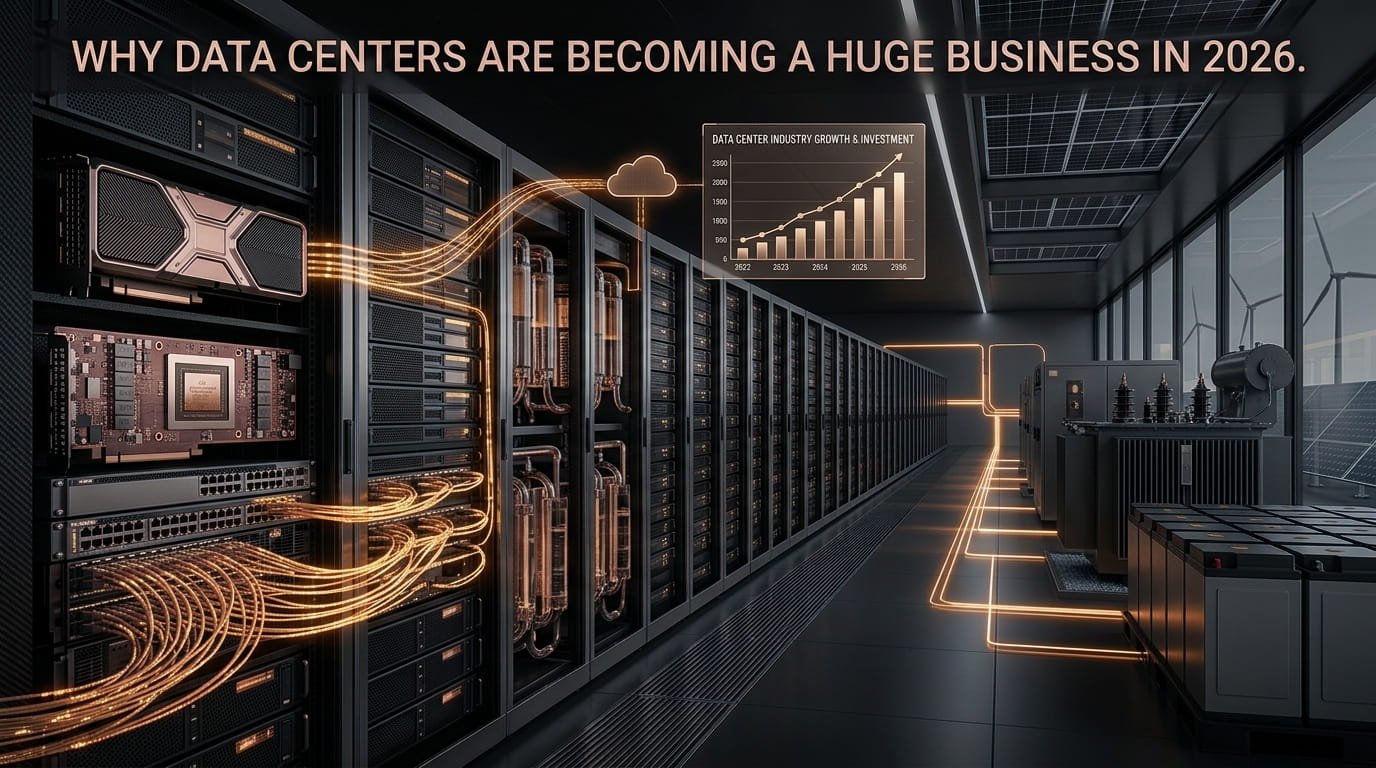
Data centers used to be one of the least visible parts of the technology industry. Most people interacted with websites, cloud apps, streaming platforms, search engines, and software without thinking about the buildings and infrastructure operating behind them.
That is changing rapidly.
In 2026, why data centers are becoming a huge business has a surprisingly simple answer: almost every major technology trend now requires enormous amounts of computing infrastructure.
Artificial intelligence is accelerating that demand. Cloud computing continues to expand it. At the same time, companies need more storage, networking, cybersecurity, digital services, and processing capacity.
As a result, data centers are no longer just buildings filled with servers. They are becoming a critical part of the global economy, linking technology companies with electricity providers, construction firms, semiconductor manufacturers, networking companies, cooling specialists, real estate investors, and financial markets.
JLL estimates that nearly 100 gigawatts of new data center capacity could be added globally between 2026 and 2030, potentially doubling global capacity. The firm also estimates that the sector could grow at roughly a 14% compound annual growth rate through 2030 and require about $3 trillion of investment for 100 GW of new supply.
That helps explain why data centers are becoming a huge business rather than remaining a niche technology segment.
Why Data Centers Are Becoming a Huge Business in 2026
The biggest change is the amount of computing required to run modern digital services.
A traditional website might need relatively modest server capacity. An AI model, however, can require thousands of specialized processors operating simultaneously. Training large models requires massive computational resources, while serving AI responses to millions of users creates a continuous inference workload.
Consequently, businesses need more than just servers.
They need:
- High-performance processors
- High-bandwidth memory
- Networking equipment
- Electricity
- Backup power
- Advanced cooling
- Physical buildings
- Fiber connectivity
- Security systems
- Storage
- Monitoring and automation
- Skilled technicians and engineers
This creates an unusually broad economic opportunity.
A new data center can generate demand for equipment before construction even begins. Developers need land, permits, power connections, transformers, generators, cooling equipment, construction materials and network connectivity.
Once the facility becomes operational, another ecosystem takes over.
Cloud providers lease capacity. Hardware companies supply processors. Networking companies connect servers. Energy companies provide electricity. Cooling specialists manage heat. Maintenance providers keep critical systems operating.
Therefore, the data center economy extends far beyond the companies that actually own the servers.
AI Is Turning Data Centers Into Strategic Infrastructure
Artificial intelligence is the strongest force behind the current expansion.
Modern AI systems require enormous computational resources. Training is only one part of the equation. Once an AI model becomes popular, millions of users may interact with it continuously.
That creates sustained demand for inference capacity.
This distinction matters.
Earlier technology investment often focused on building enough infrastructure for websites, enterprise software and conventional cloud workloads. AI introduces a much more compute-intensive workload.
According to Gartner, worldwide data center electricity consumption is expected to reach 565 terawatt-hours in 2026, up 26% from 2025. Gartner also estimates that AI-optimized servers will account for 31% of data center power consumption in 2026.
In other words, AI is not simply another application running inside existing facilities.
It is changing the physical design of those facilities.
Higher-performance processors generate more heat. Higher rack densities require more sophisticated cooling. Faster processors also require increasingly capable networking systems.
That is why why data centers are becoming a huge business cannot be separated from the AI infrastructure boom.
AI Requires a Different Kind of Data Center
Traditional server environments often focused on relatively predictable workloads.
AI clusters are different.
Large AI systems can concentrate enormous amounts of computing power inside relatively small physical areas. As rack power density increases, the supporting infrastructure becomes increasingly important.
Uptime Institute’s 2026 global survey found that rack densities continue to rise, with a growing number of operators reporting peak rack densities of 30 kW or higher. The organization also identified power availability, costs, supply-chain limitations and staffing shortages as major industry concerns.
This creates a new engineering challenge.
A company cannot simply install more GPUs and expect an old facility to handle them.
The building must support the electrical load. The cooling system must remove the additional heat. Networking must move data quickly enough to keep processors productive. Backup systems must protect the workload from interruptions.
As a result, why data centers are becoming a huge business also comes down to the rising value of specialized infrastructure.
Power Has Become One of the Most Valuable Data Center Resources
For years, companies mainly asked where they could find suitable land for a data center.
Now they increasingly ask a different question:
Where can we secure enough electricity?
That change is significant.
A data center can be constructed relatively quickly compared with major energy infrastructure. However, electricity generation, transmission lines, substations and grid upgrades can take years to plan and build.
The International Energy Agency expects global data center electricity consumption to more than double to around 945 TWh by 2030. It also estimates that data center electricity use could grow around 15% annually from 2024 through 2030.
That means electricity is becoming a strategic competitive advantage.
A developer with a ready power connection can potentially move faster than a competitor that has land but no confirmed energy supply.
Consequently, data center development is increasingly connected to:
- Utility infrastructure
- Renewable energy
- Natural gas
- Nuclear power
- Battery storage
- Transmission networks
- On-site generation
- Long-term power contracts
The relationship between technology and energy is becoming much stronger.
Why Data Centers Are Becoming a Huge Business for Energy Companies
The growing electricity requirement creates another investment opportunity.
Data centers need reliable power around the clock. Unlike many ordinary commercial buildings, a large computing facility cannot simply tolerate frequent interruptions.
Therefore, operators increasingly care about both how much electricity they can obtain and how reliably they can obtain it.
This is already influencing energy investment.
For example, Google announced in September 2026 that it plans to invest more than $15 billion in AI infrastructure in Finland while also supporting electricity-grid, clean-energy and battery projects. Google also signed a long-term agreement involving the Loviisa nuclear plant.
The broader lesson is important.
The future data center market is not just about server buildings. It is also about securing the energy ecosystem around those buildings.
Cooling Is Becoming a Major Business Opportunity
Electricity creates another problem: heat.
The more computing power a facility operates, the more heat engineers must remove.
Traditional air cooling remains useful, but high-density AI infrastructure is pushing operators toward more advanced approaches, including liquid cooling.
Liquid cooling can move heat away from high-performance components more efficiently than conventional air-based systems in certain high-density environments.
This creates opportunities for companies involved in:
- Cooling equipment
- Heat exchangers
- Pumps
- Cooling distribution systems
- Thermal management
- Liquid cooling infrastructure
- Monitoring and controls
Uptime Institute notes that rising rack densities and AI workloads are increasing the importance of cooling, while its research also highlights growing interest in automation for cooling operations.
Therefore, why data centers are becoming a huge business involves an entire thermal-management industry that many consumers rarely notice.
The Data Center Supply Chain Is Much Larger Than the Building
A common mistake is to think of a data center as a real estate project.
It is much more complicated.
A modern facility requires an interconnected supply chain.
1. Land and real estate
Developers need suitable locations with access to electricity, water or cooling resources, fiber networks and transportation.
2. Construction
Large facilities require specialized construction teams, electrical contractors, mechanical contractors and equipment suppliers.
3. Electrical infrastructure
Transformers, switchgear, backup generators, batteries and distribution systems become critical components.
4. Computing hardware
AI accelerators, CPUs, GPUs, memory and storage equipment provide the actual computing capability.
5. Networking
High-speed switches, optical connections and cables allow thousands of processors to communicate.
6. Cooling
Advanced thermal systems prevent high-density hardware from overheating.
7. Operations
Once a facility becomes operational, technicians, engineers and monitoring systems keep it available.
Each layer represents a separate commercial opportunity.
That is why the economic impact of data center growth can spread across many industries simultaneously.
Hyperscalers Are Driving Enormous Capital Spending
Amazon, Microsoft, Google and Meta are among the largest buyers of data center capacity in the world.
These companies operate enormous cloud platforms, and AI is increasing their infrastructure requirements.
The business model is straightforward.
More users and more AI workloads require more computing capacity. Computing capacity requires more servers. Servers require more data center space, electricity, cooling and networking.
That creates a feedback loop.
More AI adoption → more computing demand → more infrastructure → more data center investment.
However, companies cannot build unlimited infrastructure instantly.
They face permitting delays, grid constraints, construction bottlenecks and equipment shortages.
This creates scarcity.
And scarcity can increase the value of available capacity.
Why Data Center Operators Can Become Valuable Infrastructure Businesses
The economics of data centers have similarities with other infrastructure industries.
A facility requires large upfront capital investment. However, once constructed and occupied, it can generate recurring revenue over many years.
Customers may lease capacity under long-term agreements. That can provide relatively predictable revenue compared with some purely consumer-facing technology businesses.
The exact economics vary considerably by location, facility type, customer and financing structure.
Still, the basic attraction remains clear.
Investors are increasingly treating digital infrastructure as a real asset class rather than simply another technology subsector.
JLL’s 2026 outlook reinforces that shift, describing data centers as a rapidly expanding infrastructure market requiring trillions of dollars of investment over the coming years.
Why Data Centers Are Becoming a Huge Business for Real Estate Investors
Data center real estate is different from ordinary office or retail property.
Location matters enormously, but the most valuable characteristics may not be traditional real-estate features.
Investors care about:
- Available electrical capacity
- Speed of grid connection
- Fiber connectivity
- Land availability
- Cooling conditions
- Regulatory environment
- Tax policy
- Water availability
- Disaster risk
- Proximity to major cloud markets
A large piece of inexpensive land is not automatically valuable if it cannot receive enough electricity.
Conversely, land with secured power and strong connectivity can become extremely attractive.
This explains why some markets are becoming data center hotspots despite having little history as traditional technology hubs.
The Grid Could Become the Biggest Limitation
The biggest threat to rapid data center expansion may not be demand.
It may be infrastructure.
The IEA highlights the mismatch between the speed of technology development and the longer timelines required to build energy infrastructure. A data center may become operational in two to three years, while power infrastructure can require much longer planning and construction periods.
That creates a bottleneck.
Imagine a company has financing, land, customers and servers ready to deploy.
If the local utility cannot provide sufficient power, the entire project can remain delayed.
Uptime Institute similarly identifies power availability as one of the industry’s increasingly important constraints.
Consequently, the next phase of data center competition could depend less on who can build the biggest building and more on who can secure reliable power first.
Renewable Energy and Nuclear Power Could Become More Important
Data center operators face another challenge: sustainability.
Large technology companies have made environmental commitments, while governments increasingly scrutinize electricity consumption and emissions.
At the same time, AI workloads are increasing power requirements.
This creates a difficult balancing act.
Renewable energy can provide large amounts of electricity, but generation can vary with weather and time. Batteries can help manage that variability. Natural gas can provide dispatchable power, while nuclear energy offers another low-carbon source of reliable generation.
The IEA expects renewables and natural gas to play major roles in meeting future data center demand, while nuclear power and emerging technologies could also contribute.
Therefore, future data center development may increasingly involve energy partnerships rather than simple electricity purchases.
Networking Is Another Hidden Data Center Opportunity
AI processors are powerful, but they do not operate in isolation.
Large AI clusters require enormous amounts of data to move between processors and storage systems.
That makes networking infrastructure critical.
High-speed switches, optical transceivers, fiber connections and specialized networking technologies help prevent communication bottlenecks.
In some AI systems, improving networking can be almost as important as improving individual processors.
This creates opportunities beyond the famous AI chip companies.
Companies supplying networking equipment, optical technology and connectivity infrastructure can benefit as AI clusters become larger and more interconnected.
Semiconductor Companies Also Benefit From Data Center Expansion
The relationship works in both directions.
Data centers create demand for semiconductors, while semiconductor advances allow data centers to process more information efficiently.
AI accelerators are at the center of this ecosystem, but memory is equally important.
Large AI models require substantial amounts of high-speed memory. High-bandwidth memory has therefore become a strategically important component of modern AI systems.
This creates a broad semiconductor opportunity involving:
- AI accelerators
- CPUs
- GPUs
- High-bandwidth memory
- Networking chips
- Power-management semiconductors
- Storage controllers
- Optical components
As computing infrastructure expands, demand can spread throughout the semiconductor supply chain.
Why Data Centers Are Becoming a Huge Business Despite the Risks
The growth story is compelling, but investors and businesses should not treat every data center project as automatically profitable.
There are serious risks.
Power delays
A project can experience major delays if grid connections take longer than expected.
Construction costs
Labor, electrical equipment, transformers and specialized cooling systems can become expensive.
Interest rates
Data centers require significant upfront capital. Higher financing costs can reduce project economics.
AI demand uncertainty
AI adoption may continue strongly, but companies could slow infrastructure spending if expected returns fail to materialize.
Technology changes
New processors and architectures can make existing infrastructure less competitive if facilities cannot upgrade efficiently.
Regulatory pressure
Governments may impose new requirements involving electricity, water, emissions, land use or community impact.
Operational failures
A major outage can cause substantial financial and reputational damage.
Uptime Institute reports that although impactful outages have generally become less frequent, around one in ten outages in its 2026 research was classified as serious or severe, while outage costs continue to rise.
Therefore, infrastructure quality matters just as much as expansion speed.
Data Center Growth Could Create a New Investment Cycle
The most interesting part of this trend is how many industries can participate.
Consider the chain:
AI companies need computing.
Computing requires servers.
Servers require chips and memory.
Servers need high-speed networking.
All of that equipment requires data centers.
Data centers require electricity.
Electricity requires generation and transmission infrastructure.
High-density servers require advanced cooling.
Facilities require construction, maintenance and security.
Each layer creates economic activity.
That is the deeper reason why data centers are becoming a huge business in 2026.
The opportunity is not concentrated in one category.
What Could Slow the Data Center Boom?
A strong growth market can still experience corrections.
One major concern is overbuilding.
If companies build capacity faster than customers need it, vacancy rates can increase and pricing can weaken.
Another concern is financing.
Data center projects require enormous amounts of capital. Reuters reported in September 2026 that AI-related debt issuance had approached $500 billion by early August, while electricity constraints, project delays and political opposition were making lenders more cautious.
That does not mean the industry is collapsing.
Instead, it shows that the market is becoming more selective.
Projects with secured power, credible customers, strong financing and suitable locations may remain attractive, while speculative projects could face greater difficulty.
How Businesses Can Prepare for the Data Center Economy
Companies that want to benefit from the growth should think beyond simply owning a server facility.
Several opportunities stand out.
Infrastructure suppliers
Companies can provide electrical systems, cooling equipment, generators, batteries and networking hardware.
Energy providers
Reliable electricity is becoming increasingly valuable as computing demand rises.
Construction companies
Specialized data center construction is becoming a significant market.
Software providers
Monitoring, automation, cybersecurity and infrastructure management tools can help operators manage increasingly complex facilities.
Real estate developers
Developers with access to suitable land and power can potentially create valuable digital infrastructure projects.
Investors
Investors can evaluate data center operators, REITs, utilities, semiconductor companies, networking companies and equipment manufacturers as different ways to participate in the broader trend.
However, each category carries different risks.
What the Data Center Industry Could Look Like by 2030
The next few years could fundamentally change the industry.
JLL expects nearly 100 GW of new data center capacity to be added globally between 2026 and 2030. Meanwhile, the IEA expects data center electricity consumption to approach 945 TWh by 2030.
At the same time, AI could account for a much larger share of workloads.
JLL estimates AI could represent roughly half of data center workloads by 2030.
If that happens, facilities will need to become more specialized.
Expect greater use of:
- Liquid cooling
- High-density racks
- AI accelerators
- Advanced networking
- On-site power
- Battery storage
- Renewable energy
- Nuclear power partnerships
- Automated monitoring
- Predictive maintenance
- More efficient power systems
The data center of 2030 may look very different from the traditional server facilities many companies operated a decade ago.
How to Evaluate the Data Center Business Without Chasing Hype
The strongest projects will probably share several characteristics.
Before investing in or building a data center, businesses should examine:
1. Power availability: Is electricity actually secured, or is it only proposed?
2. Customer demand: Are credible customers committed to using the capacity?
3. Connectivity: Does the site have strong fiber and network access?
4. Cooling: Can the facility support future high-density computing?
5. Financing: Can the project withstand higher interest rates or construction delays?
6. Location: Does the market have sufficient infrastructure and a supportive regulatory environment?
7. Expansion potential: Can the facility grow without encountering another major power constraint?
8. Operational resilience: Can the site maintain service during grid failures or equipment problems?
This framework separates genuine infrastructure opportunities from speculative projects.
The Biggest Insight: Data Centers Are Becoming Part of the Energy Economy
Perhaps the most important development is that the technology industry and energy industry are increasingly becoming connected.
For decades, technology companies primarily competed over software, users and computing power.
Now they also compete for electricity.
A company with access to a large amount of reliable power can potentially deploy AI infrastructure faster. Meanwhile, utilities must plan for rapidly increasing loads, and governments must decide how to expand grids without creating reliability or affordability problems.
The result is a new relationship between:
AI + semiconductors + data centers + electricity + real estate + construction + networking.
That combination is much larger than the data center market alone.
Why Data Centers Are Becoming a Huge Business: Final Outlook
The strongest evidence points toward continued expansion, but the next phase will not simply be about building more server buildings.
It will be about building better infrastructure in locations where power, connectivity, cooling, capital and customers come together.
AI is the biggest catalyst. Cloud computing provides another major source of demand. Digital services continue to expand the underlying need for computing capacity.
At the same time, power availability is becoming a critical constraint.
That creates both opportunity and risk.
Businesses that can secure electricity, build efficiently, manage high-density computing and maintain reliable operations could benefit significantly. However, companies that underestimate financing costs, grid constraints, cooling requirements or customer demand could struggle.
Ultimately, why data centers are becoming a huge business comes down to one fundamental reality: the digital economy needs a physical foundation.
Every AI response, cloud application, online transaction, video stream and digital service depends on computing infrastructure somewhere.
In 2026, that infrastructure is becoming too important to remain in the background.
For investors, entrepreneurs and technology companies, the data center industry deserves attention not simply because AI is growing, but because the physical infrastructure required to run AI is becoming an economy of its own.
Frequently Asked Questions
1. Why are data centers becoming so important in 2026?
Data centers are becoming more important because AI, cloud computing, streaming, enterprise software and other digital services require increasing amounts of computing capacity. AI workloads are particularly demanding because they require powerful processors, high-speed networking, large amounts of memory and significant electricity.
2. Is AI the main reason for data center growth?
AI is one of the most important drivers, but it is not the only one. Cloud computing, digital services, enterprise applications, data storage and online platforms also contribute to demand. However, AI is changing the scale and physical requirements of data center infrastructure because advanced AI workloads can require much higher computing and power density.
3. Why is electricity so important for data centers?
Data centers operate continuously and require reliable electricity for servers, networking, cooling and backup systems. AI increases power requirements because high-performance processors consume substantial amounts of electricity. The IEA expects global data center electricity consumption to more than double to around 945 TWh by 2030.
4. Are data centers a good investment?
Data centers can provide attractive long-term infrastructure opportunities, but they are not automatically good investments. Investors should examine power availability, customer commitments, financing costs, construction expenses, connectivity, cooling requirements, location and regulatory risks before making a decision.
5. What companies benefit from data center growth?
The beneficiaries can extend far beyond data center operators. Semiconductor manufacturers, AI chip companies, networking providers, cooling companies, electrical equipment suppliers, utilities, construction firms, energy producers, fiber providers and digital infrastructure businesses can all benefit from increased data center investment.
Conclusion
Data centers are moving from the background of the technology industry to the center of the global investment story.
AI is accelerating demand, cloud computing is sustaining it, and the need for reliable electricity is creating entirely new infrastructure challenges.
The opportunity is therefore much broader than simply constructing server buildings.
The companies positioned to benefit may include those supplying chips, memory, networking, electricity, cooling, construction, batteries, power equipment and digital infrastructure.
At the same time, investors should remain selective. Power constraints, financing costs, construction delays, regulation and AI demand uncertainty can all change the economics of individual projects.
The most important takeaway is simple: the digital economy cannot grow without physical infrastructure.
And in 2026, that physical infrastructure is becoming one of the world’s most important—and potentially most valuable—business ecosystems.







Understanding Insurance Underwriting
Insurance companies use underwriting to evaluate, price, and accept or reject risk for policy applicants. This process helps establish the coverage terms, limits, and premiums for a person or business. By reviewing each application carefully, insurers can assess the premium necessary to cover expected claims, expenses, and unexpected losses. Underwriters protect the insurer’s financial health while shaping access to coverage.
Underwriting traces its roots to London in the 1680s at Edward Lloyd’s coffee house. Merchants and shipowners met there with financial backers willing to take on part of a sea voyage’s risk. When a ship or cargo needed insurance, those backers wrote their names beneath the description of the vessel, cargo, and venture. That practice of signing one’s name under the detailed risk gave underwriting its name.
The modern underwriting process begins with a review to confirm that a policyholder’s documents are accurate and complete. Underwriters then collect additional data from public records, inspections, and third-party databases to build a comprehensive risk profile. Next, analysts use statistical models and actuarial data to predict a claim’s likelihood during the policy period.
Based on this information, underwriters classify applicants into appropriate rating categories. This classification helps insurers calculate premiums that account for expected claims, administrative expenses, and uncertainty. Finally, the underwriter decides whether to approve the policy and sets the coverage terms, limits, or restrictions. Clear guidelines help make decisions more consistent and reduce unnecessary subjectivity.
There are several variables underwriters use to determine eligibility and monthly pricing. For example, age is a primary factor because people become more susceptible to medical conditions as they age. Sex also matters, as women often receive lower premiums than men due to their longer average life expectancy. Overall health, encompassing current medical status, history of illness, and specific medications, helps establish how a person manages various conditions.
Lifestyle choices, such as tobacco use or participation in hazardous activities, can significantly influence the final risk assessment. Underwriters may also evaluate financial information to verify that the requested insurance amount matches an applicant’s financial profile. For property insurance, important factors may include the building’s location, age, construction materials, and exposure to geographic risks. Together, these data points help insurers set appropriate prices and reduce problems caused by incomplete or inaccurate information.
Various types of insurance underwriting exist. Life insurance underwriting focuses on medical profiles and financial stability. It checks if an applicant’s net worth justifies the policy value they are requesting. Property and casualty underwriting looks at assets in relation to their exposure to natural hazards like floods or fires. Health underwriting assesses surgical histories and prescriptions for individuals or employee groups.
Auto insurance underwriters review driving records, past claims, and traffic violations. Today, some underwriters use innovations like telematics, a tracking technology, to monitor driving behavior like braking patterns and vehicle speed.
Notably, about 40 percent of an underwriter’s work goes to administrative tasks. For example, they manually manage fragmented data across old computer systems. This can slow down the approval process. To solve this, these professionals are implementing artificial intelligence (AI) to automate repetitive tasks.
AI tools can scan thousands of files in seconds to find patterns or errors, helping reduce operational costs while providing real-time insights for more accurate risk modeling. This allows underwriters to focus on other non-routine work. Importantly, insurers must ensure that their systems’ algorithms follow prescribed ethical standards and don’t generate information with unintended biases.
AI adoption in underwriting is expected to grow from 14 percent to about 70 percent within the next three years. This technology can handle standard, high-volume applications more efficiently while human underwriters manage complex or non-standard risks. Future systems will also need stronger transparency so applicants can understand the reasons behind pricing and coverage decisions. Real-time data from tools such as wearable devices or car sensors may shape future underwriting, but any claim about discounts needs stronger supporting evidence before publication.
About Eric Poe
Eric Poe is the CEO of CURE Auto Insurance, where he oversees underwriting, loss control, claims, litigation, and insurance product operations. An attorney and certified public accountant, he earned degrees from the University of Colorado Boulder and Seton Hall University School of Law. Based in Princeton, New Jersey, he has advocated for fair underwriting practices and legislation that promotes insurance pricing based on driving records rather than unrelated personal characteristics.


Why Data Centers Are Becoming a Huge Business in 2026

UK Tech Regulation: How Safety Rules Could Change Big Tech

AI Infrastructure Stocks: The Companies Powering Next AI Boom
-

 Entertainment9 years ago
The final 6 ‘Game of Thrones’ episodes might feel like a full season
-

 lifestyle6 months ago
Creative Conference Room Ideas to Enhance Productivity and Collaboration in 2026
-
Fashion9 years ago
According to Dior Couture, this taboo fashion accessory is back
-
Business9 years ago
The 9 worst mistakes you can ever make at work
-
Entertainment9 years ago
The old and New Edition cast comes together to perform
-
Business9 years ago
Uber and Lyft are finally available in all of New York State
-
Entertainment9 years ago
Disney’s live-action Aladdin finally finds its stars
-
Entertainment9 years ago
Mod turns ‘Counter-Strike’ into a ‘Tekken’ clone with fighting chickens