Connect with us

Blogs

15 Things That Measure 100 Feet (ft) In Length

Published

on

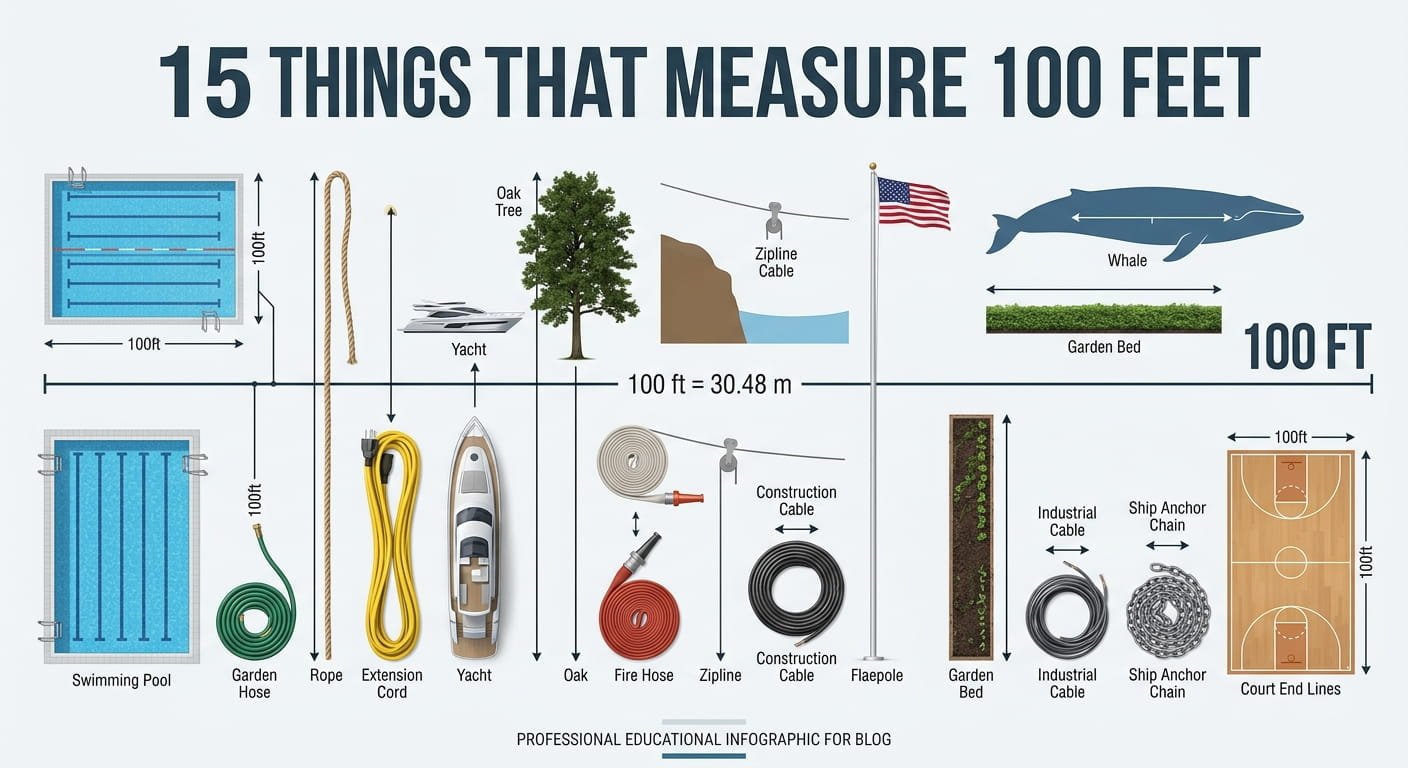
15 things that measure 100 feet in length with real-world size comparisons

Knowing what 15 things that measure 100 feet (ft) in length look like can make a large distance much easier to understand. One hundred feet may sound like a simple number, but it is difficult to visualize without a familiar reference point.

A standard foot equals exactly 0.3048 meters, so 100 feet equals 30.48 meters, or about 33.33 yards.

Some objects and spaces are naturally close to this measurement, while others are commonly manufactured, sold, or described in 100-foot lengths. Examples include long swimming pools, large boats, ropes, hoses, extension cords, utility equipment, and certain trees or structures.

This article looks at 15 useful examples and explains how each one helps put 100 feet into perspective.

How Long Is 100 Feet?

Before comparing 100 feet with familiar objects, it helps to convert the measurement into other units.

Measurement Equivalent
Feet 100 ft
Inches 1,200 in
Yards 33.33 yd
Meters 30.48 m
Centimeters 3,048 cm
Kilometers 0.03048 km
Miles About 0.0189 mi

The meter conversion is exact under the international definition of the foot: 1 foot = 0.3048 meter.

Another simple way to picture 100 feet is to imagine a straight line containing 20 objects that are each 5 feet long, or 10 objects that are each 10 feet long.

The examples below provide more recognizable references.

15 Things That Measure 100 Feet (ft) in Length

1. A 100-Foot Swimming Pool

A swimming pool can be designed to measure exactly 100 feet from one end to the other. These pools are especially useful as a straightforward visual comparison because the distance is clearly defined by the pool’s construction.

A 100-foot pool would measure 30.48 meters long.

However, not every large swimming pool is 100 feet long. Competitive pools can have standardized dimensions that differ substantially, so a pool should only be used as a precise comparison when its specifications confirm a 100-foot length.

For visualization purposes, imagine standing at one end of a 100-foot pool and looking directly toward the opposite end. The entire straight distance represents 100 feet.

2. A 100-Foot Garden Hose

Garden hoses are commonly sold in several lengths, including 25, 50, 75, and 100 feet.

A 100-foot hose is therefore one of the easiest household examples of the measurement.

If the hose is completely stretched out in a straight line, its total length is 100 feet. When coiled, however, it occupies much less horizontal space, which can make it difficult to judge its actual length visually.

A 100-foot hose is approximately:

  • 33.33 yards long
  • 30.48 meters long
  • 1,200 inches long

This example is particularly useful because you can measure a 100-foot distance simply by stretching the hose from one point to another.

3. A 100-Foot Extension Cord

Long extension cords are another practical example. Some heavy-duty extension cords are manufactured in 100-foot lengths, particularly for construction, landscaping, outdoor maintenance, events, and other applications where a standard household cord is too short.

The actual usable reach can be slightly different depending on how the cord is positioned, because bends and obstacles prevent it from forming a perfectly straight line.

Still, an extension cord labeled 100 feet provides a direct physical reference for the measurement.

4. A 100-Foot Rope

Rope is frequently sold in predetermined lengths, and 100-foot ropes are common for outdoor activities, utility work, training, rigging applications, and general-purpose use.

A straight 100-foot rope gives you an unusually accurate way to visualize the distance.

If you divide it into four equal sections, each section would be 25 feet. Divide it into ten sections and each section would be 10 feet.

This makes a 100-foot rope useful not only as an example but also as a practical measuring aid.

5. A 100-Foot Climbing or Rescue Rope

Specialized ropes used for climbing, rescue, caving, rope access, and related activities can be manufactured in lengths around 100 feet.

The important distinction is that a rope’s length is not the same as its safe working distance. Knots, anchors, bends, equipment, and safety requirements can reduce the usable distance.

For a simple physical comparison, though, a 100-foot rope stretched straight provides exactly 100 feet of linear length.

6. A 100-Foot Measuring Tape or Surveying Tape

Long measuring tapes are designed specifically for measuring large distances. A 100-foot tape measure is commonly used in construction, landscaping, athletics, property measurement, and other situations where a conventional 12- or 25-foot tape is inadequate.

Unlike an ordinary measuring tape, a long tape allows one person or a team to establish a 100-foot reference directly.

This makes it one of the most reliable examples on the list because its purpose is measurement rather than comparison.

For precise work, the tape’s markings, tension, temperature, and measuring technique can matter.

7. A Large Yacht Around 100 Feet Long

Some yachts are designed at or near 100 feet in overall length. A vessel of this size is substantially larger than the boats most people see at ordinary marinas.

A 100-foot yacht measures:

100 ft × 0.3048 = 30.48 m

So it would be roughly 30.5 meters from bow to stern.

It is worth remembering that yacht dimensions vary significantly. A yacht described as “100 feet” may have a length close to that figure, but the exact measurement depends on how the manufacturer defines overall length.

8. A Tall Tree

Certain mature trees can approach or exceed 100 feet in height, making them useful visual references for the distance.

This comparison requires some care: height is vertical while length is horizontal. A 100-foot tree does not necessarily have a 100-foot-long trunk or branch.

Large conifers and other mature trees can reach well beyond 100 feet under suitable conditions. Therefore, a tree measured at exactly 100 feet provides a good visual scale, but tree species, age, location, and growing conditions all affect its dimensions.

If you imagine laying that 100-foot height horizontally along the ground, the resulting line would represent the same distance.

9. A Long Fire Hose

Fire hoses are available in different lengths depending on their intended use, and 100-foot hose sections are used in some firefighting and specialized applications.

A 100-foot hose section provides a clear example because the measurement describes the physical length of the hose rather than the space it occupies when stored.

Fire hoses are normally coiled or folded for storage. Once deployed, they extend across the ground and can cover substantial distances.

Their actual operational reach depends on the hose arrangement, water supply, elevation, equipment, and firefighting strategy, so the hose’s physical length should not be confused with its effective operating range.

10. A Long Zipline

Some recreational zipline installations can span around 100 feet, although many are considerably longer.

A 100-foot zipline would have a cable length of approximately 30.48 meters, subject to the specific installation design.

The cable itself may not form a perfectly horizontal line. Ziplines generally have a slope between the starting and ending points, so the physical cable length and the horizontal distance between the platforms are not necessarily identical.

That distinction is useful because it demonstrates an important measurement principle: 100 feet of actual length does not always mean 100 feet of horizontal distance.

11. A Large Billboard Structure

Large advertising structures can have long horizontal or vertical components approaching 100 feet, particularly when they are installed along highways or at large commercial sites.

However, unlike a 100-foot hose or rope, there is no single standard billboard dimension of 100 feet.

This makes billboards better as approximate visual references than exact measuring examples.

If a structure is documented as having a 100-foot-long support, sign assembly, or other component, it can provide a useful reference. Without verified dimensions, however, it should not be described as exactly 100 feet.

12. A Section of Construction Cable

Construction and industrial projects frequently use cables, wires, conduit, tubing, and similar materials supplied in long lengths. Some are available in 100-foot sections or rolls.

A 100-foot cable provides a useful visual reference for understanding the length because people often lay cables across large work areas.

For example, stretching a 100-foot cable straight along a construction site can cover a distance of roughly 30.48 meters between two points.

Product lengths vary considerably, so people should check the packaging or manufacturer specifications when precision matters.

13. A 100-Foot Flagpole or Mast

Large flagpoles, communication masts, and similar vertical structures can reach approximately 100 feet in height.

A 100-foot flagpole is therefore another useful way to visualize the measurement.

If you stood at the base and looked straight upward, you would see the top approximately 100 feet above the ground, assuming the structure reaches its rated height.

As with a tree, this is a height comparison rather than a horizontal length comparison. Nevertheless, placing a 100-foot vertical structure beside a familiar building can help demonstrate how substantial the distance is.

14. A Very Large Animal, Such as a Blue Whale

The blue whale is often used when discussing extremely large biological dimensions. Adult blue whales can reach lengths approaching or exceeding 100 feet, although individual size varies.

That means a particularly large blue whale can provide a striking mental comparison for 100 feet.

Unlike manufactured objects, animals cannot be expected to measure exactly 100 feet. Their length depends on the individual, sex, age, and measurement method.

For that reason, a blue whale should be considered an approximate natural comparison, not a standardized 100-foot object.

15. A 100-Foot Cable or Mooring Line on a Boat

Boats and marine equipment can use long lines for anchoring, mooring, towing, docking, and other purposes. A 100-foot line provides a practical example of how far 100 feet can extend over water.

A 100-foot marine line measures 30.48 meters when fully stretched.

Its effective reach can be affected by knots, attachment points, slack, water movement, and the angle of the line. As a result, a line that is 100 feet long does not necessarily create a 100-foot straight horizontal separation between two objects.

Still, it is a useful physical example of the actual length.

A Quick Comparison of 100-Foot Examples

Example Approximate/Exact 100 ft? Why It Helps
100-foot swimming pool Exact when specified Easy straight-line comparison
Garden hose Exact if labeled 100 ft Common household reference
Extension cord Exact if labeled 100 ft Practical everyday example
Rope Exact if sold as 100 ft Can be stretched out
Climbing/rescue rope Exact when specified Long flexible reference
Measuring tape Exact Designed for measurement
Yacht Approximate or exact Shows large vehicle scale
Tall tree Approximate Shows vertical scale
Fire hose Exact when specified Useful industrial reference
Zipline Approximate Demonstrates long cable length
Billboard structure Approximate Large-scale built reference
Construction cable Exact when specified Industrial comparison
Flagpole/mast Approximate or exact Shows vertical scale
Blue whale Approximate Natural comparison
Marine/mooring line Exact when specified Useful long-line example

How to Visualize 100 Feet Without Measuring Equipment

You do not always need a 100-foot tape to estimate this distance.

Use 10-Foot Sections

Imagine ten equal sections, each measuring 10 feet:

10 × 10 ft = 100 ft

This is one of the simplest mental methods.

Use Yards

Since one yard equals three feet:

100 ÷ 3 = 33.33 yards

So 100 feet is approximately 33⅓ yards.

Use Meters

Because one foot equals exactly 0.3048 meters:

100 × 0.3048 = 30.48 meters

NIST also gives 100 feet as 30.48 meters in its conversion guidance.

Use a Familiar Person’s Height

Suppose an adult is approximately 5 feet 8 inches tall, or about 5.67 feet.

It would take roughly:

100 ÷ 5.67 ≈ 17.6

So the height of about 18 such people placed end-to-end would approach 100 feet.

This is only an estimation because people’s heights vary.

100 Feet Compared With Common Sports Dimensions

Sports facilities can also help put 100 feet into perspective, but exact comparisons require care.

An American football field, for example, is much longer than 100 feet. The playing field between the end zones is 300 feet long, while the full field including the two end zones measures 360 feet.

That means 100 feet is roughly one-third of the playing area between the end zones.

This is a useful comparison because most people who have watched American football have seen the field layout.

A basketball court, by contrast, is shorter than 100 feet. The NBA court is 94 feet long, so 100 feet is only 6 feet longer than an NBA court.

That makes an NBA basketball court one of the better familiar references for estimating 100 feet.

Why 100 Feet Can Be Harder to Judge Than It Sounds

People often underestimate long distances because visual perspective compresses space.

A 100-foot distance can look much shorter when:

  • The area is wide and open.
  • There are no objects between the two endpoints.
  • The ground slopes downward.
  • The distance is viewed from an elevated position.
  • The object being measured is curved.
  • The reference object is viewed from far away.

For this reason, a physical measuring tool is preferable whenever accuracy matters.

A 100-foot hose, rope, or measuring tape can give you a much better reference than trying to estimate the distance visually.

Exact vs. Approximate 100-Foot Comparisons

One of the most important distinctions in lists like this involves the difference between products manufacturers make at 100 feet and natural objects or structures that can sometimes reach 100 feet.

For example:

  • A 100-foot extension cord is an exact product length when specified by the manufacturer.
  • A 100-foot rope is an exact length when sold and labeled that way.
  • A blue whale reaching around 100 feet is an approximate biological comparison.
  • A tall tree reaching 100 feet is an approximate natural comparison.
  • A yacht described as 100 feet has a specified overall length, but different measurement conventions may apply.

This distinction prevents misleading comparisons.

Lesser-Known Ways to Think About 100 Feet

One useful insight is that 100 feet is not a particularly large distance in engineering, construction, or surveying, but it is quite large in everyday human-scale environments.

For instance, a person can easily walk 100 feet, but estimating the distance without a reference is surprisingly difficult.

Another useful observation is that 100 feet represents a meaningful transition between household and commercial scales. A 100-foot garden hose or extension cord is possible to purchase for everyday use, while a 100-foot yacht, tree, or structural mast represents a much larger physical scale.

The same number can therefore describe objects of completely different types.

Common Mistakes When Comparing 100 Feet

Confusing Height With Length

A 100-foot tree is 100 feet tall, but that does not mean its trunk is 100 feet long when laid out straight.

Assuming Every Large Object Is Exactly 100 Feet

Large boats, trees, animals, and structures come in different sizes. People should describe them as exactly 100 feet only when reliable measurements support that claim.

Ignoring Curves

A curved rope or cable can have 100 feet of material while occupying less than 100 feet of straight-line space.

Forgetting the Difference Between Horizontal and Actual Distance

A sloped cable can be 100 feet long while the horizontal distance between its endpoints is shorter.

These distinctions matter most when people use measurements for construction, property work, safety, or technical planning.

Frequently Asked Questions

How many meters is 100 feet?

100 feet equals exactly 30.48 meters under the international definition of the foot. The calculation is 100 × 0.3048 = 30.48 meters. NIST identifies 0.3048 meter as the exact metric equivalent of one international foot.

How many yards are in 100 feet?

There are approximately 33.33 yards in 100 feet. Since one yard equals three feet, you divide 100 by 3. The result is 33⅓ yards, which is usually written as approximately 33.33 yards.

Is an NBA basketball court close to 100 feet long?

Yes. An NBA basketball court is 94 feet long, making it 6 feet shorter than 100 feet. That makes a basketball court a useful real-world reference when trying to visualize a 100-foot distance.

Can a blue whale be 100 feet long?

Very large blue whales can approach or exceed 100 feet, but individual animals vary in size.Therefore, you should treat a blue whale as an approximate natural comparison rather than as an object with a standardized 100-foot length.

What household items commonly come in 100-foot lengths?

Manufacturers sell several household and outdoor products in 100-foot lengths, including garden hoses, extension cords, ropes, measuring tapes, cables, and certain utility lines.
The exact available lengths depend on the manufacturer and product type.

How far is 100 feet compared with a football field?

The playing field between the end zones of an American football field is 300 feet long. Therefore, 100 feet is one-third of that 300-foot playing area. Including the two 30-foot end zones, the entire field is 360 feet long.

How can I measure 100 feet accurately?

The easiest method is to use a 100-foot measuring tape, measuring wheel, survey equipment, or a precisely measured rope. For rough estimates, you can also use the fact that 100 feet equals 33.33 yards or 30.48 meters.

Conclusion

These 15 things that measure 100 feet (ft) in length show that 100 feet can represent many different scales, from a simple garden hose or extension cord to a large yacht, tree, or marine line. The exactness of each comparison matters: manufacturers can produce some examples at precisely 100 feet, while others only reach approximately that height.

For reference, 100 feet equals 30.48 meters, 33.33 yards, and 1,200 inches.

The easiest way to understand the distance is to combine several references. Think of a 100-foot measuring tape, imagine about 33⅓ yards, or picture a distance slightly longer than an NBA basketball court. Once you connect the number to familiar objects and spaces, 100 feet becomes much easier to visualize.

Continue Reading
Click to comment

Leave a Reply

Your email address will not be published. Required fields are marked *

Blogs

Best Exercises for Pregnant Women at Home: Safe Guide

Published

on

Safe exercises for pregnant women at home

Finding the best exercises for pregnant women at home does not mean following an intense workout plan. For most healthy pregnancies, regular moderate physical activity can support cardiovascular health, help manage pregnancy-related weight gain, and reduce the risk of gestational diabetes. Current CDC guidance recommends at least 150 minutes of moderate-intensity aerobic activity each week, although you can divide that time into smaller sessions.

At home, you can stay active without expensive equipment or a complicated routine. Walking, pelvic floor exercises, gentle prenatal yoga, modified strength movements, and mobility exercises can all fit into a pregnancy-friendly schedule.

However, pregnancy changes throughout each trimester. Therefore, an exercise that feels comfortable early in pregnancy may need modification later. If you have a pregnancy complication, have been advised to restrict activity, or feel unsure about exercise, speak with your obstetrician, midwife, or other maternity care professional before starting.

Pregnancy safety note: This article provides general educational information, not individualized medical advice. Your pregnancy history and current health should determine which activities are appropriate for you.

Why Exercise Matters During Pregnancy

Physical activity offers several potential benefits during pregnancy. According to the CDC, moderate-intensity activity can help maintain cardiovascular fitness, reduce the risk of excessive pregnancy weight gain, and lower the risk of gestational diabetes.

Exercise can also make everyday movement more comfortable. For example, strengthening the muscles around your legs, hips, back, and core can help you manage changes in posture and body weight.

There is another practical benefit: movement can support your mental well-being. Pregnancy can bring fatigue, stress, sleep changes, and physical discomfort. A short walk or gentle mobility session may feel much more manageable than a long workout.

Most importantly, you do not need to exercise perfectly.

The CDC specifically notes that some physical activity is better than none. You can split your weekly target into manageable sessions instead of trying to complete a long workout at once.

Best Exercises for Pregnant Women at Home

The best exercises for pregnant women at home should be comfortable, adaptable, low-impact, and appropriate for your current stage of pregnancy.

Here are several practical options.

1. Walking Indoors or Around Your Home

Walking remains one of the simplest pregnancy exercises.

You can walk around your home, use a treadmill if you have one, or walk outside near your home when conditions allow. The NHS describes walking as a useful way to stay active during pregnancy, particularly for people who did not exercise regularly before pregnancy.

Start with a comfortable pace. You should generally be able to maintain a conversation while exercising. If you become too breathless to talk comfortably, slow down.

A simple home walking routine could look like this:

  • 5 minutes of easy walking
  • 10–20 minutes at a comfortable moderate pace
  • 5 minutes of slower walking

You can also divide the activity into shorter sessions. For example, three 10-minute walks can make exercise easier when fatigue or a busy schedule gets in the way.

2. Pelvic Floor Exercises

Pelvic floor exercises deserve a place in almost every pregnancy exercise discussion.

These exercises target the muscles that support the bladder, bowel, and pelvic organs. The NHS recommends pelvic floor exercises during pregnancy and suggests practicing them regularly.

To practice:

  1. Sit, stand, or lie in a comfortable position.
  2. Imagine that you are gently stopping the flow of urine and preventing the passage of gas.
  3. Tighten the pelvic floor muscles without squeezing your buttocks or holding your breath.
  4. Hold briefly, then relax completely.
  5. Repeat with both slower and quicker contractions.

Avoid practicing pelvic floor exercises while actually urinating. Instead, use the bathroom normally and perform the exercises afterward.

If you experience pelvic pain, pressure, or difficulty identifying the correct muscles, ask a pelvic-health physiotherapist or maternity professional for guidance.

3. Gentle Prenatal Yoga

Prenatal yoga can combine controlled movement, breathing, balance, and gentle stretching.

However, pregnancy-friendly yoga differs from an intense yoga class. Choose routines specifically designed for pregnancy and modify positions as your body changes.

The NHS lists prenatal yoga among suitable pregnancy activities and notes that it can help with relaxation and body tension.

At home, focus on:

  • Gentle hip mobility
  • Comfortable standing poses
  • Controlled breathing
  • Supported stretching
  • Upper-back mobility
  • Relaxation exercises

Avoid pushing into deep stretches simply because you could do them before pregnancy. Pregnancy hormones and physical changes can alter joint stability and flexibility.

4. Wall Push-Ups

Wall push-ups offer a simple way to maintain upper-body strength without getting onto the floor.

Stand facing a wall with your hands at approximately chest height. Step back slightly, keep your body aligned, bend your elbows to bring your chest toward the wall, and then push gently away.

You can adjust the difficulty by changing your distance from the wall.

This movement can work well as part of a short home strength session. Nevertheless, stop if you experience pain, dizziness, unusual shortness of breath, or other concerning symptoms.

5. Supported Sit-to-Stand Exercises

Sit-to-stand movements mimic an activity you perform every day: getting up from a chair.

Use a stable chair that does not slide easily. Sit comfortably, place your feet under your knees, lean forward slightly, and stand using your legs. Then slowly sit back down.

You can keep your hands near a stable surface for additional support.

This exercise can strengthen the muscles involved in everyday movement, particularly the thighs and hips. As pregnancy progresses, you may need to widen your stance or reduce the number of repetitions.

6. Standing Leg Lifts

Standing leg movements can provide gentle hip-strengthening work without requiring you to lie down.

Hold a sturdy countertop or another stable support. Slowly move one leg backward or slightly to the side while maintaining an upright posture. Return to the starting position and repeat on the other side.

Keep the movement controlled rather than swinging your leg.

If your balance changes later in pregnancy, use more support. Safety matters more than increasing repetitions.

7. Quadruped Back Mobility

The NHS recommends a gentle abdominal and back exercise performed from a hands-and-knees position. This position can allow you to work your abdominal muscles while moving your back carefully.

Start on your hands and knees with your hands under your shoulders and knees under your hips. Gently engage your abdominal muscles and move your back toward a comfortable rounded position, then return slowly toward neutral.

The movement should remain controlled.

Do not force the range of motion. If the position causes wrist, knee, pelvic, or back discomfort, stop and ask a healthcare professional about a suitable modification.

Best Exercises for Pregnant Women at Home by Trimester

Pregnancy does not require you to use the same routine from beginning to end.

Instead, think of exercise as something you adapt.

Pregnancy stage Useful focus What to consider
First trimester Walking, pelvic floor, gentle strength, mobility Fatigue and nausea may affect consistency
Second trimester Walking, modified strength, prenatal yoga, pelvic floor Balance and body shape may change
Third trimester Gentle walking, mobility, pelvic floor, supported strength Reduce intensity and prioritize comfort and stability

These categories provide general guidance rather than individualized exercise prescriptions.

First Trimester

During the first trimester, some women can continue their normal activities if their healthcare provider has no concerns. Others may experience significant nausea or fatigue.

Therefore, flexibility matters.

A 10-minute walk may be more realistic than a 40-minute workout on a difficult day. You can build your activity gradually when you feel better.

If you already exercised regularly before pregnancy, you may be able to continue with appropriate modifications. However, pregnancy is not the right time to suddenly begin an intense exercise program if you were previously inactive. The NHS recommends starting gently when you have not exercised regularly.

Second Trimester

As your abdomen grows, your balance and movement patterns can change.

At this stage, many women find walking, prenatal yoga, pelvic floor exercises, and supported strength exercises practical.

You should also pay attention to positions that involve lying flat on your back for extended periods. The NHS advises avoiding exercise that involves prolonged time on the back, particularly after 16 weeks, because the growing uterus can affect blood return to the heart and contribute to dizziness or faintness.

Third Trimester

During the third trimester, comfort and stability become even more important.

Walking can remain useful, although you may need shorter sessions. Supported exercises can also work better than movements that challenge your balance.

Instead of asking, “How hard can I train?” ask, “Can I move comfortably and safely today?”

That shift often produces a more sustainable routine.

A Simple Home Workout Plan

If your healthcare provider has cleared you for exercise, you can build a simple routine around moderate activity.

Here is an example:

Exercise Suggested focus
Easy walking 5 minutes
Moderate walking 10–20 minutes
Wall push-ups 8–12 controlled repetitions
Sit-to-stand 8–12 repetitions
Supported leg lifts 8–12 per side
Pelvic floor exercises Several controlled contractions
Gentle mobility 5 minutes

You do not need to complete every movement every day.

For example, you could walk most days and add gentle strength work two or three times per week. Your healthcare professional can help you adapt the routine if you have specific medical or pregnancy-related concerns.

How Hard Should Pregnancy Exercise Feel?

Intensity matters more than simply counting repetitions.

One practical guide from the NHS is the conversation test: you should generally be able to talk while exercising. If you become too breathless to maintain a conversation, reduce the intensity.

Also pay attention to how you feel during and after exercise.

You may need to slow down when:

  • Your pregnancy progresses
  • The weather becomes hot
  • You feel unusually tired
  • You have not eaten or hydrated adequately
  • Your balance changes
  • A particular movement becomes uncomfortable

You do not need to reach exhaustion for exercise to provide value.

Best Exercises for Pregnant Women at Home: Safety Rules

Safety should come before workout intensity.

The NHS recommends warming up and cooling down, staying hydrated, avoiding strenuous exercise in hot conditions, and listening to your body.

Follow these basic principles:

Warm up first. Start with gentle walking and mobility before increasing your pace.

Drink fluids. Keep water nearby, particularly during longer sessions.

Avoid overheating. Hot and humid environments can make exercise harder and increase discomfort.

Use stable surfaces. Clear loose rugs, cables, toys, and other obstacles from your workout area.

Wear supportive footwear. Comfortable shoes can help with stability during walking and standing exercises.

Modify as your body changes. An exercise that worked well several weeks ago may require a smaller range of motion now.

Prioritize control. Slow, controlled movements generally make more sense than rushing through repetitions.

Exercises and Activities to Avoid or Approach Carefully

Not every exercise suits pregnancy.

The NHS advises avoiding activities that carry a significant risk of falling or being hit in the abdomen. It also advises against scuba diving during pregnancy.

Examples include:

  • Contact sports with a risk of abdominal impact
  • Activities with a substantial fall risk
  • Scuba diving
  • Prolonged exercise lying flat on the back, particularly after 16 weeks
  • Strenuous exercise in excessive heat

The CDC also advises avoiding activities that require lying flat on the back after the first trimester.

That does not mean every movement involving the back becomes automatically dangerous. Instead, position, duration, comfort, and your individual pregnancy circumstances all matter.

When You Should Stop Exercising

Some symptoms require more than simply reducing the workout.

Stop exercising and contact your maternity care professional if you experience concerning symptoms such as unusual bleeding, significant pain, fainting, or other symptoms that worry you.

You should also seek medical advice about exercise if your pregnancy involves complications or your healthcare team has recommended activity restrictions.

The safest approach is simple: do not try to push through symptoms just to complete a workout.

Common Mistakes With Pregnancy Workouts

Even when someone chooses the right type of exercise, small mistakes can make the routine unnecessarily difficult.

Trying to Maintain a Pre-Pregnancy Routine

Your body changes throughout pregnancy. Therefore, trying to maintain exactly the same pace, weight, distance, or number of repetitions can create unnecessary pressure.

Adapt instead.

Exercising Only When You Have a Large Block of Free Time

A 30-minute workout can feel impossible when you’re tired or busy.

Instead, use smaller sessions. The CDC confirms that physical activity can be divided into shorter periods while still contributing toward the weekly goal.

Ignoring Balance Changes

As your center of gravity changes, certain exercises can become less stable.

Use a wall, countertop, or sturdy chair when appropriate.

Treating Pain as a Sign of a Good Workout

Pregnancy exercise should not require you to ignore significant pain.

Muscle effort and mild exertion differ from sharp, persistent, or concerning pain. When something feels wrong, stop and reassess.

A Better Way to Build a Weekly Routine

You do not need to exercise for hours.

A practical weekly structure could include:

Day Example activity
Monday 25–30 minutes of walking
Tuesday Walking + gentle strength
Wednesday Short walk + mobility
Thursday Walking + pelvic floor exercises
Friday Gentle prenatal yoga + walking
Saturday Comfortable walk
Sunday Rest or light movement

This structure can help you work toward the CDC’s 150-minute moderate-activity target without making every day feel like a formal workout.

If 150 minutes feels unrealistic at first, start with smaller amounts and gradually increase your activity when appropriate.

Unique Insight: Consistency Beats Intensity During Pregnancy

One of the most useful ways to approach the best exercises for pregnant women at home is to stop thinking about exercise as a test of fitness.

Pregnancy creates changing demands. Some days may feel energetic; others may involve nausea, poor sleep, back discomfort, or simple exhaustion.

Consequently, a flexible routine can work better than an ambitious one.

For example, on a high-energy day you might complete a 30-minute walk and a short strength session. On a difficult day, a gentle 10-minute walk may be enough.

The goal is not to prove that you can maintain your pre-pregnancy performance. The goal is to support healthy movement while respecting the changes happening in your body.

Frequently Asked Questions

What are the best exercises for pregnant women at home?

For most healthy pregnancies, useful home options include walking, pelvic floor exercises, gentle prenatal yoga, modified strength exercises, and mobility work. The CDC recommends at least 150 minutes of moderate-intensity aerobic activity per week for healthy pregnant women, although you can divide that activity into smaller sessions.

Can I exercise at home every day while pregnant?

Many healthy pregnant women can remain physically active every day, provided they choose an appropriate intensity and their healthcare professional has not advised restrictions. Daily walking and gentle mobility can work well. However, you should adjust your activity according to fatigue, discomfort, pregnancy stage, and medical advice.

Is walking enough exercise during pregnancy?

Walking can provide meaningful moderate-intensity aerobic activity and represents one of the easiest ways to stay active during pregnancy. The NHS specifically recommends walking as a practical pregnancy activity. You can also combine walking with pelvic floor work and suitable strength exercises for a more varied routine.

Can I do strength exercises while pregnant?

Many healthy pregnant women can perform appropriately modified strength exercises. Wall push-ups, supported sit-to-stands, and controlled standing movements can provide practical options at home. However, your healthcare provider should guide you if you have pregnancy complications, previous medical concerns, or restrictions on physical activity.

Can I do prenatal yoga at home?

Yes, prenatal yoga can provide gentle movement, stretching, breathing, and relaxation. Choose routines specifically designed for pregnancy rather than advanced routines that require extreme flexibility or challenging balance positions. The NHS includes prenatal yoga among suitable pregnancy activities.

Conclusion

The best exercises for pregnant women at home do not need to be complicated. Walking, pelvic floor exercises, gentle prenatal yoga, mobility work, and supported strength movements can provide practical ways to stay active while pregnancy progresses.

At the same time, exercise should remain adaptable. Start gently if you were previously inactive, use the conversation test to judge moderate intensity, stay hydrated, avoid overheating, and modify positions as your body changes.

Most importantly, pregnancy exercise should work with your body rather than against it. If your pregnancy has complications or you develop concerning symptoms, pause your routine and speak with your maternity care professional before continuing.

Continue Reading

Blogs

Time Management Tips for New Parents: A Practical Guide

Published

on

Time management tips for new parents organizing daily baby care

The first months with a baby can make ordinary tasks feel surprisingly difficult. Feeding, changing, soothing, appointments, household chores, work, and sleep can compete for attention throughout the same day. That is why effective Time Management Tips for New Parents should focus less on fitting everything into a perfect schedule and more on deciding what deserves attention first.

New parents also face an unusual challenge: a baby’s needs can change quickly. A plan that works at 9 a.m. may become irrelevant an hour later. Therefore, flexible routines, realistic priorities, shared responsibilities, and protected rest often work better than rigid timetables.

This guide explains practical ways to organize your day, reduce unnecessary tasks, share the workload, and create routines that can adapt as your baby grows.

Why Time Management Becomes Difficult After Having a Baby

Before a baby arrives, adults can usually estimate how long everyday activities will take. Afterward, that predictability changes.

A simple shower can take longer because the baby wakes up. A grocery trip may require feeding first. A short household task can turn into several interruptions.

In addition, newborns commonly wake multiple times during the night. The CDC notes that newborns may wake every few hours to feed, which can create significant sleep disruption for parents.

Consequently, new parents should not measure productivity by the number of tasks completed.

A better question is:

What needs to happen today, and what can safely wait?

That shift in thinking forms the foundation of useful Time Management Tips for New Parents.

1. Use Three Priority Levels Instead of a Huge To-Do List

A long task list can create more stress than organization. Instead, divide responsibilities into three categories.

Must Do

These tasks directly affect health, safety, or essential responsibilities.

Examples include:

  • Feeding the baby
  • Taking necessary medication
  • Attending medical appointments
  • Preparing essential meals
  • Washing feeding equipment when required
  • Completing urgent work responsibilities

Should Do

These tasks matter but can usually move if the day becomes unpredictable.

Examples include:

  • Laundry
  • Grocery shopping
  • Cleaning the bathroom
  • Replying to non-urgent messages
  • Organizing paperwork

Could Do

These tasks can wait without causing a meaningful problem.

Examples include:

  • Deep cleaning
  • Organizing cupboards
  • Rearranging furniture
  • Non-essential errands
  • Perfecting household organization

This system prevents a common mistake: treating every task as equally urgent.

2. Build a Flexible Routine, Not a Minute-by-Minute Schedule

One of the most practical Time Management Tips for New Parents is to create a routine around predictable activities while leaving space for interruptions.

Instead of writing:

8:00 — breakfast
8:30 — laundry
9:00 — cleaning
9:30 — exercise

try using broader blocks:

Morning: feeding, breakfast, basic hygiene
Late morning: essential errands or work
Afternoon: rest, baby care, and one household priority
Evening: dinner, preparation for tomorrow, bedtime routine

This approach gives you direction without creating unnecessary pressure.

The CDC also recommends consistent routines for children because predictable patterns help children know what to expect.

However, consistency does not require perfection. A routine should support your household rather than control it.

3. Plan Around Your Baby’s Natural Rhythm

New parents sometimes try to force the entire day into an adult schedule. That approach can become frustrating, especially during the newborn stage.

Instead, observe recurring patterns.

  • When does your baby usually feed?
    When does the baby tend to become alert? When does the baby often sleep? Which parts of the day tend to feel calmer?

Once you identify these patterns, place suitable tasks around them.

For instance, you might use a relatively predictable quiet period for:

  • A shower
  • A short work session
  • Meal preparation
  • A necessary phone call
  • Rest

As your baby grows, these patterns may change. Therefore, review the routine periodically rather than assuming today’s schedule will work indefinitely.

CDC guidance also encourages steady feeding and sleeping routines as babies develop.

4. Protect Rest Instead of Treating It as Leftover Time

Among all Time Management Tips for New Parents, protecting rest deserves special attention.

Many parents see a baby’s nap as an opportunity to clean the kitchen, answer emails, fold laundry, and prepare dinner. Sometimes those tasks genuinely need attention. However, using every quiet moment for chores can leave parents exhausted.

The NHS specifically recommends resting when the baby sleeps rather than automatically using every nap for housework.

That does not mean you must sleep every time your baby sleeps. Instead, ask what would help you recover.

Sometimes that means:

  • Taking a nap
  • Eating a proper meal
  • Sitting quietly for 20 minutes
  • Taking a shower
  • Reading
  • Talking with your partner
  • Doing nothing productive at all

Rest supports your ability to manage the rest of the day.

5. Divide Responsibilities With Specific Assignments

“Can you help more?” sounds reasonable, but it can produce confusion because neither person knows exactly what “more” means.

Instead, assign responsibilities.

For example:

Responsibility Parent A Parent B
Morning feeding preparation
Evening bath preparation
Laundry
Grocery shopping
Night-time diaper changes
Appointment scheduling
Meal planning

The exact division does not matter as much as clarity.

Furthermore, responsibilities can change according to work schedules, feeding arrangements, recovery needs, and the baby’s routine.

The goal is not to divide every task exactly 50/50. The goal is to prevent one person from becoming the default manager of everything.

6. Create a “Minimum Viable Day”

Some days simply will not go according to plan.

The baby may sleep poorly. You may have an appointment. Someone may become sick. Work may become unexpectedly busy.

On those days, use a minimum viable day.

Your only goals might be:

  1. Keep the baby safe and cared for.
  2. Eat and drink enough.
  3. Take essential medication if applicable.
  4. Complete the most urgent work or household task.
  5. Get some opportunity for rest.
  6. Leave non-essential tasks for another day.

This strategy is one of the most realistic Time Management Tips for New Parents because it recognizes that productivity fluctuates.

A difficult day does not mean your routine has failed.

7. Batch Similar Tasks Together

Task switching consumes mental energy.

Instead of repeatedly checking messages throughout the day, choose one or two short periods for non-urgent communication.

Likewise, you can batch:

  • Laundry
  • Meal preparation
  • Online shopping
  • Household administration
  • Bills
  • Emails
  • Appointment scheduling

For example, preparing several simple meals at once can reduce the number of decisions required later.

However, do not turn batching into another source of pressure. If your baby needs attention, the task can wait.

8. Make Meals Easier During the Newborn Stage

Food can become an overlooked time-management problem.

Rather than aiming for elaborate meals every day, create a short list of reliable options.

A useful system might include:

Meal Type Simple Examples
Breakfast Oatmeal, eggs, yogurt, fruit
Lunch Sandwiches, leftovers, soup
Dinner Rice and vegetables, pasta, simple protein
Snacks Fruit, nuts, yogurt, whole-grain options

Keep frequently used ingredients accessible. If possible, prepare basic ingredients ahead of time.

The objective is not culinary perfection. It is reducing the number of daily decisions.

9. Use a Weekly Planning Session

A 15- to 20-minute weekly planning session can prevent many avoidable problems.

Choose one consistent day and review:

  • Medical appointments
  • Work deadlines
  • Grocery needs
  • Household responsibilities
  • Childcare arrangements
  • Important calls
  • Social commitments
  • Personal priorities

Then identify the three most important priorities for the coming week.

This prevents every day from becoming a reaction to whatever happens first.

At the same time, leave several open spaces in the calendar. New parenting rarely follows a completely predictable timetable.

10. Simplify the Home to Save Time

Organization does not always mean adding storage boxes and complicated systems.

Sometimes the fastest system is having fewer things to manage.

Keep frequently used baby supplies close to where you actually use them. You might create small stations for changing, feeding, and bedtime.

For example:

Changing station: diapers, wipes, cream, spare clothing
Feeding station: bottles or feeding supplies, water, burp cloths
Night station: appropriate baby sleep space, feeding supplies, necessary essentials

Keep safety at the center of any setup. For sleep, the CDC recommends placing babies on their backs on a firm, flat sleep surface and keeping soft bedding, pillows, toys, and similar items out of the baby’s sleep area.

Convenience should never replace safe practices.

11. Use Technology for Reminders, Not Constant Monitoring

A calendar or reminder app can reduce mental load.

Use technology for things such as:

  • Appointments
  • Prescription reminders
  • Bills
  • Grocery lists
  • Work deadlines
  • Shared household tasks

A shared calendar can be particularly useful when two parents manage different schedules.

However, avoid creating dozens of alerts. Too many notifications can become another distraction.

A simple system with a calendar, shared shopping list, and a small task list may work better than several complicated productivity apps.

12. Learn to Say No to Low-Priority Commitments

New parents often receive invitations, requests, errands, and social obligations at exactly the time when their available energy decreases.

Therefore, one of the most useful Time Management Tips for New Parents is learning to decline or postpone non-essential commitments.

You can say:

  • “We cannot commit to that this week.”
  • “Let’s check again next month.”
  • “We need a quieter weekend.”
  • “I appreciate the invitation, but we need to rest.”

Protecting your family’s limited time does not make you antisocial. It helps you spend your energy deliberately.

13. Make Night-Time Routines Safe and Simple

Night-time interruptions can make the next day significantly harder.

Create a predictable routine that both caregivers understand. HealthyChildren.org recommends easy-to-remember routines and emphasizes safe sleep practices for tired parents.

For example, caregivers can agree beforehand about:

  • Who responds first
  • Who handles diaper changes
  • Who prepares feeding supplies
  • Where the baby sleeps
  • What happens when both parents feel exhausted

Safety matters more than speed.

If a parent feels they might fall asleep while feeding, the American Academy of Pediatrics advises taking steps to reduce the risk and returning the baby to a safe sleep space after waking.

14. Use a “Next Three Tasks” System

A large task list can feel overwhelming.

Instead, choose only three non-baby tasks for the day.

For example:

Today

  1. Send an important work email.
  2. Start one load of laundry.
  3. Buy groceries.

If you finish those tasks, anything else becomes a bonus.

This method works particularly well because new parents often face interruptions. You can restart the list after a feeding, nap, appointment, or unexpected change.

15. Don’t Confuse Efficiency With Doing Everything Yourself

Another important part of Time Management Tips for New Parents involves accepting help.

If a trusted person offers to bring food, watch the baby while you rest when appropriate, pick up groceries, or handle a household task, consider accepting.

HealthyChildren.org specifically encourages exhausted parents to ask trusted people for help and explain their safe-care routines clearly.

You can also make requests specific:

Instead of:

“Can you help me?”

Try:

  • “Could you bring dinner on Tuesday?”
  • “Could you pick up groceries?”
  • “Could you handle the laundry today?”

Specific requests make it easier for others to contribute.

A Simple Daily Time-Management Template for New Parents

Here is a flexible framework you can adapt:

Part of Day Main Focus Optional Task
Morning Baby care + food + hygiene One essential chore
Late morning Rest or work Short errand
Afternoon Baby care + meal Laundry or administration
Early evening Dinner + family time Prepare tomorrow
Night Feeding + safe sleep routine Only essential cleanup

The schedule should remain flexible.

If the baby has an unusually difficult day, reduce the optional tasks rather than trying to recover the entire schedule.

Common Time-Management Mistakes New Parents Make

Even good systems can fail when expectations become unrealistic.

Trying to Keep the Pre-Baby Schedule

Your responsibilities have changed, so your schedule needs to change too.

Scheduling Every Minute

A rigid calendar leaves no room for feeding, crying, appointments, or unexpected needs.

Using Every Nap for Chores

Rest has value. It should not always come last.

Taking Responsibility for Everything

One parent should not automatically become the planner, scheduler, cleaner, shopper, and caregiver.

Comparing Your Routine With Other Families

Different babies have different temperaments, feeding patterns, sleep patterns, and needs.

Consequently, a routine that works beautifully for another family may not suit yours.

The Most Overlooked Part of Time Management: Mental Load

Physical tasks are visible. Mental tasks are easier to miss.

Someone may remember the pediatric appointment, notice that diapers are running low, track feeding supplies, plan meals, monitor household bills, and remember which family member offered help.

That invisible planning consumes attention.

Therefore, effective Time Management Tips for New Parents should divide mental responsibilities as well as physical chores.

A shared calendar can help. So can a weekly planning conversation where both parents review upcoming responsibilities.

The goal is simple: fewer tasks should live entirely inside one person’s head.

When Time Management Problems Signal a Need for More Support

Sometimes the issue is not poor organization.

If a parent remains extremely exhausted, cannot sleep even when the baby sleeps, feels persistently hopeless, or struggles to cope, additional support may be necessary. The NHS recommends speaking with a GP or health visitor when ongoing tiredness or emotional symptoms become difficult to manage.

Similarly, if you have concerns about your baby’s feeding, sleep, development, or health, contact an appropriate healthcare professional rather than trying to solve the issue through scheduling alone.

Time management should support health and family wellbeing. It should never become a reason to ignore significant physical or emotional concerns.

Frequently Asked Questions

What are the best Time Management Tips for New Parents?

Start with realistic priorities rather than a long task list. Protect rest, use flexible routines, divide responsibilities clearly, batch similar tasks, and keep several parts of the day open for unexpected baby needs. Most importantly, focus on essential tasks first and allow non-essential chores to wait when necessary.

How can new parents manage household chores?

Choose only a few essential chores each day. Batch laundry, grocery shopping, meal preparation, and administrative tasks when possible. Also, share responsibilities rather than assigning all household work to one parent. If trusted family or friends offer practical help, consider giving them a specific task.

Should parents follow a strict schedule with a newborn?

Usually, a flexible routine works better than a strict minute-by-minute schedule during the newborn stage. Feeding and sleeping can change frequently. Instead, create predictable sequences around major parts of the day while leaving enough space for unexpected needs and interruptions.

How can parents get more rest after having a baby?

Look for opportunities to rest rather than automatically using every quiet period for chores. If you have a partner, discuss how you can share responsibilities. The NHS also recommends sharing night responsibilities when possible and seeking professional help if exhaustion remains severe or affects your ability to cope.

How can both parents share responsibilities fairly?

Start by listing both physical and mental responsibilities. Then divide specific tasks according to work schedules, feeding arrangements, recovery needs, and available energy. Review the arrangement regularly because a system that works during one stage of infancy may need adjustment later.

Conclusion

The best Time Management Tips for New Parents do not involve squeezing every possible task into a busy day. Instead, they help families identify priorities, protect rest, simplify routines, share responsibilities, and leave room for the unpredictability of caring for a baby.

Start small. Choose three important tasks, create a flexible daily rhythm, and remove unnecessary commitments. Then adjust the system as your baby grows.

Most importantly, remember that a productive day with a newborn may simply mean that everyone stayed fed, rested when possible, safe, and cared for. That is not falling behind. It is the work that matters most.

Continue Reading

Blogs

Complete History of Al Satwa: From 1970s to 2026

Published

on

Al Satwa Dubai history from the 1970s to 2026

The Complete History of Al Satwa: From 1970s to 2026 tells the story of one of Dubai’s most distinctive neighbourhoods. Located between Jumeirah, Bur Dubai and Sheikh Zayed Road, Al Satwa developed from a relatively low-rise residential district into a dense, multicultural urban community. Its history is closely connected with Dubai’s rapid expansion after the discovery of oil, the growth of national housing, changing patterns of migration and the city’s ambitious redevelopment plans.

Unlike Dubai’s newer districts, Satwa still carries visible traces of an earlier urban landscape. Narrow streets, low-rise buildings, independent shops, tailors, restaurants, mosques and small businesses sit close to major roads and modern skyscrapers. As a result, the neighbourhood provides an unusual view of how Dubai changed from the 1970s onward without completely losing its older street-level character.

The story is also more complicated than a simple transformation from “old Dubai” to “modern Dubai.” Satwa experienced demographic change, redevelopment pressure, demolition and displacement, while its commercial and cultural life continued to attract new communities. By 2026, it remains one of central Dubai’s best-known low-rise neighbourhoods.

Where Is Al Satwa?

Al Satwa is a compact central Dubai community positioned between established districts including Jumeirah and Bur Dubai, with Sheikh Zayed Road forming its southern boundary. Its location has always influenced its development because the neighbourhood sits close to some of Dubai’s most important transport routes and urban centres.

The area is relatively small compared with many newer Dubai communities. Yet its central location gives it an importance that goes beyond its size.

The neighbourhood is associated with several recognizable places and roads, including:

  • Al Satwa Road
  • 2nd December Street
  • Satwa Grand Mosque
  • Al Satwa bus station
  • Iranian Hospital
  • Satwa Park
  • The Union House and the wider 2nd December Street area

The combination of residential streets and commercial corridors is one of Satwa’s defining characteristics.

Al Satwa Before the 1970s

The early history of Satwa is less thoroughly documented than the history of Dubai’s creek-side settlements.

Some modern websites describe the land as a sparsely developed area before Dubai’s rapid urban expansion, while local accounts associate the wider area with early Emirati settlement and traditional activities. However, detailed claims about the exact number of families living in Satwa before the 1970s should be treated cautiously because publicly available historical documentation is limited.

What is much clearer is that Dubai’s urban structure changed dramatically during the late 1960s and early 1970s.

Oil revenues gave the government greater resources for infrastructure and housing. At the same time, Dubai adopted new planning approaches designed to support rapid population and economic growth. Academic research into Dubai’s urban development identifies 1971–1993 as a major period of suburban growth.

Satwa became part of that transformation.

The 1970s: The Beginning of Modern Satwa

The 1970s are central to the Complete History of Al Satwa because this was the period when the neighbourhood became increasingly integrated into Dubai’s expanding urban system.

Research into Dubai’s national housing policies shows that the government began implementing a housing scheme in the late 1960s. Al Satwa was among the areas where land was provided to Emirati citizens as part of this broader housing approach.

This was significant because the neighbourhood was not initially conceived as one of the high-rise developments that would later define Dubai.

Instead, Satwa developed around relatively modest housing forms, including courtyard-style homes, low-rise structures and narrow streets. The resulting urban pattern was very different from the towers and master-planned communities that would appear elsewhere in Dubai decades later.

Local memories provide another perspective on this period.

A shopkeeper interviewed by Khaleej Times recalled arriving in Satwa in 1975, when there were few roads and water was scarce. Residents reportedly relied on water tanks, while the neighbourhood had a meat market and an open-air cinema showing Bollywood films.

These recollections are particularly useful because they show what Satwa looked and felt like at street level rather than simply describing it through planning documents.

Satwa in the Late 1970s

By the end of the 1970s, commercial activity was beginning to become an important part of Satwa’s identity.

One well-known example is Ravi Restaurant. Its owner told Khaleej Times that he opened the restaurant in 1978, when Satwa was still largely sandy and had only one market.

The story illustrates a broader pattern.

Small businesses could establish themselves in a neighbourhood that was still developing. As Dubai expanded, these businesses benefited from increasing numbers of residents, workers and visitors.

Consequently, Satwa gradually became more than a residential district. Shops, restaurants and everyday services became part of its identity.

The 1980s: Infrastructure and Community Growth

During the 1980s, Dubai continued to expand rapidly.

Road infrastructure improved, housing became more established and commercial activity increased. Satwa benefited from its central position because it was close to the growing Jumeirah area and the major road corridors connecting different parts of Dubai.

The neighbourhood’s low-rise character also became more firmly established.

Rather than developing as a single large project, Satwa evolved incrementally. Shops, homes, services and community facilities grew around existing streets.

That gradual development helps explain why Satwa can feel different from newer Dubai districts. Many newer communities were designed around a unified master plan, whereas Satwa accumulated layers over time.

The 1990s: A Major Demographic Change

The 1990s marked an important turning point in Satwa’s social history.

Academic research on the neighbourhood describes how many Emirati families moved toward newer suburban housing areas during the period. As a result, older national housing districts such as Satwa increasingly became occupied by expatriate workers and other residents.

At the same time, Dubai’s construction, service and retail sectors were expanding.

The city needed large numbers of workers, and migration from South Asia and the Philippines contributed significantly to the changing population of areas such as Satwa. Research describes the mid-1990s as an important period in this demographic transition.

This shift had lasting consequences.

Satwa gradually became known for its multicultural population, particularly its Indian, Pakistani, Bangladeshi, Filipino and Arab communities. Khaleej Times later described the neighbourhood as a multicultural area whose population had changed significantly from its earlier character.

Why Satwa Became Known as “Mini-Manila”

One of Satwa’s most recognizable modern descriptions is “Mini-Manila.”

The nickname reflects the neighbourhood’s strong Filipino community and the presence of Filipino-oriented businesses and services. However, Satwa is not exclusively Filipino.

Its streets also serve Indian, Pakistani, Bangladeshi, Arab and other communities. That broader diversity is one of the neighbourhood’s defining features.

The nickname therefore describes one important layer of Satwa’s identity rather than the entire neighbourhood.

This distinction matters because Satwa’s multicultural character developed through several waves of migration rather than a single community replacing another.

The 2000s: Dubai’s Rapid Transformation Reaches Satwa

The early 2000s brought an enormous change to Dubai.

High-rise developments, new roads and major commercial projects transformed the city’s skyline. Satwa’s location suddenly became even more valuable because it was close to emerging central business and luxury districts.

However, this strategic position also created pressure.

Satwa’s low-rise traditional urban fabric occupied land that could potentially support much larger developments. As Dubai became increasingly focused on large-scale redevelopment, the future of older neighbourhoods became a major question.

This was not simply a cosmetic change.

Researchers describe Satwa as an important case of urban redevelopment because traditional neighbourhood structures were demolished and residents were displaced during redevelopment efforts.

The 2007–2008 Redevelopment Controversy

One of the most significant chapters in the Complete History of Al Satwa concerns redevelopment plans announced during the late 2000s.

Academic research records that a large portion of Satwa was allocated to a semi-government developer in 2007 with plans to transform the area into a luxury district. Compensation was provided to local owners, and demolition began.

In 2008, a substantial part of the area was demolished.

However, the global financial crisis interrupted the redevelopment project. Researchers describe the project as being halted after the demolition of a large section of the neighbourhood.

This produced an unusual urban landscape.

Parts of the older neighbourhood disappeared, while other parts survived. The result was neither a complete preservation of old Satwa nor a total replacement with a new luxury district.

Why the 2008 Redevelopment Matters

The Satwa redevelopment story is important beyond the neighbourhood itself.

Urban researchers have used Satwa as a case study of how rapid redevelopment can affect:

  • Housing
  • Community networks
  • Cultural identity
  • Traditional urban form
  • Residents’ attachment to place
  • Low-income workers
  • Local businesses

Khaled Alawadi’s peer-reviewed research describes displacement and the destruction of cultural fabric as major consequences of redevelopment in Al Satwa. The research draws on government and historical documents, field observations and interviews with 30 Satwa residents.

This makes Satwa particularly valuable for understanding Dubai’s urban history.

The neighbourhood demonstrates that development is not simply about replacing old buildings with new ones. It can also reshape who lives in an area, how people interact and what kinds of businesses survive.

Satwa’s Commercial Identity

Despite redevelopment pressure, Satwa retained a strong street-level commercial culture.

The main roads are lined with restaurants, cafés, tailoring shops, fabric stores, supermarkets, electronics businesses, mobile-phone shops and other everyday services.

This commercial environment differs from Dubai’s large shopping malls.

Satwa’s businesses are often smaller and more specialized. Many are closely connected to the daily needs of residents and workers.

Tailoring is particularly associated with the neighbourhood. Food is another major attraction, with restaurants serving South Asian, Filipino and other cuisines.

As a result, Satwa became known not simply as a place to live but as a place where people from different parts of Dubai could shop, eat and access services.

Satwa and 2nd December Street

2nd December Street is one of the most historically significant roads associated with the area.

The street was formerly known as Diyafah Street and is closely connected to the wider history of the UAE. The Union House, where the UAE’s founding leaders signed the federation agreement in 1971, is located in the wider area.

That gives Satwa a geographical relationship with one of the most important moments in UAE history.

The road also became an important commercial corridor, with restaurants, cafés and shops contributing to the area’s everyday identity.

Al Satwa in the 2010s

During the 2010s, Satwa continued to experience the tension between preservation and modernization.

The neighbourhood remained low-rise in many sections, even as skyscrapers grew around it.

That contrast became one of Satwa’s most recognizable visual characteristics: older residential streets could exist within minutes of Dubai’s modern financial and tourism districts.

Local reporting from 2018 highlighted Satwa’s multicultural population and its collection of shops and restaurants. Residents interviewed for the report also recalled earlier decades, offering a living connection between the neighbourhood’s past and present.

Preserving Satwa’s Memory

Satwa’s history has increasingly been documented through photography, oral histories and cultural projects.

A notable example is “Satwa Stories,” a spoken-word and photographic project that documented characters and places associated with the neighbourhood.

More recently, a Dubai photography exhibition explored memories of older neighbourhoods and the changes brought by redevelopment. The National reported on the exhibition in 2023, highlighting the role of photography in preserving parts of Dubai’s urban memory that might otherwise disappear.

This is significant because buildings are not the only historical records.

A restaurant, shop, mosque, street corner or familiar business can also represent decades of community history.

Al Satwa From 2020 to 2026

By the 2020s, Satwa remained a mature central Dubai neighbourhood with a mixture of older buildings, commercial streets and newer development pressures.

Current area guides continue to describe it as a low-rise mixed-use community with apartments, villas, shops, offices and local services.

Its central location remains one of its biggest advantages.

Satwa is close to major parts of Dubai, including Jumeirah and the central business districts. At the same time, it maintains a more traditional street-level atmosphere than many surrounding areas.

Current descriptions also emphasize its continued multicultural character and lively retail environment.

What Makes Al Satwa Different in 2026?

Several characteristics continue to distinguish Satwa.

Characteristic Al Satwa in 2026
Urban form Mostly low-rise and compact
Main identity Residential and commercial
Population Highly multicultural
Retail Independent shops and local services
Food Strong South Asian, Filipino and other cuisines
Location Central Dubai near Jumeirah and Sheikh Zayed Road
History Strong links to Dubai’s 20th-century urban expansion
Development Older fabric alongside modernization
Community character Dense, active and street-oriented
Historical challenge Balancing redevelopment with local identity

The most important point is that Satwa has not remained frozen in the past.

Instead, it has repeatedly adapted to Dubai’s changing economy and population.

What Competitors Often Miss About Satwa’s History

One of the biggest weaknesses in simplified accounts of Satwa is that they treat the neighbourhood as either an “old Dubai” relic or simply a multicultural shopping district.

Neither description is complete.

Satwa’s history contains several overlapping phases.

First came the development of national housing and low-rise residential areas. Then came demographic change as Emirati families moved toward newer suburban housing. After that, the neighbourhood became increasingly important to expatriate workers and businesses. Finally, redevelopment pressure brought demolition and displacement while other parts of Satwa continued to survive.

This means Satwa’s identity is not based on one population or one architectural style.

Its identity comes from layers.

An older street may sit beside a newer building. A decades-old restaurant may operate near a modern business. A Filipino service shop may stand beside an Indian restaurant and an Emirati community institution.

That mixture is precisely what makes the neighbourhood historically interesting.

Why Al Satwa Still Matters to Dubai’s History

Satwa offers a useful alternative to the familiar story of Dubai’s development through skyscrapers and mega-projects.

The Burj Khalifa, Dubai Marina and other major developments represent one side of the city’s transformation.

Satwa represents another.

It shows what happened at the neighbourhood level as Dubai expanded. It demonstrates how housing policies, migration, commerce, road development and redevelopment affected an existing community.

In that sense, Satwa is not outside Dubai’s modernization story.

It is part of it.

Frequently Asked Questions

When did Al Satwa develop?

Al Satwa’s modern urban development is closely associated with the late 1960s and 1970s, when Dubai expanded its housing and infrastructure systems. Academic research identifies Al Satwa as one of the areas involved in the government’s national housing scheme during this period. Local residents also recall the neighbourhood as relatively undeveloped in the mid-1970s.

What was Al Satwa like in the 1970s?

According to resident recollections, Satwa in the 1970s had fewer roads and buildings than it does today. Water availability was more limited, and residents used shared water tanks. The neighbourhood also had a meat market and an open-air cinema that showed Bollywood films.

Why is Al Satwa famous?

Al Satwa attracts residents and visitors with its central location, low-rise urban character, multicultural population, independent shops, tailoring businesses, restaurants, and vibrant street life.
It is also historically important because of its connection to Dubai’s early urban expansion and its proximity to 2nd December Street and Union House.

Why is Satwa called Mini-Manila?

People associate the nickname “Mini-Manila” with Satwa’s large Filipino community and its concentration of Filipino-oriented businesses and services. However, the neighbourhood is much more diverse than the nickname suggests, with Indian, Pakistani, Bangladeshi, Arab and other communities also contributing to its identity.

What happened to Al Satwa during the 2008 redevelopment?

A major redevelopment plan led to the demolition of a substantial portion of Satwa in 2008. The planned transformation into a luxury district was subsequently interrupted during the global financial crisis. Academic research has examined the resulting displacement and loss of traditional neighbourhood fabric.

Is Al Satwa still a low-rise neighbourhood in 2026?

Yes, significant parts of Satwa continue to have a low-rise character. Current area guides describe the district as a mixed-use community containing low-rise residential buildings, villas, shops, offices and local services. At the same time, redevelopment and newer construction continue to influence the wider area.

Is Al Satwa historically important to Dubai?

Yes. Satwa is important because it reflects several stages of Dubai’s urban development, including national housing, suburban expansion, demographic change, expatriate migration, commercial growth and redevelopment. Its history also provides an example of the social and cultural effects that can accompany rapid urban transformation.

Conclusion

The Complete History of Al Satwa: From 1970s to 2026 is ultimately a history of adaptation.

Satwa developed during Dubai’s early period of rapid urban expansion, grew through the 1980s and 1990s, became increasingly multicultural, faced major redevelopment pressure in the 2000s and continued evolving through the 2010s and 2020s.

Yet the neighbourhood has retained something that many newer districts do not: a strong street-level identity built around small businesses, established communities and layers of urban history.

By 2026, Al Satwa is neither simply an old neighbourhood nor an untouched example of Dubai’s past. It is a living part of the city where older streets, multicultural commerce and modern development continue to exist alongside one another.

That layered character is what makes Satwa particularly valuable when understanding how Dubai changed from the 1970s to the present.

Continue Reading

Trending

Contact Us Email:- Team3brothers.uk@gmail.com