
Finance
Personal Loan vs. Line of Credit: Which Is Better?


Borrowing money has become more flexible than ever. Whether you’re planning a home renovation, paying unexpected medical bills, consolidating debt, or funding a major purchase, choosing the right financing option can save you money and reduce financial stress.
Two of the most common borrowing options are personal loans and lines of credit. While both provide access to funds, they work in very different ways. Understanding these differences is essential before signing any lending agreement.
In this guide, we’ll compare personal loans vs. lines of credit, explain how each works, highlight their advantages and disadvantages, and help you decide which option best fits your financial goals.
What Is a Personal Loan?
A personal loan is a type of installment loan where a lender provides you with a fixed amount of money upfront. You repay the loan through equal monthly payments over a specific period, usually between one and seven years.
Personal loans can be either secured or unsecured. Most borrowers choose unsecured personal loans because they don’t require collateral, although approval depends heavily on your credit score, income, and financial history.
People commonly use personal loans for:
- Debt consolidation
- Home improvement projects
- Wedding expenses
- Medical bills
- Emergency expenses
- Large purchases
One major advantage is predictability. Because the monthly payment and repayment schedule are fixed, it’s easier to budget throughout the life of the loan.
What Is a Line of Credit?
A line of credit works differently.
Instead of receiving one large payment, the lender approves you for a maximum borrowing limit. You can borrow only the amount you need, repay it, and borrow again as long as your account remains in good standing.
Think of it as a reusable source of funds.
For example, if you’re approved for a $20,000 line of credit, you might only use $5,000 initially. Later, after repaying part or all of that balance, you can borrow again without submitting a new loan application.
Lines of credit are commonly used for:
- Business expenses
- Ongoing home renovations
- Emergency funds
- Cash flow management
- Unexpected medical costs
Most lines of credit have variable interest rates, meaning your borrowing costs may increase or decrease depending on market conditions.
Personal Loan vs. Line of Credit: Key Differences
Although both financing options provide access to money, they serve different purposes.
| Feature | Personal Loan | Line of Credit |
|---|---|---|
| Money Received | Lump sum | Borrow as needed |
| Interest | Usually fixed | Usually variable |
| Payments | Fixed monthly payments | Flexible payments |
| Best For | One-time expenses | Ongoing expenses |
| Reuse Funds | No | Yes |
| Budgeting | Easy | Requires discipline |
A personal loan is generally better for planned expenses with a known cost, while a line of credit offers greater flexibility when future expenses are uncertain.
Interest Rates Compared
Interest rates play a significant role in determining the total cost of borrowing.
Personal Loans
Personal loans often come with fixed interest rates. This means your monthly payment remains the same throughout the loan term, making budgeting much easier.
Borrowers with excellent credit usually qualify for the lowest available rates.
Lines of Credit
Lines of credit typically use variable interest rates tied to market benchmarks.
As interest rates rise or fall, your borrowing costs may change. While this flexibility can sometimes work in your favor, it also introduces uncertainty into your monthly payments.
If interest rates increase significantly, a line of credit could become more expensive than expected.
Repayment Terms
Understanding repayment is just as important as understanding interest rates.
Personal Loan Repayment
When you receive a personal loan, you begin repaying it immediately according to a fixed schedule.
Each monthly payment generally includes:
- Principal
- Interest
- Any applicable fees
By the end of the loan term, the balance is fully paid off.
Line of Credit Repayment
A line of credit offers greater flexibility.
You only make payments on the amount you’ve borrowed—not your total credit limit.
Many lenders require minimum monthly payments, although paying more than the minimum reduces interest costs and helps you become debt-free sooner.
Advantages of a Personal Loan
A personal loan offers several important benefits.
Predictable Payments
Fixed monthly payments make financial planning much easier.
Lower Interest for Qualified Borrowers
Applicants with strong credit often receive attractive interest rates.
Great for Large Purchases
Whether you’re renovating your home or consolidating debt, receiving one lump sum simplifies budgeting.
No Repeated Borrowing Decisions
Once approved, you receive the money immediately and follow a structured repayment schedule.
Advantages of a Line of Credit
Lines of credit provide flexibility that traditional loans cannot.
Borrow Only What You Need
There’s no need to borrow your full credit limit.
Reusable Credit
After repaying borrowed funds, you can access them again without reapplying.
Excellent for Ongoing Projects
If you’re renovating your home over several months, borrowing gradually can be far more efficient than taking one large loan.
Emergency Financial Backup
Many people keep a line of credit available for unexpected expenses without using it until absolutely necessary.
Disadvantages to Consider
Neither option is perfect.
Personal Loan Drawbacks
- Fixed borrowing amount
- Cannot reuse funds after repayment
- Possible origination fees
- Less flexibility
Line of Credit Drawbacks
- Variable interest rates
- Easier to overspend
- Requires financial discipline
- Monthly payments may fluctuate






Semiconductor stocks 2026 have regained investor attention as artificial intelligence spending, data-center expansion, memory demand, and advanced chip manufacturing continue to reshape the technology sector.
The rally is not simply another short-term AI trade. This time, investors are looking at something more substantial: real revenue growth across multiple parts of the semiconductor supply chain.
Global semiconductor sales reached $403.3 billion in the second quarter of 2026, according to the Semiconductor Industry Association, representing a 35.1% increase from the first quarter. June sales alone reached $134.5 billion, up 123.6% from a year earlier.
At the company level, the numbers are equally striking. NVIDIA reported $96.2 billion in fiscal Q2 2027 revenue, with data-center revenue reaching $89 billion, up 117% year over year. AMD reported second-quarter revenue of $11.5 billion, while its data-center revenue more than doubled year over year.
Meanwhile, TSMC’s July revenue increased 44.7% year over year, and ASML says continuing AI investment is driving demand for advanced logic and memory chips.
So why are semiconductor stocks rallying again?
The answer involves much more than NVIDIA.
Why Semiconductor Stocks 2026 Are Rallying Again
The latest semiconductor rally has several interconnected drivers.
First, AI infrastructure spending remains extremely strong. Second, memory has become a critical bottleneck in AI systems. Third, semiconductor manufacturers are expanding capacity to meet long-term demand.
At the same time, investors have become more confident that AI spending is translating into actual revenue rather than simply producing enormous capital-expenditure plans.
That distinction matters.
Markets can tolerate massive spending when companies can demonstrate that the spending eventually produces higher sales, margins, and cash flow.
Several semiconductor companies are now providing exactly that evidence.
The biggest drivers behind the current rally include:
- AI data-center expansion
- Accelerator and GPU demand
- High-bandwidth memory demand
- Custom AI chips
- Advanced semiconductor manufacturing
- Networking and optical infrastructure
- Strong semiconductor sales growth
- Capacity expansion
- Improving memory economics
- Continued hyperscaler investment
Consequently, the semiconductor sector has moved from being a cyclical technology story toward becoming one of the central investment themes of the AI economy.
Semiconductor Stocks 2026 Have a Much Bigger AI Story Behind Them
The easiest way to understand the current rally is to stop thinking about AI as a single chip.
An AI data center requires an entire ecosystem.
It needs:
- GPUs and AI accelerators.
- CPUs.
- High-bandwidth memory.
- Networking chips.
- Optical components.
- Advanced packaging.
- Semiconductor manufacturing.
- Power-management components.
- Storage.
- Cooling and data-center infrastructure.
That means a major increase in AI computing demand can benefit many different semiconductor companies.
For example, NVIDIA supplies AI accelerators, while AMD competes in GPUs and server processors. Broadcom supplies custom AI accelerators and networking technology. Micron supplies memory products, including HBM. TSMC manufactures advanced chips, while ASML supplies critical lithography equipment used to produce them.
Therefore, investors should think about the AI semiconductor supply chain, not just individual chip stocks.
NVIDIA Is Still the Center of the AI Chip Rally
NVIDIA remains one of the most important companies to watch when analyzing semiconductor stocks 2026.
Its latest numbers provide a clear explanation for investor enthusiasm.
For fiscal Q2 2027, NVIDIA reported revenue of $96.2 billion, up 106% from a year earlier. Data Center revenue reached $89 billion, an increase of 117%. The company also reported a 75% gross margin.
Those numbers are important because they show that AI demand has not simply remained strong.
It has continued accelerating.
NVIDIA also issued a long-term revenue outlook that helped revive confidence in the broader AI trade. Reuters reported that the company projected a 70% increase in revenue for the next fiscal year, helping push chip stocks higher after investors had become concerned that AI infrastructure spending might slow.
The market reaction extended beyond NVIDIA.
Other AI-linked semiconductor companies also benefited because stronger NVIDIA expectations suggested that demand for computing infrastructure could remain elevated.
However, investors should not assume that NVIDIA’s success automatically guarantees that every semiconductor stock will perform well.
Valuation, product competitiveness, customer concentration, margins, and execution still matter.
AMD Is Becoming an Increasingly Important AI Semiconductor Player
AMD provides another important part of the semiconductor stocks 2026 story.
The company reported $11.5 billion in second-quarter 2026 revenue, with gross margin of 54%. More importantly, AMD said data-center revenue more than doubled year over year.
AMD’s latest 10-Q provides additional detail.
Data-center revenue reached $6.7 billion in the quarter ended June 27, 2026, up 107% from the same period a year earlier. The company attributed the increase primarily to demand for EPYC processors and Instinct MI350-series GPUs.
That matters because AI infrastructure requires more than GPUs.
Modern AI systems need powerful CPUs to manage workloads, servers, networking, and data movement.
AMD is therefore positioned across multiple parts of the data-center computing market.
Its developing Instinct accelerator portfolio also gives investors another way to participate in the AI accelerator market without relying entirely on NVIDIA.
Why Memory Stocks Have Become One of the Biggest Semiconductor Stories
Memory may be one of the most important reasons semiconductor stocks 2026 are attracting renewed attention.
AI models require enormous amounts of data to move rapidly between processors and memory.
That has increased demand for high-bandwidth memory, commonly called HBM.
HBM is especially important because AI accelerators need extremely high memory bandwidth to process increasingly complex workloads efficiently.
The result has been a major change in the economics of memory.
Micron’s fiscal Q3 2026 results illustrate the scale of the shift. The company reported $41.46 billion in revenue, compared with $23.86 billion in the previous quarter and $9.30 billion a year earlier. Micron also said HBM4 had entered high-volume shipments for its lead customer’s platform.
That is an extraordinary increase.
It also explains why memory companies have become increasingly important to the AI investment story.
Micron has specifically highlighted how AI workloads are moving beyond model training toward large-scale inference, reasoning-heavy systems, and agent-based applications.
As AI workloads become more complicated, memory requirements can rise substantially.
The Semiconductor Market Is Expanding Beyond a Few AI Names
One of the strongest arguments for the semiconductor stocks 2026 rally is the breadth of the underlying industry.
The Semiconductor Industry Association reported that global chip sales reached $403.3 billion during Q2 2026. Sales increased across major regions, with the Americas, Asia Pacific, and China contributing to growth.
WSTS has also reported exceptional semiconductor-market growth during the first half of 2026.
The organization said global semiconductor sales reached approximately $702 billion in the first half of 2026, representing a 102% year-over-year increase. Memory grew 305%, while logic increased 45%.
Those figures show that the current cycle is not limited to one company.
The industry itself is experiencing a powerful expansion.
That does not eliminate risks. Semiconductor markets remain cyclical, and extraordinary growth rates can eventually normalize.
Still, the breadth of current demand gives the rally a stronger foundation than a simple momentum trade.
Why TSMC Matters to Semiconductor Stocks 2026
TSMC is arguably one of the most strategically important companies in the global semiconductor supply chain.
Rather than primarily designing chips for consumers, TSMC manufactures advanced processors for major technology companies.
That gives investors a useful view into the underlying demand for leading-edge manufacturing capacity.
TSMC’s July 2026 revenue reached approximately NT$467.58 billion, up 44.7% from July 2025. Revenue for January through July increased 37% year over year.
This is significant.
If advanced-chip demand were weakening sharply, a major contract manufacturer would eventually feel that pressure.
Instead, TSMC’s revenue performance indicates that demand for advanced manufacturing remains strong.
The company’s position also highlights an important reality about semiconductor stocks:
The AI boom benefits chip designers and the companies that manufacture those chips.
ASML Shows Why Semiconductor Equipment Stocks Matter
Another way to understand the semiconductor cycle is to look further upstream.
Before an advanced chip reaches a data center, it must be manufactured.
That requires extremely sophisticated equipment.
ASML is one of the most important suppliers in this part of the ecosystem.
The company reported Q2 2026 sales of €9.3 billion and net income of €2.9 billion. ASML also raised its full-year 2026 sales outlook to between €43 billion and €45 billion.
ASML said ongoing AI investment and progress in AI technologies were driving demand for advanced logic and memory chips.
Its customers are responding by accelerating capacity expansion.
That creates a powerful feedback loop:
AI demand → more chips required → more manufacturing capacity → more semiconductor equipment demand.
Therefore, semiconductor investors should not limit their research to chip designers.
Equipment companies can provide another way to participate in the same long-term trend.
Why Custom AI Chips Are Changing the Semiconductor Landscape
NVIDIA’s dominance does not mean every AI chip will come from NVIDIA.
Large technology companies increasingly want customized hardware.
The reason is efficiency.
A hyperscaler operating massive AI infrastructure can potentially improve performance, energy efficiency, and economics by designing specialized processors for specific workloads.
Broadcom has become one of the most important beneficiaries of this trend.
In September 2026, Broadcom raised its forecast for AI semiconductor revenue to approximately $115 billion in fiscal 2027, compared with its earlier forecast of more than $100 billion. It expects AI semiconductor revenue to reach approximately $230 billion by 2028.
Broadcom also reported $16.7 billion in AI semiconductor sales during its latest quarter.
The important point is that AI computing is becoming more diversified.
Instead of one chip architecture dominating every workload, the industry is moving toward a mixture of:
- General-purpose AI accelerators.
- Custom ASICs.
- CPUs.
- Networking processors.
- Memory.
- Specialized inference hardware.
That diversification could create opportunities across the semiconductor ecosystem.
AI Inference Could Be the Next Major Growth Driver
The first phase of the AI boom focused heavily on training.
Companies built enormous computing clusters to train increasingly sophisticated models.
Now inference is becoming equally important.
Inference happens when trained AI models perform tasks for users and businesses.
As AI becomes embedded into search, software, customer service, robotics, enterprise applications, and other products, inference workloads can scale dramatically.
AMD has specifically pointed to inference and agentic AI as drivers of increased demand for CPUs and accelerators.
This matters for semiconductor stocks 2026 because inference could extend the AI hardware cycle.
The industry would no longer depend exclusively on a limited number of massive training projects.
Instead, millions of businesses and consumers could generate continuous demand for AI computing.
Why HBM Could Remain a Semiconductor Bottleneck
Memory is increasingly becoming a limiting factor in AI system performance.
High-bandwidth memory connects closely with AI accelerators and allows huge quantities of data to move rapidly.
As AI models become larger and more complex, memory capacity and bandwidth become increasingly important.
Micron has highlighted this shift directly, noting that memory performance and capacity are becoming increasingly important as AI workloads expand.
That creates an interesting investment dynamic.
A company does not necessarily need to produce the most famous AI processor to benefit from AI spending.
It may instead supply a critical component that every advanced AI system requires.
This is one reason memory stocks have attracted so much investor attention.
Semiconductor Stocks 2026 Still Face a Major Valuation Problem
Strong business growth does not automatically make a stock attractive.
This is one of the most important lessons for investors entering the semiconductor sector.
A company can report excellent earnings and still see its stock decline if investors expected even better results.
The semiconductor sector has already experienced periods of extreme optimism.
MarketWatch recently noted that semiconductor stocks had fallen significantly from their June peak before the latest rebound, highlighting how quickly sentiment can change even when the long-term AI story remains intact.
Therefore, investors should separate business performance from stock performance.
A great company can become an expensive stock.
Likewise, a temporary decline does not necessarily mean the underlying business has deteriorated.
What Could Stop the Semiconductor Rally?
The biggest mistake investors can make is assuming the AI chip boom can continue at the same growth rate forever.
Several risks could interrupt the rally.
1. AI spending slows
Hyperscalers could eventually reduce capital expenditure after building sufficient infrastructure.
2. Valuations become excessive
Even excellent companies can fall if investors pay too much for expected future growth.
3. Export controls increase
Geopolitical restrictions can limit semiconductor companies’ access to important markets.
4. Competition intensifies
Custom chips and competing accelerators could reduce market share for dominant suppliers.
5. Memory supply increases
If manufacturers add too much capacity, memory pricing could weaken.
6. Interest rates stay high
Higher Treasury yields can put pressure on high-growth technology valuations.
7. AI monetization disappoints
If businesses struggle to generate sufficient returns from AI investment, future infrastructure spending could slow.
8. Supply-chain disruptions emerge
Semiconductors depend on a highly interconnected global supply chain.
Any disruption involving Taiwan, South Korea, Japan, the Netherlands, or other key manufacturing hubs could affect production.
Geopolitics Could Create More Volatility
Semiconductors sit directly at the intersection of technology, national security, and international trade.
The United States, China, Taiwan, South Korea, Japan, and Europe all have strategic interests in semiconductor manufacturing.
Export restrictions can therefore change the investment outlook quickly.
China is also developing domestic alternatives.
Reuters recently reported that emerging Chinese AI-chip companies are gaining momentum and challenging NVIDIA’s position in China’s AI semiconductor market.
For investors, that means semiconductor stocks 2026 cannot be analyzed purely through earnings forecasts.
Government policy matters.
Trade policy matters.
Technology restrictions matter.
Geopolitical developments can change the addressable market for a company almost overnight.
How Interest Rates Could Affect Semiconductor Stocks
Semiconductor companies are growth businesses, so interest rates matter.
When rates rise, investors generally place a lower present value on future earnings.
That can create pressure on high-growth stocks.
At the same time, strong semiconductor earnings can offset some of that valuation pressure.
This creates an important distinction.
If rates rise but AI chip demand remains exceptionally strong, semiconductor companies with rapidly growing earnings may remain resilient.
If rates rise while AI spending slows, the sector could face a much more difficult environment.
That is why investors should monitor both macro conditions and semiconductor fundamentals.
Semiconductor Stocks 2026: What Investors Should Actually Watch
Instead of trying to predict which chip stock will rise next, investors can track several measurable indicators.
AI capital expenditure
Watch spending plans from major cloud companies.
Higher AI infrastructure budgets generally support demand throughout the chip supply chain.
Data-center revenue
Companies such as NVIDIA and AMD provide direct evidence of AI infrastructure demand.
HBM pricing and supply
Memory economics can reveal whether AI demand remains stronger than supply.
Semiconductor equipment orders
Companies such as ASML provide insight into future manufacturing capacity.
Foundry revenue
TSMC’s revenue and utilization trends can help confirm whether advanced-chip demand remains strong.
Gross margins
Rapid revenue growth is less valuable if margins collapse.
Inventory levels
Inventory increases can sometimes signal weakening demand.
Export-control developments
Policy changes can affect revenue opportunities for semiconductor companies.
A Simple Semiconductor Stock Framework for 2026
Investors researching semiconductor stocks can divide companies into five broad categories.
| Semiconductor segment | Examples | Main growth driver | Key risk |
|---|---|---|---|
| AI accelerators | NVIDIA, AMD | AI training and inference | Competition and valuation |
| Custom AI chips | Broadcom | Hyperscaler customization | Customer concentration |
| Memory | Micron, SK Hynix | HBM and AI servers | Memory-cycle volatility |
| Foundries | TSMC | Advanced-chip manufacturing | Geopolitical risk |
| Equipment | ASML | Capacity expansion | Semiconductor capex cycle |
This framework helps investors understand why the sector can continue rising even if one individual company struggles.
The semiconductor industry is an ecosystem.
Are Semiconductor Stocks Still Attractive After the Rally?
There is no universal answer.
The better question is whether the earnings growth of a particular company justifies its valuation.
Investors should consider:
- Revenue growth.
- Earnings growth.
- Free cash flow.
- Gross margins.
- Competitive position.
- Customer concentration.
- Valuation.
- Balance-sheet strength.
- AI exposure.
- Geographic exposure.
- Supply-chain risks.
A semiconductor company growing revenue by 50% annually may justify a higher valuation than a mature chipmaker growing at 5%.
However, investors should also compare the expected growth rate with what the stock price already assumes.
That is where many momentum trades become dangerous.
What the 2026 Semiconductor Cycle Could Mean for 2027
The biggest question is whether the current semiconductor expansion can continue beyond 2026.
There are reasons for optimism.
WSTS expects the global semiconductor market to remain on a dramatically higher trajectory, while ASML’s customers continue expanding capacity in response to AI demand.
Broadcom is also projecting very large AI semiconductor revenue growth through 2028.
Meanwhile, NVIDIA’s long-term outlook suggests that the company expects AI computing demand to continue expanding.
Still, investors should not extrapolate extraordinary 2026 growth rates indefinitely.
The semiconductor industry is cyclical.
Eventually, supply catches up with demand.
Prices normalize.
Growth rates slow.
Competition increases.
The companies that remain strongest will likely be those with technological advantages, strong customer relationships, efficient manufacturing, and healthy cash flow.
How to Approach Semiconductor Stocks Without Chasing the Rally
Investors who are interested in the sector do not necessarily need to buy after every strong trading session.
A more disciplined approach is to build a research framework.
Step 1: Identify the semiconductor category
Decide whether you want exposure to AI accelerators, memory, foundries, equipment, networking, or another segment.
Step 2: Examine actual revenue growth
Do not rely solely on AI-related headlines.
Look at reported financial results.
Step 3: Compare growth with valuation
A rapidly growing company can still be overpriced.
Step 4: Monitor customer concentration
A company relying heavily on a small number of hyperscalers may carry greater risk.
Step 5: Track industry capacity
Future oversupply can hurt semiconductor pricing.
Step 6: Watch geopolitical developments
Export restrictions and trade tensions can change the investment case quickly.
Step 7: Avoid treating the entire sector as one trade
Different semiconductor businesses operate under very different economic conditions.
The Bigger Picture Behind Semiconductor Stocks 2026
The semiconductor rally reflects a broader change in the global economy.
AI is increasing demand for computing power.
Computing power requires chips.
More chips require advanced manufacturing.
Advanced manufacturing requires equipment.
AI systems also require memory, networking, storage, power, and cooling.
That creates a huge economic chain.
The most important development is therefore not simply that NVIDIA or another chip stock is rising.
The bigger story is that AI infrastructure is creating demand across the entire semiconductor ecosystem.
Global semiconductor sales, company earnings, memory demand, foundry revenue, and equipment orders all provide evidence that this cycle has become much larger than a single-product trend.
Final Takeaway: Why Semiconductor Stocks Are Rallying Again
Semiconductor stocks 2026 are rallying again because the underlying industry continues to produce evidence of powerful AI-driven demand.
NVIDIA’s data-center revenue has reached extraordinary levels. AMD’s data-center business is expanding rapidly. Micron is benefiting from HBM demand. TSMC is reporting strong revenue growth. ASML is seeing continued demand for advanced manufacturing equipment. Broadcom is raising its long-term AI semiconductor forecast.
At the industry level, global semiconductor sales have also accelerated dramatically.
That gives the current rally a stronger fundamental foundation than a simple speculative surge.
However, investors should remain selective.
The biggest opportunities may continue to come from companies supplying critical components of the AI infrastructure buildout. At the same time, the biggest risks include excessive valuations, slowing AI spending, rising interest rates, export controls, geopolitical tensions, competition, and eventual semiconductor oversupply.
The most useful way to approach semiconductor stocks is therefore not to ask, “Which chip stock will go up next?”
Instead, ask:
Where is semiconductor demand actually growing, which companies are capturing that demand, and how much of that future growth is already reflected in the stock price?
That approach separates a durable semiconductor investment thesis from short-term market excitement.
Frequently Asked Questions
1. Why are semiconductor stocks rallying again in 2026?
Semiconductor stocks are benefiting from strong AI infrastructure spending, rising data-center demand, HBM memory demand, advanced-chip manufacturing, custom AI processors, and improving semiconductor industry sales. Recent results from NVIDIA, AMD, Micron, TSMC, ASML, and Broadcom provide evidence that AI demand remains strong.
2. Are semiconductor stocks still a good investment in 2026?
Some semiconductor companies may remain attractive if their earnings growth, competitive advantages, and valuations support the investment case. However, the sector has already experienced significant rallies, so investors should evaluate individual companies rather than assuming every chip stock will continue rising.
3. Which semiconductor trends matter most in 2026?
The most important trends include AI accelerators, inference computing, high-bandwidth memory, custom AI chips, advanced manufacturing, networking, and semiconductor equipment. Memory has become particularly important because AI systems require enormous bandwidth and capacity.
4. What could cause semiconductor stocks to fall?
The major risks include weaker AI capital spending, excessive valuations, higher interest rates, export restrictions, geopolitical disruptions, increased competition, memory oversupply, and weaker-than-expected semiconductor demand. Because chip companies operate in a cyclical industry, strong growth can eventually create additional supply and pricing pressure.
5. Is NVIDIA still the most important semiconductor stock in 2026?
NVIDIA remains one of the most important companies in the AI semiconductor market, particularly because of its accelerator technology and data-center scale. Its fiscal Q2 2027 data-center revenue reached $89 billion, up 117% year over year. However, the broader AI semiconductor opportunity now extends to AMD, Broadcom, Micron, TSMC, ASML, networking companies, and other suppliers.
6. Why is memory so important to AI chips?
AI accelerators need extremely high memory bandwidth to process large quantities of data efficiently. High-bandwidth memory has therefore become a critical component of advanced AI systems, helping companies such as Micron benefit from the rapid expansion of AI infrastructure.
7. Could semiconductor stocks fall even if the chip industry keeps growing?
Yes. Industry growth and stock performance are not the same thing. A semiconductor company can report strong revenue growth while its shares decline if investors expected even stronger results, if valuation becomes excessive, or if interest rates rise. That is why earnings growth, valuation, expectations, and competitive positioning should all be considered together.
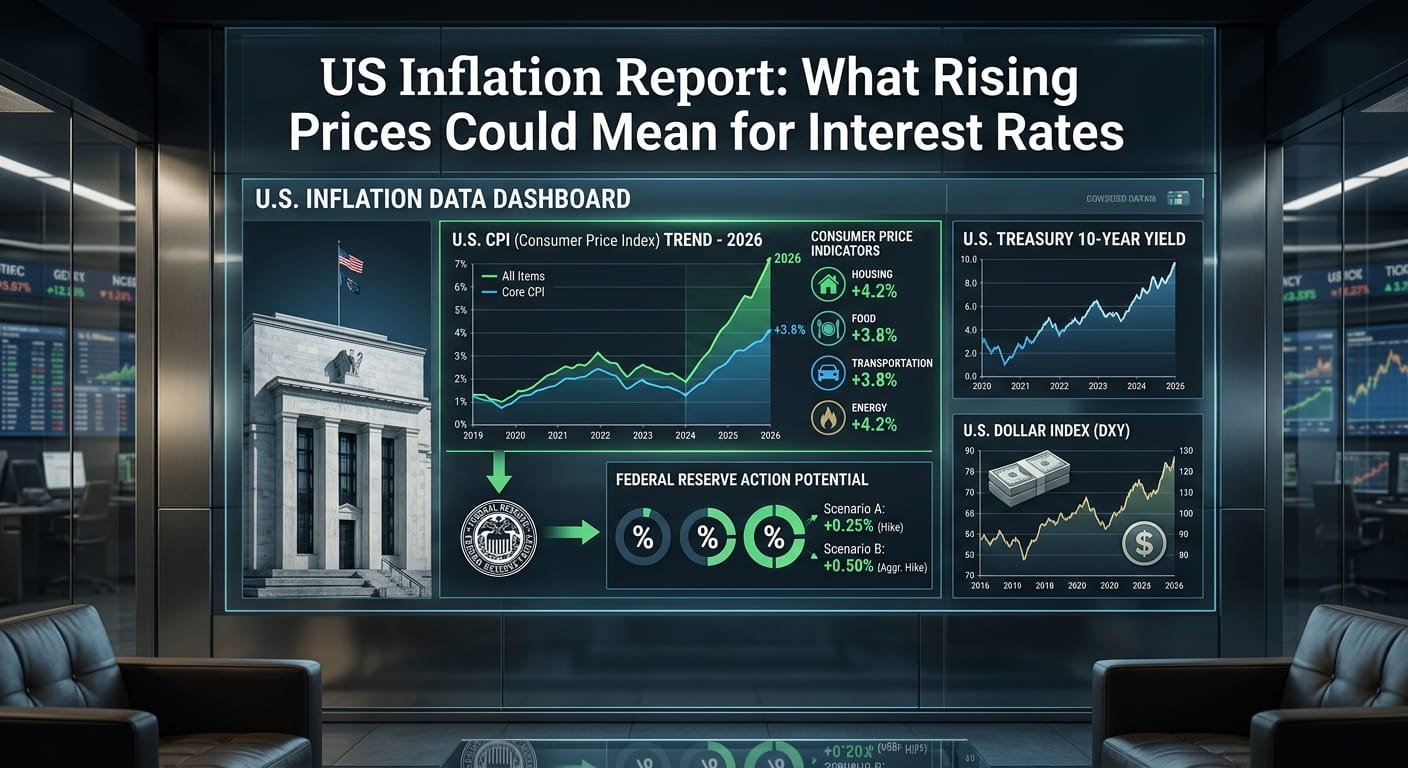
The latest US Inflation Report has become one of the most important pieces of economic data for investors, borrowers, businesses, and anyone watching the Federal Reserve. Inflation remains above the Fed’s 2% long-term goal, while interest-rate decisions are becoming increasingly sensitive to energy prices, labor-market conditions, and the persistence of price pressures.
However, there is an important timing detail: the August 2026 Consumer Price Index report has not yet been released. The U.S. Bureau of Labor Statistics has scheduled the August CPI report for September 11, 2026, at 8:30 a.m. Eastern Time. The August Producer Price Index is scheduled for September 10.
The latest completed CPI report, covering July, showed consumer prices rising 3.4% over the previous year. Core CPI, which excludes food and energy, increased 2.5%. Meanwhile, the Federal Reserve is holding the federal funds target range at 3.50% to 3.75%, and officials continue to watch inflation closely.
That creates a difficult question: if the next US Inflation Report shows prices rising faster than expected, what happens to interest rates?
The short answer is that hotter inflation could make the Federal Reserve more reluctant to cut rates and, depending on the size and persistence of the increase, could even strengthen arguments for higher rates.
But the full picture is more complicated.
What the Latest US Inflation Report Actually Shows
Before looking ahead, it helps to understand where inflation stands now.
The July CPI report showed that the headline Consumer Price Index increased 0.1% in July after declining 0.4% in June. On a 12-month basis, headline CPI increased 3.4%. Core CPI rose 0.2% during July and 2.5% over the year.
Those numbers tell two different stories.
On one hand, the monthly increase was relatively modest. On the other, annual inflation remained significantly above the Federal Reserve’s 2% objective.
Several categories also continued to experience noticeable price increases.
For example:
- Shelter increased 3.2% over the year.
- Food increased 3.0%.
- Energy increased 14.7%.
- Gasoline increased 24.6%.
- Airline fares increased 25.5%.
- Core CPI increased 2.5% year over year.
Energy deserves particular attention because it can quickly change the inflation picture.
Oil prices have recently moved sharply higher amid geopolitical disruptions in the Middle East. That creates another potential source of inflation pressure heading into the August and September data. Reuters reported on September 8 that investors were watching upcoming U.S. inflation figures closely as rising oil prices increased concerns about the Federal Reserve’s next move.
So, while the latest US Inflation Report does not yet include August data, the economic backdrop has already become more complicated.
Why the August US Inflation Report Matters So Much
The August CPI report arrives at an especially important moment.
The Federal Reserve’s next policy meeting is approaching, and markets are trying to determine whether policymakers will keep rates unchanged, cut them, or consider another increase.
The Fed maintained its federal funds target range at 3.50% to 3.75% at its July 29 meeting. The central bank said inflation remained elevated relative to its 2% goal and noted that some price increases reflected supply shocks, including energy pressures.
That means the next US Inflation Report could influence expectations in several ways.
A hotter inflation reading
If August CPI comes in above expectations, investors could interpret it as evidence that inflation is proving difficult to control.
That could:
- Reduce expectations for near-term rate cuts.
- Push Treasury yields higher.
- Strengthen the U.S. dollar.
- Increase borrowing costs.
- Pressure rate-sensitive stocks.
- Increase volatility across financial markets.
A cooler inflation reading
If inflation comes in below expectations, the opposite could happen.
Markets could increase expectations for monetary easing, particularly if employment data also shows signs of weakening.
That could support:
- Lower Treasury yields.
- Lower borrowing costs.
- Higher valuations for growth stocks.
- More favorable conditions for housing.
- A weaker dollar.
- Increased expectations for future rate cuts.
The key is not simply whether inflation rises or falls.
The market cares heavily about whether the result is above or below expectations.
How Inflation Influences Federal Reserve Interest Rates
The relationship between inflation and interest rates is straightforward in principle but complicated in practice.
When prices rise too quickly, the Federal Reserve can use higher interest rates to slow economic demand.
Higher rates make borrowing more expensive.
That can discourage:
- Mortgage borrowing.
- Auto loans.
- Business investment.
- Credit-card spending.
- Corporate expansion.
- Speculative investment.
As demand cools, businesses may find it harder to raise prices.
At the same time, tighter financial conditions can slow wage and employment growth. Eventually, that can reduce the pressure pushing prices higher.
However, monetary policy does not instantly solve every inflation problem.
If inflation comes from an oil-supply shock, for example, raising interest rates cannot directly produce more oil.
Instead, higher rates work by influencing the broader economy and preventing a temporary supply shock from becoming a more persistent inflation problem.
That distinction is extremely important when interpreting the next US Inflation Report.
Why Core Inflation Could Matter More Than Headline Inflation
Headline inflation includes everything in the CPI basket, including food and energy.
Core inflation excludes food and energy.
The reason is simple: those categories can be extremely volatile.
A sudden oil-price spike can push headline inflation higher even if underlying price pressures remain relatively stable.
For monetary policy, however, the Fed wants to understand whether inflation is becoming embedded across the economy.
That makes core inflation particularly important.
The July numbers illustrate the difference.
Headline CPI was up 3.4% annually, while core CPI increased 2.5%.
Neither figure is exactly where policymakers would ideally want it, but the gap shows why investors should not focus on a single inflation number.
A strong analysis should examine:
- Headline CPI.
- Core CPI.
- Monthly inflation.
- Shelter inflation.
- Services inflation.
- Energy prices.
- Wage growth.
- Producer prices.
- Inflation expectations.
- Consumer spending.
Together, these indicators provide a much better picture than headline CPI alone.
What the US Inflation Report Could Mean for Rate Cuts
One of the biggest questions investors are asking is whether the Federal Reserve can reduce interest rates while inflation remains above target.
The answer depends on the direction of the data.
If inflation continues to moderate gradually, policymakers could eventually have more room to lower rates.
However, if inflation accelerates again, the Fed may need to keep rates restrictive for longer.
Federal Reserve Governor Christopher Waller recently indicated that favorable inflation data could support maintaining rates, while an unexpected inflation increase could make a rate hike more attractive. Reuters reported that Waller specifically emphasized the importance of seeing continued progress toward the Fed’s inflation objective.
That means the next US Inflation Report could change the market’s perception of the entire rate path.
A single report probably will not determine policy by itself.
But a surprisingly strong report can become much more important when combined with strong employment and rising energy costs.
The Jobs Market Could Change the Inflation Story
Inflation cannot be analyzed separately from employment.
The Federal Reserve has a dual mandate involving maximum employment and price stability.
That means policymakers must balance inflation risks against the health of the labor market.
The August employment report showed U.S. employers added 162,000 jobs, while the unemployment rate remained at 4.1%. The stronger-than-expected labor-market data contributed to higher Treasury yields and increased expectations for a possible rate increase.
This creates an important policy combination.
Scenario 1: High inflation + strong jobs
This would be the most concerning combination for markets.
The Fed could face stronger pressure to maintain restrictive policy or raise rates.
Scenario 2: High inflation + weak jobs
This would be more complicated.
The Fed could face a difficult trade-off between controlling inflation and protecting employment.
Scenario 3: Low inflation + strong jobs
This would be one of the most favorable outcomes.
The Fed could potentially ease policy without worrying as much about reigniting inflation.
Scenario 4: Low inflation + weak jobs
This would strengthen the argument for rate cuts.
Therefore, the US Inflation Report should always be analyzed alongside employment data.
Why the Producer Price Index Matters Too
Consumer prices are only one side of the inflation story.
The Producer Price Index measures price changes from the perspective of producers and sellers.
The July PPI report showed final-demand prices were unchanged during the month, while final-demand prices increased 4.7% over the year. Final-demand services rose 0.2%, while final-demand goods fell 0.7%.
The August PPI report is scheduled for September 10, one day before the August CPI report.
That timing matters.
If PPI accelerates sharply and CPI subsequently confirms stronger consumer inflation, investors could become more concerned about persistent price pressure.
Conversely, subdued producer prices could provide some reassurance that inflationary pressure is not broadening rapidly.
What Rising Oil Prices Could Mean for the Inflation Report
Energy prices have become one of the biggest wild cards.
The July CPI data already showed energy prices up 14.7% over the year. Gasoline prices were up 24.6%.
Since then, oil markets have experienced additional volatility.
Higher crude prices can affect inflation through several channels.
First, gasoline prices can rise.
Second, transportation becomes more expensive.
Third, businesses may face higher costs for manufacturing and logistics.
Finally, some companies may pass those costs to consumers.
This is known as a second-round inflation effect.
The initial shock may come from energy. However, if higher energy costs begin affecting services, goods, wages, and consumer expectations, the inflation problem can become broader.
That is precisely the kind of development central banks watch carefully.
What Higher Interest Rates Would Mean for Everyday Americans
The impact of a hotter US Inflation Report would not stop at Wall Street.
Interest rates affect everyday financial decisions.
Mortgages
Higher market interest rates can keep mortgage borrowing expensive.
For prospective homebuyers, even a relatively small change in mortgage rates can significantly affect monthly payments.
Existing borrowers with fixed-rate mortgages may not feel an immediate impact, but people with adjustable-rate loans can be more exposed.
Credit cards
Credit-card rates generally move with broader interest-rate conditions.
Therefore, prolonged high rates can make carrying a balance increasingly expensive.
Consumers should pay particular attention to revolving debt when rates remain elevated.
Auto loans
Higher financing costs can make vehicles more expensive even when the sticker price does not change.
That can encourage consumers to delay purchases or choose less expensive models.
Savings accounts
Higher rates can benefit savers.
Money-market funds, certificates of deposit, and high-yield savings accounts may offer more attractive returns when short-term interest rates remain elevated.
However, the real return depends on inflation.
If inflation remains high, a savings account paying a higher nominal rate may still provide limited purchasing-power growth.
How the US Inflation Report Could Affect Stocks
Stock markets tend to react quickly to changes in interest-rate expectations.
When investors expect lower rates, stock valuations can benefit because future corporate cash flows become more valuable when discounted at lower rates.
Growth stocks can be especially sensitive because much of their expected value may come from future earnings.
Therefore, a hotter US Inflation Report could put pressure on:
- Technology stocks.
- High-growth companies.
- Speculative investments.
- Highly leveraged businesses.
- Small-cap stocks.
On the other hand, companies with strong cash flows, pricing power, and lower debt may prove more resilient.
Energy companies can also behave differently because higher oil prices may improve revenue expectations for producers.
That is why investors should avoid treating inflation as uniformly positive or negative for every stock.
What Inflation Could Mean for Treasury Bonds
Bond markets are often among the first places where inflation expectations appear.
When investors expect inflation to remain elevated, they may demand higher yields.
Higher Treasury yields generally mean lower prices for existing bonds.
That creates a challenging environment for bond investors holding longer-duration securities.
However, the situation changes when inflation begins falling.
If investors become confident that the Fed can eventually lower interest rates, Treasury yields may decline and existing bonds can appreciate.
This is why the inflation report can move both stock and bond markets at the same time.
Could the US Inflation Report Push the Dollar Higher?
Interest-rate expectations also influence the U.S. dollar.
If traders believe the Federal Reserve will maintain higher rates for longer, U.S. assets can become more attractive relative to assets in countries with lower rates.
That can support the dollar.
A stronger dollar can then affect international markets.
Imported goods may become relatively cheaper for U.S. consumers, while U.S. companies with substantial overseas revenue can face currency-related pressure when foreign earnings are converted back into dollars.
Therefore, the inflation-to-interest-rate relationship can eventually spread through global financial markets.
Why the Fed Watches PCE Inflation Too
CPI gets enormous media attention, but it is not the Federal Reserve’s only inflation measure.
The Fed closely watches the Personal Consumption Expenditures price index, particularly core PCE.
The latest July data showed headline PCE inflation at 3.7% year over year, while core PCE rose 3.3%. Both increased 0.2% during July.
The core PCE measure is especially important because it is designed to provide a clearer view of underlying inflation by excluding food and energy.
It also captures changes in consumer spending patterns differently from CPI.
Consequently, investors should compare CPI and PCE rather than treating one report as the complete inflation picture.
Three Inflation Scenarios Investors Should Watch
The next US Inflation Report could produce several different market reactions.
| Inflation outcome | Likely Fed interpretation | Potential market reaction |
|---|---|---|
| Much hotter than expected | Inflation remains persistent | Yields may rise, rate-cut expectations may fall |
| Roughly in line with expectations | Existing policy path remains plausible | Markets may stabilize |
| Cooler than expected | Disinflation may be continuing | Rate-cut expectations could strengthen |
However, the reaction will depend on the details.
For example, a high headline CPI number driven almost entirely by gasoline could produce a different reaction from a broad increase in shelter, services, medical care, and other categories.
The composition of inflation matters as much as the headline number.
What Investors Should Watch Inside the Next US Inflation Report
When the August report arrives, do not look only at the top-line percentage.
Instead, check these indicators:
1. Monthly headline CPI
A surprisingly large monthly increase could quickly alter market expectations.
2. Core CPI
This can reveal whether underlying inflation is accelerating.
3. Shelter
Housing costs remain one of the most important components of consumer inflation.
4. Services
Persistent services inflation can be more concerning than a temporary commodity spike.
5. Energy
Energy prices can explain large short-term movements but may also create broader inflation risks.
6. Used vehicles and other goods
Goods inflation can provide clues about supply chains, tariffs, and consumer demand.
7. Three- and six-month trends
One monthly report should not be treated as a complete trend.
Looking across several months can help distinguish temporary volatility from sustained acceleration.
How Consumers Can Prepare for Higher-for-Longer Rates
You do not need to predict the exact Federal Reserve decision to prepare for different interest-rate scenarios.
Instead, focus on financial resilience.
Pay down expensive variable-rate debt first.
Credit-card balances can become particularly costly when rates remain elevated.
Review refinancing decisions carefully.
Do not refinance solely because rates moved slightly. Calculate the total interest savings, fees, and break-even period.
Keep an emergency fund.
Higher borrowing costs make unexpected expenses more difficult to absorb with debt.
Compare savings rates.
When interest rates are elevated, cash can earn meaningful returns if it is placed in an appropriate interest-bearing account.
Avoid making major financial decisions based on one inflation report.
Economic data changes constantly. A single CPI release can move markets, but long-term financial planning requires a broader view.
What Businesses Should Watch if Inflation Stays High
Companies face a different set of challenges.
If input prices rise, businesses must decide whether to absorb higher costs or pass them on to customers.
Companies with strong pricing power may protect profit margins more effectively.
Businesses with thin margins can struggle.
Higher rates can also raise financing costs for companies with floating-rate debt or upcoming refinancing needs.
Consequently, investors should examine:
- Debt levels.
- Interest expense.
- Operating margins.
- Pricing power.
- Cash flow.
- Refinancing schedules.
- Capital expenditure plans.
These factors can reveal which companies are most vulnerable to prolonged restrictive monetary policy.
The Biggest Risk: Stagflation
One of the more difficult possibilities is stagflation.
Stagflation occurs when inflation remains elevated while economic growth weakens.
It creates a difficult environment for central banks.
If the Fed raises rates aggressively, it may further weaken economic activity.
If it cuts rates too quickly, it could risk allowing inflation to remain elevated.
Recent energy-price volatility makes this scenario worth watching, particularly if higher oil prices persist long enough to affect household spending and business costs.
Still, higher oil prices alone do not automatically create stagflation.
The broader economy, labor market, consumer demand, and underlying inflation all matter.
What Would Be a Positive Signal in the Next US Inflation Report?
A favorable inflation report would probably show more than just a lower headline number.
Ideally, investors would want to see:
- Moderate monthly core inflation.
- Continued improvement in shelter inflation.
- Stable services prices.
- Reduced goods-price pressure.
- No major acceleration in energy-related second-round effects.
- Continued progress in broader inflation measures.
- Stable inflation expectations.
That combination would give the Federal Reserve more confidence that inflation is moving toward its 2% objective.
It could also give policymakers more flexibility.
What Would Be a Warning Sign?
The opposite combination would be more concerning.
A warning scenario would involve:
- Headline CPI accelerating.
- Core CPI accelerating.
- Shelter remaining sticky.
- Services inflation rising.
- Producer prices increasing.
- Energy prices staying elevated.
- Wage pressure remaining strong.
- Inflation expectations moving higher.
If several of these developments appear simultaneously, investors may need to reconsider assumptions about future rate cuts.
US Inflation Report: What It Means for Interest Rates Right Now
As of September 8, 2026, the Federal Reserve’s policy rate remains at 3.50% to 3.75%. The July FOMC statement said inflation remained elevated relative to the Fed’s 2% goal, while three committee members preferred a 25-basis-point increase at that meeting.
Meanwhile, the latest CPI showed 3.4% annual inflation, core CPI at 2.5%, and energy prices up substantially.
The labor market has also remained relatively firm, with August payrolls increasing by 162,000 and unemployment at 4.1%.
That combination explains why the next US Inflation Report matters so much.
The Fed is not looking at inflation in isolation.
It is balancing inflation, employment, economic growth, financial conditions, and supply-side risks.
Therefore, the most important question is not simply:
“Did inflation rise?”
The better question is:
“Is inflation becoming more persistent than the Federal Reserve can comfortably tolerate while the labor market remains resilient?”
That is the question that could determine the next phase of monetary policy.
US Inflation Report Outlook: What Could Happen Next?
The August CPI report is scheduled for September 11, following the August PPI report on September 10.
That creates a concentrated period of market-sensitive economic information.
Investors will likely compare the new inflation figures with:
- Recent employment data.
- Oil prices.
- Treasury yields.
- Inflation expectations.
- Core CPI.
- PPI.
- PCE inflation.
- Federal Reserve commentary.
- If inflation cools, expectations for easier monetary policy could strengthen.
- If inflation remains stubbornly high, the Fed may keep rates elevated for longer.
- If inflation unexpectedly accelerates while employment remains strong, the possibility of tighter policy could become more important.
That is why the next US Inflation Report could influence markets well beyond a single trading session.
Final Takeaway: What Rising Prices Could Mean for Interest Rates
The US Inflation Report is more than a monthly economic statistic. It is one of the key pieces of evidence the Federal Reserve uses to judge whether price pressures are moving toward its 2% objective.
The latest available CPI data shows inflation remains elevated, with headline CPI at 3.4% and core CPI at 2.5% in July. At the same time, the Federal Reserve is maintaining a 3.50% to 3.75% federal funds target range.
The upcoming August report therefore matters because markets are trying to determine whether inflation is continuing to cool or beginning to reaccelerate.
For consumers, the biggest lesson is simple: higher inflation can mean higher-for-longer interest rates, which can affect mortgages, credit cards, auto loans, savings, and investment returns.
For investors, the most useful strategy is to avoid reacting to the headline number alone.
- Watch the underlying details.
- Watch core inflation.
- Watch shelter and services.
- Watch energy.
- Watch wages and employment.
And, most importantly, watch whether several indicators point in the same direction.
No single US Inflation Report can predict the future with certainty. However, when inflation data is combined with employment, spending, producer prices, and Federal Reserve guidance, it becomes a much more powerful tool for understanding where interest rates may go next.
Frequently Asked Questions
1. What is the latest US Inflation Report showing?
The latest completed CPI report covers July 2026. It showed headline CPI rising 3.4% over the previous year, while core CPI increased 2.5%. Monthly headline CPI increased 0.1%, while core CPI rose 0.2%.
2. When will the next US Inflation Report be released?
The August 2026 Consumer Price Index report is scheduled for September 11, 2026, at 8:30 a.m. Eastern Time, according to the Bureau of Labor Statistics. The August Producer Price Index is scheduled for September 10.
3. Could higher inflation cause the Federal Reserve to raise interest rates?
Yes. If inflation rises unexpectedly and appears persistent, the Federal Reserve could maintain restrictive policy for longer or consider additional rate increases. However, policymakers also consider employment, economic growth, financial conditions, and the source of inflation.
4. How does inflation affect mortgage rates?
Higher inflation can contribute to higher market interest rates because investors may expect the Federal Reserve to maintain tighter monetary policy. Mortgage rates are also influenced by Treasury yields, mortgage-market conditions, lender pricing, and other factors, so they do not move one-for-one with the federal funds rate.
5. Is lower inflation always good for stocks?
Not necessarily. Lower inflation can support stocks if it reduces interest-rate pressure without signaling a major economic slowdown. However, rapidly falling inflation accompanied by weakening employment and economic activity could indicate recession risks. The broader economic context matters.
6. Why does the Federal Reserve focus on core inflation?
Core inflation removes food and energy prices, which can fluctuate sharply because of weather, geopolitical events, commodity markets, and supply disruptions. Looking at core inflation helps policymakers evaluate underlying price pressure. The Fed also closely monitors the PCE price index, including core PCE.
7. What should investors watch after the next inflation report?
Investors should compare the actual inflation numbers with expectations and examine core CPI, shelter, services, energy, PPI, Treasury yields, the U.S. dollar, employment data, and Federal Reserve commentary. The market reaction often depends more on the surprise relative to expectations than on the headline number alone.
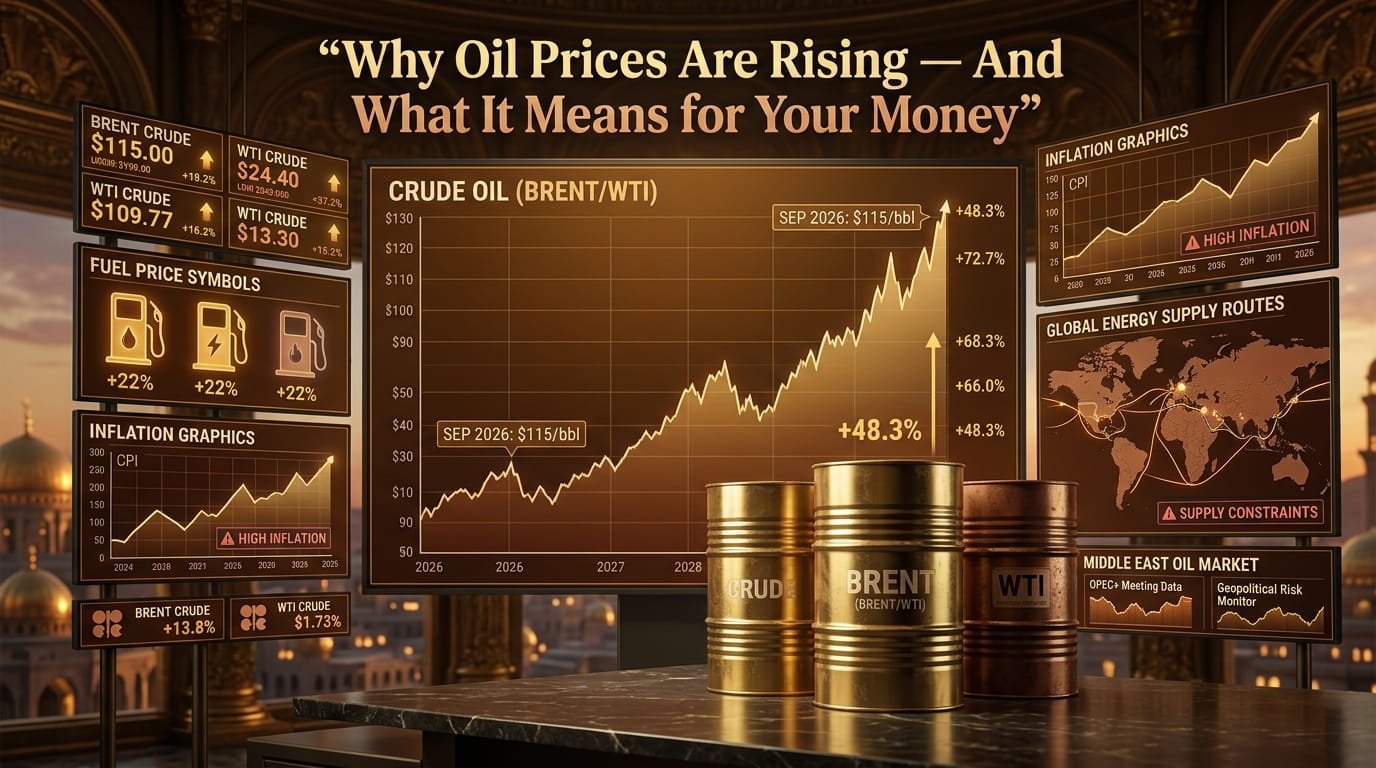
Why oil prices are rising has suddenly become an important question for households, businesses, and investors as crude prices push toward $100 a barrel again.
On September 8, 2026, Brent crude climbed to about $99.46 per barrel while U.S. West Texas Intermediate reached roughly $94.73. The latest move followed attacks on Saudi energy facilities, continued U.S.-Iran tensions, and reduced tanker traffic through the Strait of Hormuz.
That matters because crude oil is not just another commodity traded on financial markets. Oil is embedded in transportation, manufacturing, agriculture, shipping, plastics, aviation, electricity generation, and countless everyday products.
Therefore, when oil prices rise sharply, the effects can eventually reach your fuel bill, grocery budget, travel costs, business expenses, investment portfolio, and even interest rates.
The bigger question, however, is whether this is a temporary geopolitical spike or the beginning of a much longer period of expensive energy.
Here is what the latest market evidence tells us, why oil prices are rising now, and what consumers and investors should watch next.
Why Oil Prices Are Rising Right Now
The immediate answer is supply risk.
Oil markets have become increasingly sensitive to developments around Iran, the Persian Gulf, Saudi Arabia, and the Strait of Hormuz. That sensitivity has intensified because the conflict has already disrupted normal energy flows.
Reuters reported on September 8 that Brent had moved close to $100 after attacks on Saudi energy infrastructure and escalating tensions involving Iran and the United States. Tanker movements through the Strait of Hormuz have also remained below normal levels.
However, geopolitics is only part of the explanation.
Oil prices respond to a combination of:
- Supply disruptions
- Geopolitical risk
- OPEC+ production decisions
- Global oil demand
- Commercial inventories
- Refinery capacity
- Shipping costs and transportation bottlenecks
- Currency movements
- Financial-market expectations
- Future expectations about supply and demand
The U.S. Energy Information Administration identifies supply from OPEC and non-OPEC producers, inventories, demand in OECD and non-OECD economies, spot prices, and financial markets among the major forces influencing crude oil prices.
So, when asking why oil prices are rising, it is better to think about the market as a constantly changing balance rather than blaming one headline.
The Strait of Hormuz Has Become the Market’s Biggest Risk
The Strait of Hormuz is particularly important because enormous volumes of energy products normally pass through this narrow waterway.
Recent disruptions have reduced tanker traffic, creating fears that exporters may have oil underground but cannot move enough of it to international buyers.
That distinction is critical.
The world does not necessarily need to lose every barrel of disrupted production before prices rise. Traders can push prices higher simply because they believe future availability could become tighter.
In other words, expectations can move oil prices before physical shortages become obvious.
Reuters reported on September 2 that tanker traffic through the strait had fallen sharply, although alternative export routes and continued flows helped prevent an even larger immediate supply shock.
Why Oil Prices Are Rising Even Without a Complete Global Oil Shortage
This is one of the most misunderstood parts of the current oil market.
A global shortage does not have to exist for crude prices to rise dramatically.
Oil is traded globally, and inventories provide an important buffer between production and consumption. When traders believe that inventories could fall because supply is becoming less reliable, the market can price in scarcity before storage tanks actually become empty.
The EIA describes inventories as a physical buffer and an important signal of the supply-demand balance.
That means three things can happen at once:
- Oil production remains substantial.
- Some oil continues moving through global trade routes.
- Prices still rise because the market fears future disruption.
That is essentially what makes the current situation so complicated.
Reuters reported on September 8 that oil had not yet broken decisively above $100 despite major Middle Eastern disruptions because substantial flows were still moving through Hormuz, Gulf producers were using alternative routes, and additional production from countries such as the United States, Canada, and Guyana was helping offset some losses.
So the market is balancing real supply disruption against available alternatives.
Why Oil Prices Are Rising Because of Geopolitical Risk
Oil has always carried a geopolitical premium.
When a major producing region becomes unstable, buyers and traders immediately reassess the possibility of lost production, damaged infrastructure, shipping interruptions, sanctions, and higher insurance costs.
The Middle East is particularly important because several major energy producers and transportation routes are concentrated in the region.
The latest conflict has therefore created a risk premium on crude.
This explains why oil can jump even when economic demand is not booming.
Investors are effectively asking:
What happens if today’s disruption lasts another week?
Then:
What happens if it lasts another month?
And finally:
What happens if energy infrastructure becomes a repeated target?
Each answer can produce a higher risk premium.
Reuters reported on September 7 that Brent settled around $97.31 and WTI around $92.65 as tensions intensified and concerns over the Strait of Hormuz increased.
The next day’s attacks pushed prices even closer to $100.
Why Oil Prices Are Rising as OPEC+ Holds Its Ground
OPEC+ remains another major part of the story.
On September 6, seven OPEC+ countries agreed to maintain September production requirements for October. The group said it would continue monitoring market conditions and meeting monthly.
That decision matters because investors were looking for clues about whether additional supply could be released quickly.
If OPEC+ dramatically increases production, it could help compensate for disrupted barrels.
If production remains constrained, however, the market has less of a safety cushion.
At the same time, production targets do not automatically equal actual physical supply. Infrastructure damage, transportation problems, sanctions, and logistical constraints can prevent producers from delivering every barrel they theoretically have available.
Therefore, investors should distinguish between announced production capacity and barrels actually reaching consumers.
Why Oil Prices Are Rising Despite Additional Production Elsewhere
Another important piece of the puzzle is non-OPEC supply.
The United States, Canada, Guyana, and other producers have increased output over time, helping prevent the global market from becoming even tighter.
Reuters noted that non-OPEC producers are expected to add significant production, which is one reason oil has remained below $100 despite serious Middle Eastern disruptions.
This is one of the strongest arguments against assuming that today’s price spike automatically becomes a permanent oil crisis.
More supply creates a ceiling on prices.
However, that ceiling can disappear temporarily if transportation routes, refineries, or major production facilities experience prolonged disruption.
Therefore, the key question is not simply how much oil the world produces.
It is how much oil can reliably reach the right market at the right time.
Why Oil Prices Are Rising Even Though Oil Demand Is Not Exploding
Demand provides another important counterweight.
Normally, higher economic activity means more driving, flying, shipping, manufacturing, and energy consumption.
Yet current oil prices are being influenced heavily by supply risk rather than an extraordinary global demand boom.
Reuters reported that global oil demand expectations have weakened, with lower demand in China helping limit the upside pressure on crude.
China matters enormously because it is one of the world’s largest oil consumers.
If Chinese demand weakens, that can offset some supply losses elsewhere.
Meanwhile, electrification and changes in industrial activity can gradually reduce oil demand in certain sectors.
This creates an unusual market situation:
Supply risk is pushing prices upward while weaker demand is preventing an even larger spike.
That tension explains why oil can trade near $100 without necessarily exploding far above it.
Why Oil Prices Are Rising When Inventories Are Tight
Inventories are one of the most useful indicators for understanding where the oil market may go next.
When inventories rise, buyers generally have more protection against temporary supply disruptions.
When inventories fall, the market becomes more vulnerable.
The EIA expects U.S. commercial crude inventories to remain below the five-year 2021–2025 low through the end of 2026, citing high refinery runs and lower net imports.
That does not automatically mean a shortage is coming.
Instead, it means the market has less room for error.
If another major supply disruption occurs while inventories are already low, prices can respond much more aggressively.
Therefore, investors should watch inventory reports alongside geopolitical developments rather than treating crude prices as an isolated number.
Why Oil Prices Are Rising and What It Means for Gasoline
For ordinary households, this is probably the most important question.
Higher crude prices can eventually translate into higher gasoline prices because crude oil is the largest component of the retail gasoline price in many markets.
The EIA says retail gasoline prices reflect crude oil costs, refining costs and profits, taxes, distribution, and marketing.
That means crude does not move one-for-one with the price at the pump.
Still, sustained crude increases generally put upward pressure on gasoline.
There can also be a delay.
A fuel station may still be selling gasoline purchased under earlier wholesale conditions. Meanwhile, refiners may need time to process more expensive crude.
Therefore, consumers should not expect every oil-price move to appear immediately at the pump.
What Higher Oil Prices Could Mean for Diesel
Diesel deserves special attention.
Diesel powers trucks, agricultural equipment, construction machinery, ships, and many industrial operations.
Consequently, higher diesel prices can affect the cost of moving goods across entire economies.
Reuters reported that U.S. diesel prices had reached record levels during the recent supply disruptions, with tight refined-product markets adding pressure beyond the crude oil increase itself.
This distinction matters because consumers sometimes focus only on Brent or WTI.
In reality, refined products can become tighter than crude itself.
That is why diesel prices can remain elevated even when crude prices stop rising.
What Rising Oil Prices Mean for Inflation
Oil is an inflation multiplier.
When fuel becomes more expensive, transportation costs rise.
Then companies may face higher costs for:
- Shipping
- Manufacturing
- Farming
- Construction
- Air travel
- Logistics
- Packaging
- Food distribution
- Business travel
Some companies absorb those costs.
Others pass them to customers.
That process can create broader inflationary pressure.
The effect is especially important when oil prices remain high for several months. A one-day spike can disappear quickly, while sustained energy inflation can influence wages, pricing decisions, corporate margins, and consumer expectations.
This is why central banks watch energy markets carefully.
If oil rises sharply and inflation expectations increase, interest-rate cuts can become more difficult.
In some circumstances, central banks may even consider tighter policy.
Why Oil Prices Are Rising Could Affect Interest Rates
This connection is easy to miss.
Imagine crude prices remain near $100 for an extended period.
Gasoline and diesel become more expensive. Transportation costs increase. Businesses pay more for energy. Consumers have less money available for discretionary spending.
At the same time, inflation rises.
That creates a difficult environment for central banks.
They may want to support economic growth, but higher inflation limits their ability to cut rates.
Therefore, a prolonged oil shock can produce a strange combination:
Higher inflation + weaker growth + tighter monetary policy.
Economists sometimes describe this as a stagflationary risk.
It does not mean stagflation is guaranteed.
However, it is one of the biggest risks investors should monitor if oil prices remain elevated.
Why Oil Prices Are Rising and What It Means for Your Investments
Oil does not affect every investment in the same way.
Some companies benefit from higher crude prices.
Others suffer.
Potential beneficiaries
Energy producers can benefit when the price of crude rises faster than their production costs.
Potential beneficiaries include:
- Oil exploration companies
- Integrated energy companies
- Oilfield service providers
- Certain pipeline businesses
- Some energy-focused funds
- Producers with low operating costs
However, higher oil prices do not guarantee higher stock prices.
Investors still need to consider debt, production costs, hedging, capital spending, political risk, and company-specific execution.
Potential losers
Businesses that consume large quantities of fuel may face margin pressure.
These can include:
- Airlines
- Trucking companies
- Delivery businesses
- Chemical manufacturers
- Some industrial companies
- Consumer businesses with high transportation costs
The impact depends heavily on how much fuel represents total operating expenses and whether the company can pass higher costs to customers.
Why Oil Prices Are Rising and What It Means for Stocks
The broader stock market can react negatively to a major oil shock, but the relationship is not automatic.
Higher energy prices can increase inflation and reduce consumer purchasing power.
That can hurt companies dependent on discretionary spending.
Meanwhile, energy companies may report stronger revenue and cash flow.
As a result, the market can experience sector rotation rather than a simple rise or fall.
Investors should therefore avoid thinking:
“Oil is up, so stocks must fall.”
The better question is:
Which companies benefit from higher energy prices, and which companies pay the bill?
That distinction can be far more useful for portfolio analysis.
Why Oil Prices Are Rising and What It Means for Your Household Budget
For households, the first effect is usually fuel.
But the second-round effects can be more important.
If transportation becomes more expensive, businesses may eventually increase prices.
That can affect groceries, deliveries, travel, and services.
A household can respond by focusing on expenses that are most sensitive to energy prices.
Practical ways to protect your budget
- Track fuel consumption.
Small reductions in unnecessary driving can become meaningful when fuel prices stay high. - Combine trips.
Planning errands together can reduce transportation expenses. - Compare transportation options.
Public transport, carpooling, or remote work can reduce exposure to fuel costs. - Review recurring expenses.
Higher energy costs can make it more important to eliminate unnecessary subscriptions and purchases. - Avoid panic buying.
A temporary oil spike does not automatically mean gasoline will remain at the same level for months.
The goal is not to predict the exact price of oil.
It is to make your household less vulnerable to volatility.
What Rising Oil Prices Mean for Pakistan
For Pakistan, the relationship can be particularly important because international crude prices can influence domestic petroleum costs.
On September 8, Pakistan’s petrol price was raised by Rs12.90 per litre to Rs358.77, while high-speed diesel increased by Rs3.72 to Rs381.77. The revision came amid renewed pressure from international energy markets and Middle East tensions.
This illustrates how international oil-market developments can eventually reach local consumers.
Higher fuel costs can influence:
- Transport fares
- Delivery charges
- Agricultural expenses
- Electricity-generation costs
- Food distribution
- Business operating costs
- Household budgets
However, local pump prices do not depend solely on Brent or WTI.
Taxes, duties, exchange rates, government pricing decisions, refining costs, freight, and local market conditions also matter.
Therefore, a 10% move in international crude does not necessarily translate into a 10% move in Pakistani petrol.
Why Oil Prices Are Rising But Could Still Fall Again
Oil markets are extremely cyclical.
A geopolitical premium can disappear quickly if tensions ease.
Similarly, prices could fall if:
- The Strait of Hormuz returns to normal operations.
- Middle East production recovers.
- OPEC+ increases supply.
- U.S. and other non-OPEC production rises.
- Chinese demand weakens further.
- Global economic growth slows.
- Inventories rebuild.
- Traders reduce speculative positions.
Reuters has already highlighted several factors preventing Brent from breaking decisively above $100, including alternative shipping routes, continued Hormuz flows, additional non-OPEC supply, and weaker Chinese demand.
That is why investors should not assume that today’s oil price is the new normal.
Could Oil Prices Reach $120?
It is possible, but it should be treated as a scenario rather than a certainty.
A move toward $120 would likely require a significantly more serious or prolonged supply disruption.
For example, the market could face a combination of:
- Prolonged Strait of Hormuz disruption
- Major damage to Gulf energy infrastructure
- Additional tanker attacks
- Reduced OPEC+ availability
- Falling global inventories
- Continued tight refined-product markets
Reuters reported that some analysts believe Brent could move substantially higher if shipping disruptions intensify.
At the same time, higher prices create their own corrective forces.
Expensive oil encourages more production, conservation, substitution, and efficiency.
It can also weaken demand.
Therefore, very high prices can eventually plant the seeds of lower prices.
What the EIA Says About the Oil Market Outlook
The U.S. Energy Information Administration’s August 2026 outlook assumed that severe constraints on Strait of Hormuz transits would continue through August and expected some Middle Eastern production disruptions to persist into 2027.
The EIA forecast Brent crude to average around $85 per barrel during the third quarter of 2026 under those assumptions.
The latest September price surge shows why oil forecasting is difficult.
Forecasts are built on assumptions.
When geopolitical conditions change rapidly, those assumptions can become outdated within days.
That is an important lesson for investors: an oil-price forecast is not a promise.
It is a scenario based on information available at a particular time.
The Five Indicators That Could Tell You Where Oil Prices Go Next
If you want to understand where oil prices may head next, watch these five indicators.
1. Strait of Hormuz traffic
This is arguably the most important near-term indicator.
If tanker traffic normalizes, the geopolitical premium could shrink.
If traffic falls further, prices could face additional upward pressure.
2. OPEC+ production
Watch both official production targets and actual physical output.
The difference between the two can become important during a crisis.
3. U.S. and global inventories
Inventory draws suggest tighter conditions.
Inventory builds can reduce pressure.
The EIA specifically identifies inventories as an important balancing mechanism in the oil market.
4. Chinese demand
China’s economic activity remains a major driver of global petroleum demand.
A stronger-than-expected recovery could support oil prices.
A prolonged slowdown could do the opposite.
5. Refined-product markets
Do not watch crude alone.
Gasoline and diesel inventories, refinery outages, and refining margins can sometimes tell you more about what consumers will experience.
The EIA notes that gasoline prices depend on crude costs as well as refining, distribution, inventories, taxes, and market conditions.
What Consumers and Investors Should Do Now
The biggest mistake during an oil-price shock is making decisions based entirely on headlines.
Instead, separate your response into two categories.
If you are a consumer
Focus on controlling expenses that you can actually influence.
Do not dramatically change your lifestyle because crude prices moved for a few trading sessions.
Instead, prepare for the possibility that elevated fuel and transportation costs could persist.
If you are an investor
Avoid treating oil as a simple “buy” or “sell” signal.
Study the companies and sectors affected by higher energy prices.
Ask:
- Does this company benefit from higher crude prices?
- How much fuel does it consume?
- Can it pass higher costs to customers?
- Does it have significant debt?
- Does it hedge fuel or commodity exposure?
- Are earnings expectations already pricing in expensive oil?
- Could weaker economic growth offset energy-sector gains?
These questions are more useful than simply predicting whether Brent will rise another $5.
A Simple Oil-Price Scenario Guide for Investors
| Scenario | What could happen | Likely market effect |
|---|---|---|
| Conflict eases | Shipping normalizes and supply fears decline | Oil could fall |
| Current disruption continues | Risk premium remains elevated | Oil may stay near high levels |
| Supply disruption worsens | Inventories fall and physical shortages increase | Oil could surge |
| OPEC+ adds meaningful supply | More barrels reach the market | Oil could moderate |
| Global demand weakens | Consumption slows | Oil could decline |
| Refining disruptions worsen | Gasoline and diesel become tighter | Fuel prices could remain high even if crude stabilizes |
The important point is that oil prices are driven by competing forces.
A bullish supply story can be canceled by weak demand.
A bearish demand story can be overwhelmed by a major geopolitical disruption.
That is why the market can change direction so quickly.
Why Oil Prices Are Rising: The Bigger Picture
The current oil rally is not the result of one isolated event.
It is the result of several forces colliding at once.
Geopolitical tensions have created fears about supply reliability. Reduced shipping activity has increased concerns about transportation bottlenecks. At the same time, tight refined-product markets and relatively low inventories have reduced the market’s cushion.
Meanwhile, additional production from outside OPEC+ and weaker demand in parts of the global economy are limiting the upside.
That balance explains the unusual situation in which Brent is approaching $100 while still facing significant forces that could push it back down.
The market is effectively fighting a tug-of-war between supply disruption and demand restraint.
Frequently Asked Questions About Why Oil Prices Are Rising
1. Why oil prices are rising so quickly in September 2026?
Why oil prices are rising so quickly is mainly connected to renewed Middle East tensions, attacks on energy infrastructure, disruptions around the Strait of Hormuz, and concerns about future oil availability. Brent reached about $99.46 per barrel on September 8, while WTI reached roughly $94.73.
2. Will higher oil prices make gasoline more expensive?
They can. Crude oil is the largest component of gasoline pricing in many markets, although refining costs, taxes, transportation, inventories, and local market conditions also affect the final pump price.
The effect may also take time to appear because refiners, distributors, and retailers operate through different stages of the supply chain.
3. Could oil prices reach $100 a barrel?
Yes. Brent is already very close to that level, reaching about $99.46 on September 8.
Whether it stays above $100 depends largely on the duration of Middle East supply disruptions, tanker traffic through Hormuz, OPEC+ policy, inventories, and global demand.
4. Are higher oil prices good for energy stocks?
They can be, particularly for producers with relatively low production costs. Higher crude prices can increase revenue and cash flow when companies can sell their production at higher prices.
However, investors should still examine debt, production expenses, hedging, capital spending, taxes, and valuation. A high oil price does not automatically make every energy stock attractive.
5. What should investors watch if oil prices keep rising?
The most useful indicators include Strait of Hormuz traffic, OPEC+ production, global inventories, Chinese oil demand, refinery utilization, and gasoline and diesel inventories.
Investors should also monitor inflation expectations because prolonged energy inflation can influence central-bank policy and interest rates.
Conclusion:
Why oil prices are rising is ultimately a story about risk, supply, demand, and expectations.
The immediate pressure comes from escalating Middle East tensions and concerns about disrupted energy flows. Brent has moved close to $100, while WTI has climbed sharply as traders reassess the reliability of regional supplies.
However, the situation is not one-directional.
Additional production outside OPEC+, alternative export routes, inventories, and weaker demand in some major economies are helping prevent an even larger supply shock.
For consumers, the practical risk is higher fuel and transportation costs.
For investors, the bigger concern is whether expensive energy becomes persistent enough to push inflation higher and change interest-rate expectations.
That is why the most important thing to watch is not simply whether oil crosses $100.
Watch how long it stays there and why.
A short-lived geopolitical spike could eventually unwind.
A prolonged disruption combined with falling inventories and tight refined-product markets would be much more serious.
For now, the smartest approach is to avoid panic, monitor the underlying data, protect your household budget from unnecessary fuel exposure, and evaluate investments based on their sensitivity to energy prices rather than chasing the latest crude-oil headline.
The oil market can change quickly. Your financial decisions should not have to.


Why Data Centers Are Becoming a Huge Business in 2026

UK Tech Regulation: How Safety Rules Could Change Big Tech

AI Infrastructure Stocks: The Companies Powering Next AI Boom
-

 Entertainment9 years ago
The final 6 ‘Game of Thrones’ episodes might feel like a full season
-

 lifestyle6 months ago
Creative Conference Room Ideas to Enhance Productivity and Collaboration in 2026
-
Fashion9 years ago
According to Dior Couture, this taboo fashion accessory is back
-
Business9 years ago
The 9 worst mistakes you can ever make at work
-
Entertainment9 years ago
The old and New Edition cast comes together to perform
-
Business9 years ago
Uber and Lyft are finally available in all of New York State
-
Entertainment9 years ago
Disney’s live-action Aladdin finally finds its stars
-
Entertainment9 years ago
Mod turns ‘Counter-Strike’ into a ‘Tekken’ clone with fighting chickens